Loading...
Quett Masire vs Tony Tan Keng Yam
Quett Masire leads by 12.9 pts · 2 figures compared
…
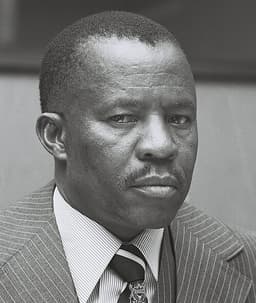
Quett Masire
Politician · Modern
61.8Total

Tony Tan Keng Yam
Politician · Modern
48.9Total
Basic Information
Born
1925
1940
Died
—
—
Era
Modern
Modern
Nationality
Botswana
Singapore
Occupation
Politician
Politician
Civilization
Other
Eastern
Score Comparison
Military (10%)
38.0
13.9
Political (20%)
85.0
68.0
Influence (20%)
60.0
50.2
Legacy (20%)
54.0
40.8
Leadership (15%)
83.3
72.0
Strategy (15%)
42.3
37.8
TOTAL
61.8
48.9
Quett Masire — Complete Timeline
1966 AD
Elected Vice President of BotswanaPolitical Action◆ Major
Masire was elected Vice President of Botswana upon independence in 1966, serving under President Seretse Khama. He was a key architect of Botswana's economic policies.
Vice PresidencyEconomic Planning
Impact: nationalconstructive
1980 AD
Led Botswana through diamond boomReform◆ Major
Masire oversaw the expansion of diamond mining through Debswana, a joint venture with De Beers. Revenue from diamonds funded infrastructure, education, and healthcare, transforming Botswana into a middle-income country.
Economic DevelopmentDiamond Revenue
Impact: nationalconstructive
Became President of BotswanaPolitical Action
Masire became President of Botswana on July 13, 1980, following the death of Seretse Khama. He continued Khama's policies of democracy, fiscal discipline, and diamond-led development.
PresidencyContinuity
Impact: nationalconstructive
1984 AD
Re-elected President (1984, 1989, 1994)Political Action◆ Major
Masire was re-elected in 1984, 1989, and 1994, each time with large majorities. His Botswana Democratic Party maintained power through free and fair elections, reinforcing Botswana's democratic reputation.
Re-electionDemocratic Stability
Impact: nationalconstructive
1998 AD
Retired as PresidentPolitical Action◆ Major
Masire retired as President in March 1998, handing power to his Vice President, Festus Mogae. His retirement was voluntary and peaceful, setting a precedent for democratic transitions in Africa.
RetirementDemocratic Transition
Impact: nationalconstructive
Tony Tan Keng Yam — Complete Timeline
1995 AD
Served as Deputy Prime Minister and Defence MinisterPolitical Action◆ Major
Tony Tan served as Deputy Prime Minister and Minister for Defence from 1995 to 2005. He oversaw the modernization of the Singapore Armed Forces and played a key role in defense policy.
Singapore PoliticsDefenceGovernment
Impact: nationalconstructive
2011 AD
Appointed President of SingaporePolitical Action◆ Major
Tony Tan Keng Yam was elected as the 7th President of Singapore on August 27, 2011, in a closely contested election. He served as a non-executive head of state, focusing on national unity and social cohesion.
Singapore PoliticsPresidencyElection
Impact: national
2017 AD
Re-elected as President UncontestedPolitical Action◆ Major
Tony Tan was re-elected as President of Singapore on September 13, 2017, after being declared the sole eligible candidate following changes to the eligibility criteria. His second term focused on social issues and community engagement.
Singapore PoliticsPresidencyRe-election
Impact: national
Expert Analysis
Origins
**Quett Masire** was born on July 23, 1925, in Kanye, Bechuanaland (now Botswana). He came from a modest farming family and trained as a teacher, later becoming a journalist and co-founding the Botswana Democratic Party (BDP) in 1961. His early career included serving as a member of the Legislative Council and as Minister of Finance after independence in 1966.
**Tony Tan Keng Yam** was born on February 7, 1940, in Singapore. He studied physics at the University of Singapore and earned a PhD in mathematics from the University of Adelaide. Tan worked as a banker and academic before entering politics in 1979. He served as Member of Parliament for Sembawang and held various ministerial roles, including Minister for Education and Minister for Finance.
Rise to Power
Masire became Vice President upon Botswana's independence in 1966, working closely with President Seretse Khama. He was instrumental in negotiating the diamond mining agreement with De Beers in 1969. After Khama's death in 1980, Masire succeeded him as President, winning his first full term in 1984. He was re-elected in 1989 and 1994 with large majorities, maintaining the BDP's dominance.
Tan's political rise began when he was elected to Parliament in 1979. He became Minister for Finance in 1983 and later Minister for Education (1985-1991). He served as Deputy Prime Minister and Minister for Defence from 1995 to 2005, overseeing the modernization of the Singapore Armed Forces. In 2011, he was elected President of Singapore in a close contest, and he was re-elected unopposed in 2017 after changes to eligibility criteria.
Leadership & Governance
Masire's leadership style was consensus-driven and technocratic. He continued Khama's policies of fiscal discipline, free markets, and democratic governance. Under his watch, Botswana's economy grew at an average of 10% per year during the 1980s, fueled by diamond revenues from Debswana. He invested heavily in education, infrastructure, and health care, while maintaining a balanced budget and low debt. His political score of 85.0 reflects his ability to maintain stability and democratic institutions.
Tan's role as President was largely ceremonial, as Singapore's head of state has limited executive powers. However, he wielded influence through his experience and advisory role. As Defence Minister, he oversaw the expansion of the Singapore Armed Forces, including the acquisition of advanced weaponry and participation in international exercises. His political score of 68.0 indicates his effectiveness within a constrained constitutional framework.
Triumph & Tragedy
Masire's greatest success was overseeing Botswana's transformation from one of the world's poorest countries to a middle-income nation. He maintained a multi-party democracy, with free and fair elections, and avoided the corruption that plagued many resource-rich states. His failure was the inability to diversify the economy away from diamonds, leaving Botswana vulnerable to commodity price fluctuations. Additionally, unemployment remained high, particularly among the youth.
Tan's triumph was his role in modernizing Singapore's defense capabilities, ensuring the country's security in a volatile region. He also helped maintain Singapore's financial stability as a senior minister. His tragedy was the controversial nature of his 2011 presidential election, which was the first contested presidential election in Singapore, and the subsequent changes to eligibility rules that were seen as limiting political competition.
Character & Destiny
Masire was known for his humility, pragmatism, and commitment to democratic norms. He voluntarily stepped down in 1998, setting a precedent for peaceful transitions. His leadership score of 83.3 reflects his ability to build consensus and maintain stability. His strategy score of 42.3 indicates a cautious approach to economic diversification.
Tan is characterized as a meticulous and reserved figure, with a strong analytical mind from his mathematics background. He prioritized long-term planning and national security. His leadership score of 72.0 shows his competence, while his strategy score of 37.8 suggests a more reactive than innovative approach.
Legacy
Masire's legacy is Botswana's reputation as Africa's longest continuous democracy and a model of resource management. His policies laid the foundation for sustained growth and political stability. He is remembered as a steward of Botswana's prosperity, with a legacy score of 54.0.
Tan's legacy is more institutional: he strengthened Singapore's defense and contributed to its financial governance. As President, he upheld the role's ceremonial duties. His legacy score of 40.8 reflects his lower profile and limited executive impact.
Conclusion
Quett Masire had a greater impact than Tony Tan Keng Yam. Masire's total score of 61.8 exceeds Tan's 48.9 by 12.9 points. While both served as heads of state, Masire was the chief executive of a developing nation and directly shaped its economic and political trajectory. Tan operated within a parliamentary system where the Prime Minister holds real power. Masire's achievements in building a stable, prosperous democracy from poverty are more substantial than Tan's contributions to Singapore's defense modernization. Therefore, Masire's influence on his country's development and global standing is clearly superior.
Rankings
🥇
Quett MasireLeader
Mil: 38.0Pol: 85.0Inf: 60.0
61.8
🥈
Tony Tan Keng Yam
Mil: 13.9Pol: 68.0Inf: 50.2
48.9
+12.9 behind
How This Comparison Works
Algorithm
Each figure is scored on 6 dimensions (0—100 scale) based on structured historical data: Military (10%), Political (20%), Influence (20%), Legacy (20%), Leadership (15%), Strategy (15%). The weighted total produces the final ranking.
Data Sources
Scores are computed from structured sub-indicators in the database. Scale factors adjust for era (Ancient ×0.85, Modern ×1.0) and civilization size (Eastern ×1.05, Other ×0.80) to account for differences in population and military scale.
Maximum 3 Figures
Comparisons are limited to 2—3 figures to ensure readability and statistical meaningfulness.
Error Margins
±5 points per dimension — Sub-scores are derived from historical records with inherent uncertainty. Two figures within 5 points on a dimension should be considered roughly equivalent in that area.
Total Score Accuracy
±3 points overall — The weighted combination of 6 dimensions produces a total score with approximately ±3 points of uncertainty. Differences of less than 3 points are not statistically significant— the figures are effectively tied.
Known Limitations
- Historical records are incomplete and uneven across civilizations
- Figures from oral-tradition societies may be underrepresented
- Occupation labels can misclassify multi-role figures
- Scores measure capability and impact, not moral character
- Quantitative scoring is a comparison tool, not absolute truth
Capability Radar
Military (10%) — Battles & Warfare
Battles
20
13
Win Rate
26
17
Expansion
27
21
Political (20%) — Governance & Reform
Reform
70
45
Diplomacy
80
55
Economy
85
50
Influence (20%) — Cultural & Global Reach
Cultural
40
20
Global
50
20
Legacy (20%) — Historical Impact
Historical
55
25
Longevity
60
20
Leadership (15%) — Power & Stability
Tenure
75
60
Stability
90
60
Strategy (15%) — Tactics & Innovation
Strategy
32
20
Tactics
31
25
Reform
38
28
Similar Comparisons
Comments & Discussion
No comments yet. Be the first to share your thoughts!