Loading...
This comparison has not been analyzed yet.
One-time AI generation (~1 minute). Scores and timeline are already available below.
Radu the Great vs Sarki Kanta Kotal
Sarki Kanta Kotal leads by 1.6 pts · 2 figures compared
…
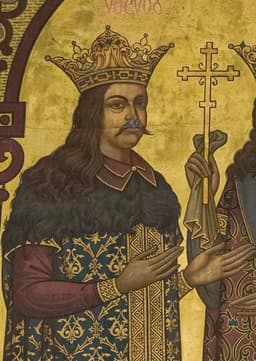
Radu the Great
Emperor · Medieval
43.4Total

Sarki Kanta Kotal
Emperor · Medieval
45.0Total
Basic Information
Born
1467
1450
Died
1508
1500
Era
Medieval
Medieval
Nationality
Wallachia
Kebbi
Occupation
Emperor
Emperor
Civilization
Western
Other
Score Comparison
Military (10%)
21.2
25.0
Political (20%)
35.1
35.1
Influence (20%)
50.2
52.5
Legacy (20%)
41.7
43.3
Leadership (15%)
62.2
58.8
Strategy (15%)
36.8
45.0
TOTAL
43.4
45.0
Radu the Great — Complete Timeline
1490 AD
Rebuilding of Wallachian ChurchesCultural◆ Major
Radu sponsored the construction and restoration of numerous churches and monasteries across Wallachia. His patronage of Orthodox art and architecture earned him the epithet 'the Great' and strengthened the church.
Church BuildingPatronage
Impact: nationalconstructive
1495 AD
Peaceful ReignPolitical Action◆ Major
Radu maintained a stable and peaceful reign, avoiding major wars with the Ottoman Empire and neighboring states. This stability allowed for economic growth and cultural development in Wallachia.
StabilityWallachia
Impact: nationalconstructive
1496 AD
Tribute to the Ottoman EmpirePolitical Action
Radu continued paying tribute to the Ottoman Empire, maintaining Wallachia's vassal status. This policy avoided conflict but limited Wallachian independence.
Ottoman TributeVassalage
Impact: national
1500 AD
Support for the Orthodox ChurchCultural
Radu granted lands and privileges to the Orthodox Church, including the establishment of new bishoprics. His support strengthened the church's role in Wallachian society.
Church SupportOrthodoxy
Impact: nationalconstructive
Sarki Kanta Kotal — Complete Timeline
1475 AD
Foundation of the Kebbi KingdomPolitical Action◆ Major
Sarki Kanta Kotal established the independent kingdom of Kebbi in what is now northwestern Nigeria. He unified various Hausa and other local groups under his rule, creating a state that would resist Songhai expansion for decades.
FoundationKebbi Kingdom
Impact: regionalconstructive
1490 AD
Resistance Against Songhai ExpansionWar◆ Major
Sarki Kanta Kotal led successful military campaigns to defend Kebbi against the expanding Songhai Empire under Askia Mohammed I. His resistance preserved Kebbi's independence and established it as a significant power in the region.
WarResistanceSonghai
Impact: regional
This comparison has not been analyzed yet.
One-time AI generation (~1 minute). Scores and timeline are already available below.
Rankings
🥇
Sarki Kanta KotalLeader
Mil: 25.0Pol: 35.1Inf: 52.5
45.0
🥈
Radu the Great
Mil: 21.2Pol: 35.1Inf: 50.2
43.4
+1.6 behind
How This Comparison Works
Algorithm
Each figure is scored on 6 dimensions (0—100 scale) based on structured historical data: Military (10%), Political (20%), Influence (20%), Legacy (20%), Leadership (15%), Strategy (15%). The weighted total produces the final ranking.
Data Sources
Scores are computed from structured sub-indicators in the database. Scale factors adjust for era (Ancient ×0.85, Modern ×1.0) and civilization size (Eastern ×1.05, Other ×0.80) to account for differences in population and military scale.
Maximum 3 Figures
Comparisons are limited to 2—3 figures to ensure readability and statistical meaningfulness.
Error Margins
±5 points per dimension — Sub-scores are derived from historical records with inherent uncertainty. Two figures within 5 points on a dimension should be considered roughly equivalent in that area.
Total Score Accuracy
±3 points overall — The weighted combination of 6 dimensions produces a total score with approximately ±3 points of uncertainty. Differences of less than 3 points are not statistically significant— the figures are effectively tied.
Known Limitations
- Historical records are incomplete and uneven across civilizations
- Figures from oral-tradition societies may be underrepresented
- Occupation labels can misclassify multi-role figures
- Scores measure capability and impact, not moral character
- Quantitative scoring is a comparison tool, not absolute truth
Capability Radar
Military (10%) — Battles & Warfare
Battles
10
35
Win Rate
10
40
Expansion
10
40
Political (20%) — Governance & Reform
Reform
30
30
Diplomacy
30
35
Economy
30
25
Influence (20%) — Cultural & Global Reach
Cultural
30
30
Global
10
15
Legacy (20%) — Historical Impact
Historical
30
35
Longevity
20
25
Leadership (15%) — Power & Stability
Tenure
40
45
Stability
40
30
Strategy (15%) — Tactics & Innovation
Strategy
10
35
Tactics
10
30
Reform
10
25
Similar Comparisons
Comments & Discussion
No comments yet. Be the first to share your thoughts!