Loading...
Richard I vs Roderic
Richard I leads by 16.3 pts · 2 figures compared
…

Richard I
Emperor · Medieval
54.4Total
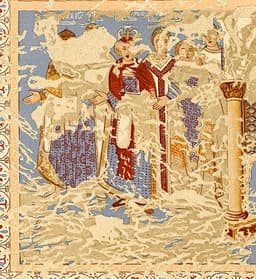
Roderic
Emperor · Medieval
38.1Total
Basic Information
Born
1157
688
Died
1199
711
Era
Medieval
Medieval
Nationality
England
Visigothic Kingdom
Occupation
Emperor
Emperor
Civilization
Western
Western
Score Comparison
Military (10%)
70.0
21.2
Political (20%)
37.9
32.1
Influence (20%)
55.0
47.9
Legacy (20%)
52.0
40.0
Leadership (15%)
55.3
44.5
Strategy (15%)
66.3
25.0
TOTAL
54.4
38.1
Richard I — Complete Timeline
1189 AD
Third CrusadeWar◆ Major
Richard I led the Third Crusade to reclaim Jerusalem from Saladin. He captured Cyprus and Acre, but failed to take Jerusalem. He negotiated the Treaty of Jaffa, securing safe passage for Christian pilgrims.
CrusadeHoly LandSaladin
Impact: global
1191 AD
Battle of ArsufWar◆ Major
Richard I defeated Saladin's forces at the Battle of Arsuf, a key engagement during the Third Crusade. This victory allowed the Crusaders to secure the coast and march toward Jaffa.
CrusadeBattleSaladin
Impact: regional
Conquest of CyprusWar◆ Major
Richard I conquered the island of Cyprus en route to the Holy Land, defeating the Byzantine ruler Isaac Komnenos. He later sold the island to the Knights Templar, establishing a Crusader base.
ConquestCrusadeCyprus
Impact: regional
1192 AD
Capture and RansomPolitical Action◆ Major
On his return from the Crusade, Richard was captured by Duke Leopold V of Austria and handed over to Emperor Henry VI. He was held for ransom, which was paid by England in 1194, totaling 150,000 marks.
ImprisonmentRansom
Impact: regionaltragic
1199 AD
Death at ChâlusWar◆ Major
Richard I was fatally wounded by a crossbow bolt while besieging the castle of Ch
DeathSiege
Impact: nationaltragic
Roderic — Complete Timeline
710 AD
Civil War with Achila's FactionWar◆ Major
Roderic's claim to the throne was contested by Achila, son of Wittiza, who controlled the northeastern part of the kingdom. This civil war divided Visigothic forces and resources, contributing to the kingdom's inability to effectively resist the Muslim invasion in 711.
Visigothic KingdomCivil WarSuccession Crisis
Impact: regionaldestructive
Accession as Visigothic KingPolitical Action◆ Major
Roderic became king of the Visigoths after the death of King Wittiza. His accession was disputed by Wittiza's family, leading to a civil war. This internal division weakened the Visigothic Kingdom and made it vulnerable to external threats.
Visigothic KingdomSuccessionCivil War
Impact: regional
711 AD
Battle of GuadaleteWar
Roderic led the Visigothic army against an invading Muslim force under Tariq ibn Ziyad at the Battle of Guadalete. The Visigoths were decisively defeated, and Roderic was killed in the battle. This defeat marked the end of the Visigothic Kingdom and the beginning of Muslim rule in Hispania.
Visigothic KingdomBattleMuslim Conquest
Impact: regionaltragic
Expert Analysis
Origins
Richard I of England, born in 1157 in Oxford, was the third son of King Henry II and Eleanor of Aquitaine. He spent his early years in Aquitaine, where he was educated in knightly arts and troubadour culture. His mother's influence fostered his ambition and love for chivalric ideals. In contrast, Roderic, born around 688, was a Visigothic nobleman in the Iberian Peninsula. Little is known of his early life, but he likely served as a duke under King Wittiza. His family background placed him in the tumultuous politics of the Visigothic kingdom, where succession disputes were common.
Rise to Power
Richard became Duke of Aquitaine in 1172 and led rebellions against his father before inheriting the English throne in 1189. His path to power was marked by conflict with his brothers and father, culminating in Henry II's death. Richard immediately began preparations for the Third Crusade. Roderic's rise came after the death of King Wittiza in 710. He seized the throne, likely through a coup, but faced opposition from Wittiza's sons, leading to a civil war. This internal strife weakened the Visigothic kingdom just as Muslim forces from North Africa launched invasions.
Leadership & Governance
Richard's leadership was defined by his crusading zeal and military focus. He spent only six months of his ten-year reign in England, governing through appointed officials. His primary concern was funding and leading the Third Crusade. He levied heavy taxes and sold offices to raise funds. In contrast, Roderic's rule was short and dominated by civil war. He failed to unite the Visigothic nobility against the external threat. His governance was ineffective, as seen by the rapid collapse of his kingdom after his death. Richard's political score of 37.9 reflects his neglect of domestic affairs, while Roderic's 32.1 shows even weaker political acumen.
Triumph & Tragedy
Richard's greatest triumph was his performance in the Third Crusade. He captured Cyprus in 1191 and secured Acre after a siege. At the Battle of Arsuf, he defeated Saladin's forces, demonstrating tactical skill (strategy score 66.3). However, he failed to retake Jerusalem, and his crusade ended with a treaty that allowed pilgrims access. His tragedy came on his return journey: he was captured by Duke Leopold V of Austria and held for a ransom of 150,000 marks, which burdened England. Roderic's triumph is minimal; his only notable success was briefly consolidating power after his accession. His tragedy was the Battle of Guadalete in 711, where he was killed and his army routed by Tariq ibn Ziyad, leading to the rapid Muslim conquest of Iberia. His military score of 21.2 reflects this disaster.
Character & Destiny
Richard was courageous and charismatic but also reckless and arrogant. His decision to travel through hostile territory after the crusade led to his capture. His character as a warrior king defined his reign, but his absence harmed England. Roderic's character is less documented, but his actions suggest ambition and poor judgment. By engaging in civil war while facing an external threat, he sealed his fate. Historical assessments note that Roderic's divisive rule made the Visigothic kingdom vulnerable. Both men's personalities directly influenced their outcomes: Richard's crusading zeal brought glory but also captivity; Roderic's infighting brought destruction.
Legacy
Richard's legacy is that of a romantic crusader king, immortalized in literature and folklore. His military achievements influenced later crusades, and his reign set precedents for English taxation and governance. However, his long-term impact on England was limited. He scored 55.0 in influence and 52.0 in legacy. Roderic's legacy is as the last Visigothic king, symbolizing the fall of Christian Iberia. His defeat at Guadalete marked the beginning of Muslim rule in Spain, which lasted centuries. His legacy score of 40.0 reflects his role as a footnote in history. Richard's legacy is more prominent globally, while Roderic's is regionally significant.
Conclusion
Richard I had a greater impact than Roderic, as evidenced by his higher total score (54.4 vs 38.1). Richard's military campaigns influenced the course of the Crusades and European politics, while Roderic's defeat led to the end of Visigothic rule. Richard's actions had lasting effects on the Middle East and Europe, whereas Roderic's failure primarily affected Iberia. Although both faced tragedy, Richard's achievements and recognition far surpass Roderic's. Thus, Richard I is the more significant historical figure.
Rankings
🥇
Richard ILeader
Mil: 70.0Pol: 37.9Inf: 55.0
54.4
🥈
Roderic
Mil: 21.2Pol: 32.1Inf: 47.9
38.1
+16.3 behind
How This Comparison Works
Algorithm
Each figure is scored on 6 dimensions (0—100 scale) based on structured historical data: Military (10%), Political (20%), Influence (20%), Legacy (20%), Leadership (15%), Strategy (15%). The weighted total produces the final ranking.
Data Sources
Scores are computed from structured sub-indicators in the database. Scale factors adjust for era (Ancient ×0.85, Modern ×1.0) and civilization size (Eastern ×1.05, Other ×0.80) to account for differences in population and military scale.
Maximum 3 Figures
Comparisons are limited to 2—3 figures to ensure readability and statistical meaningfulness.
Error Margins
±5 points per dimension — Sub-scores are derived from historical records with inherent uncertainty. Two figures within 5 points on a dimension should be considered roughly equivalent in that area.
Total Score Accuracy
±3 points overall — The weighted combination of 6 dimensions produces a total score with approximately ±3 points of uncertainty. Differences of less than 3 points are not statistically significant— the figures are effectively tied.
Known Limitations
- Historical records are incomplete and uneven across civilizations
- Figures from oral-tradition societies may be underrepresented
- Occupation labels can misclassify multi-role figures
- Scores measure capability and impact, not moral character
- Quantitative scoring is a comparison tool, not absolute truth
Capability Radar
Military (10%) — Battles & Warfare
Battles
75
20
Win Rate
70
5
Expansion
40
5
Political (20%) — Governance & Reform
Reform
20
10
Diplomacy
55
10
Economy
25
10
Influence (20%) — Cultural & Global Reach
Cultural
65
15
Global
55
10
Legacy (20%) — Historical Impact
Historical
70
25
Longevity
60
15
Leadership (15%) — Power & Stability
Tenure
40
15
Stability
30
5
Strategy (15%) — Tactics & Innovation
Strategy
65
15
Tactics
80
15
Reform
30
5
Similar Comparisons
Comments & Discussion
No comments yet. Be the first to share your thoughts!