Loading...
Askia Muhammad vs Richard I
Askia Muhammad leads by 16.8 pts · 2 figures compared
…
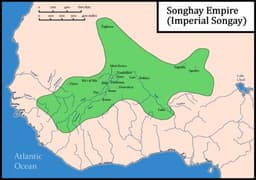
Askia Muhammad
Emperor · Medieval
71.2Total

Richard I
Emperor · Medieval
54.4Total
Basic Information
Born
1443
1157
Died
1538
1199
Era
Medieval
Medieval
Nationality
Songhai Empire
England
Occupation
Emperor
Emperor
Civilization
Other
Western
Score Comparison
Military (10%)
78.0
70.0
Political (20%)
70.3
37.9
Influence (20%)
82.0
55.0
Legacy (20%)
55.0
52.0
Leadership (15%)
78.0
55.3
Strategy (15%)
69.1
66.3
TOTAL
71.2
54.4
Askia Muhammad — Complete Timeline
1493 AD
Coup against Sonni BaruPolitical Action
Askia Muhammad overthrew Sonni Baru, the son of Sonni Ali, in a coup. Muhammad, a general under Sonni Ali, seized power after Baru refused to embrace Islam more fully, establishing the Askia dynasty.
CoupAskia DynastyIslam
Impact: regional
1496 AD
Pilgrimage to MeccaCultural◆ Major
Askia Muhammad made a pilgrimage to Mecca, traveling with a large retinue and distributing gold. He was appointed Caliph of the Sudan by the Abbasid caliph, enhancing his religious and political legitimacy.
PilgrimageMeccaCaliph
Impact: regionalconstructive
1498 AD
Administrative ReformsReform◆ Major
Askia Muhammad reorganized the Songhai Empire into provinces governed by appointed officials. He standardized weights, measures, and currency, and established a professional bureaucracy, improving tax collection and governance.
AdministrationBureaucracyTaxation
Impact: regionalconstructive
1500 AD
Promotion of Islamic ScholarshipCultural◆ Major
Askia Muhammad patronized Islamic scholars and built mosques and schools in Timbuktu, Gao, and Djenn
ScholarshipTimbuktuIslam
Impact: regionalconstructive
1512 AD
Conquest of the Hausa StatesWar◆ Major
Askia Muhammad led a military campaign against the Hausa city-states, including Kano and Katsina. He conquered them and imposed tribute, extending Songhai control over the Hausa region and securing trade routes.
ConquestHausa StatesTrade Routes
Impact: regional
Richard I — Complete Timeline
1189 AD
Third CrusadeWar◆ Major
Richard I led the Third Crusade to reclaim Jerusalem from Saladin. He captured Cyprus and Acre, but failed to take Jerusalem. He negotiated the Treaty of Jaffa, securing safe passage for Christian pilgrims.
CrusadeHoly LandSaladin
Impact: global
1191 AD
Battle of ArsufWar◆ Major
Richard I defeated Saladin's forces at the Battle of Arsuf, a key engagement during the Third Crusade. This victory allowed the Crusaders to secure the coast and march toward Jaffa.
CrusadeBattleSaladin
Impact: regional
Conquest of CyprusWar◆ Major
Richard I conquered the island of Cyprus en route to the Holy Land, defeating the Byzantine ruler Isaac Komnenos. He later sold the island to the Knights Templar, establishing a Crusader base.
ConquestCrusadeCyprus
Impact: regional
1192 AD
Capture and RansomPolitical Action◆ Major
On his return from the Crusade, Richard was captured by Duke Leopold V of Austria and handed over to Emperor Henry VI. He was held for ransom, which was paid by England in 1194, totaling 150,000 marks.
ImprisonmentRansom
Impact: regionaltragic
1199 AD
Death at ChâlusWar◆ Major
Richard I was fatally wounded by a crossbow bolt while besieging the castle of Ch
DeathSiege
Impact: nationaltragic
Expert Analysis
Origins
Askia Muhammad, born as Muhammad Toure around 1443 in the Songhai Empire (modern-day Mali), rose from a military background. He was a general under Sonni Ali, the previous ruler. His early life was shaped by the Islamic faith and the imperial ambitions of Songhai. In contrast, Richard I was born on September 8, 1157, in Oxford, England, as the third son of King Henry II and Eleanor of Aquitaine. His upbringing was steeped in the chivalric culture of medieval Europe, with a focus on martial prowess. Richard's early years were marked by conflicts with his father and brothers over land and power.
Rise to Power
Askia Muhammad seized power in 1493 by overthrowing Sonni Baru, the son of Sonni Ali, in a coup. Baru had refused to embrace Islam fully, alienating Muslim merchants and scholars. Muhammad, a devout Muslim, garnered support from the Islamic establishment and the military. He was proclaimed Askia, meaning "forceful one." Richard I became King of England in 1189 after the death of Henry II. His rise was preceded by rebellions against his father, including an alliance with King Philip II of France. Richard's reputation as a military leader was solidified during the Third Crusade (1189-1192), where he emerged as a key figure.
Leadership & Governance
Askia Muhammad's governance was characterized by administrative centralization. He divided the empire into provinces with appointed governors, standardized weights and measures, and introduced a uniform currency. He promoted Islamic scholarship, founding schools and libraries in Timbuktu, which became a center of learning. His leadership score of 78.0 reflects his effective rule. Richard I, with a leadership score of 55.3, spent only six months of his ten-year reign in England. He viewed the kingdom primarily as a source of funds for his crusading ventures. His governance was marked by heavy taxation and the sale of offices to finance his wars, leaving the administration in the hands of others.
Triumph & Tragedy
Askia Muhammad's greatest triumph was his pilgrimage to Mecca in 1496-1498, where he was appointed Caliph of the Sudan by the Abbasid caliph, boosting his legitimacy. He expanded the empire to its largest extent, conquering the Hausa states and parts of the Sahel. However, his later years were tragic: he was overthrown by his son Musa in 1528 and exiled, dying in 1538. Richard I's triumph was his military prowess in the Third Crusade, notably the Battle of Arsuf in 1191, where he defeated Saladin's forces. He also captured Cyprus in 1191. His tragedy was his capture in 1192 by Duke Leopold V of Austria while returning from the Crusade. He was imprisoned for over a year and ransomed for a huge sum, draining English resources. He died in 1199 from a crossbow wound at Châlus, a minor siege.
Character & Destiny
Askia Muhammad was a devout Muslim and a pragmatic ruler. His character combined religious piety with administrative acumen. His destiny was shaped by his successful consolidation of power but also by the internal dynastic conflicts that led to his downfall. Richard I was known for his courage and military skill, earning the nickname "Lionheart." However, his reckless disregard for his kingdom's finances and his absence led to instability. His character, focused on personal glory and crusading ideals, ultimately limited his effectiveness as a king.
Legacy
Askia Muhammad's legacy is profound in West Africa. He transformed Songhai into a centralized, Islamic state that flourished culturally and economically. The University of Timbuktu attracted scholars from across the Islamic world. His administrative reforms influenced later empires. With an influence score of 82.0 and legacy of 55.0, his impact on the region was lasting. Richard I's legacy is more romanticized. He is remembered as a chivalric crusader and a military hero, but his actual governance left England financially drained. His legacy score of 52.0 reflects his iconic status rather than substantive contributions. The myths surrounding him, such as Robin Hood, have overshadowed his real achievements.
Conclusion
While Richard I is a celebrated figure in European history, Askia Muhammad had a greater impact on the world. His military score of 78.0 and political score of 70.3 demonstrate his effectiveness as a ruler, compared to Richard's 70.0 military and 37.9 political scores. Askia Muhammad built a lasting empire that fostered learning and trade, while Richard's reign was characterized by absence and financial exploitation. Askia Muhammad's total score of 71.2 versus Richard's 54.4 reflects a more balanced and impactful leadership. Therefore, Askia Muhammad stands as the more consequential historical figure.
Rankings
🥇
Askia MuhammadLeader
Mil: 78.0Pol: 70.3Inf: 82.0
71.2
🥈
Richard I
Mil: 70.0Pol: 37.9Inf: 55.0
54.4
+16.8 behind
How This Comparison Works
Algorithm
Each figure is scored on 6 dimensions (0—100 scale) based on structured historical data: Military (10%), Political (20%), Influence (20%), Legacy (20%), Leadership (15%), Strategy (15%). The weighted total produces the final ranking.
Data Sources
Scores are computed from structured sub-indicators in the database. Scale factors adjust for era (Ancient ×0.85, Modern ×1.0) and civilization size (Eastern ×1.05, Other ×0.80) to account for differences in population and military scale.
Maximum 3 Figures
Comparisons are limited to 2—3 figures to ensure readability and statistical meaningfulness.
Error Margins
±5 points per dimension — Sub-scores are derived from historical records with inherent uncertainty. Two figures within 5 points on a dimension should be considered roughly equivalent in that area.
Total Score Accuracy
±3 points overall — The weighted combination of 6 dimensions produces a total score with approximately ±3 points of uncertainty. Differences of less than 3 points are not statistically significant— the figures are effectively tied.
Known Limitations
- Historical records are incomplete and uneven across civilizations
- Figures from oral-tradition societies may be underrepresented
- Occupation labels can misclassify multi-role figures
- Scores measure capability and impact, not moral character
- Quantitative scoring is a comparison tool, not absolute truth
Capability Radar
Military (10%) — Battles & Warfare
Battles
75
75
Win Rate
80
70
Expansion
80
40
Political (20%) — Governance & Reform
Reform
90
20
Diplomacy
80
55
Economy
85
25
Influence (20%) — Cultural & Global Reach
Cultural
70
65
Global
60
55
Legacy (20%) — Historical Impact
Historical
75
70
Longevity
65
60
Leadership (15%) — Power & Stability
Tenure
85
40
Stability
80
30
Strategy (15%) — Tactics & Innovation
Strategy
75
65
Tactics
70
80
Reform
85
30
Similar Comparisons
Comments & Discussion
No comments yet. Be the first to share your thoughts!