Loading...
This comparison has not been analyzed yet.
One-time AI generation (~1 minute). Scores and timeline are already available below.
Salote Tupou III vs Tohwechipi
Salote Tupou III leads by 2.8 pts · 2 figures compared
…
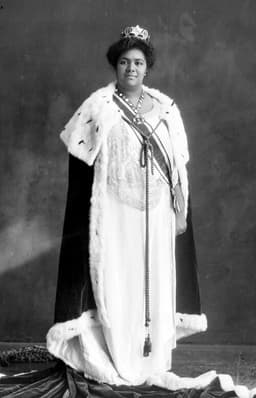
Salote Tupou III
Emperor · Modern
54.4Total

Tohwechipi
Emperor · Modern
51.6Total
Basic Information
Born
1900
1750
Died
1965
1787
Era
Modern
Modern
Nationality
Tonga
Rozvi Empire
Occupation
Emperor
Emperor
Civilization
Other
Other
Score Comparison
Military (10%)
12.0
50.0
Political (20%)
70.3
68.0
Influence (20%)
55.0
53.3
Legacy (20%)
54.0
44.2
Leadership (15%)
81.7
40.0
Strategy (15%)
31.8
60.0
TOTAL
54.4
51.6
Salote Tupou III — Complete Timeline
1918 AD
Ascended to the throne as Queen of TongaPolitical Action◆ Major
Salote Tupou III became Queen of Tonga on 5 April 1918, following the death of her father King George Tupou II. She was the first queen regnant of Tonga and reigned for 47 years.
TongaMonarchySuccession
Impact: regional
1920 AD
Modernized Tonga's education and health systemsReform◆ Major
Salote Tupou III oversaw the expansion of education and healthcare in Tonga. She established schools, improved public health infrastructure, and promoted literacy, significantly raising living standards in the kingdom.
TongaEducationHealth
Impact: regionalconstructive
1939 AD
Maintained Tonga's independence during World War IIPolitical Action◆ Major
During World War II, Salote Tupou III kept Tonga neutral while allowing Allied forces to use Tongan territory. She also contributed troops and resources to the Allied war effort, strengthening Tonga's relationship with Western powers.
TongaWorld War IIDiplomacy
Impact: regionalconstructive
1953 AD
Attended the coronation of Queen Elizabeth IICultural◆ Major
Salote Tupou III attended the coronation of Queen Elizabeth II in London in 1953. Her open carriage ride in the rain, smiling and waving, won her widespread admiration and made her a beloved figure internationally.
TongaRoyaltyInternational
Impact: globalconstructive
Tohwechipi — Complete Timeline
1780 AD
Defense against Nguni incursionsWar◆ Major
Tohwechipi led Rozvi forces to repel Nguni raiders from the south who threatened the empire's borders. His military campaigns preserved Rozvi territorial integrity during a period of increasing external pressure.
Nguni RaidsMilitary DefenseRozvi Empire
Impact: regional
1785 AD
Last great Rozvi expansionWar
Tohwechipi extended Rozvi control over the lower Zambezi valley, subjugating local chieftaincies and securing access to ivory trade routes. This was the final major territorial expansion of the Rozvi Empire before its decline.
Territorial ExpansionIvory TradeZambezi Valley
Impact: regionalconstructive
This comparison has not been analyzed yet.
One-time AI generation (~1 minute). Scores and timeline are already available below.
Rankings
🥇
Salote Tupou IIILeader
Mil: 12.0Pol: 70.3Inf: 55.0
54.4
🥈
Tohwechipi
Mil: 50.0Pol: 68.0Inf: 53.3
51.6
+2.8 behind
How This Comparison Works
Algorithm
Each figure is scored on 6 dimensions (0—100 scale) based on structured historical data: Military (10%), Political (20%), Influence (20%), Legacy (20%), Leadership (15%), Strategy (15%). The weighted total produces the final ranking.
Data Sources
Scores are computed from structured sub-indicators in the database. Scale factors adjust for era (Ancient ×0.85, Modern ×1.0) and civilization size (Eastern ×1.05, Other ×0.80) to account for differences in population and military scale.
Maximum 3 Figures
Comparisons are limited to 2—3 figures to ensure readability and statistical meaningfulness.
Error Margins
±5 points per dimension — Sub-scores are derived from historical records with inherent uncertainty. Two figures within 5 points on a dimension should be considered roughly equivalent in that area.
Total Score Accuracy
±3 points overall — The weighted combination of 6 dimensions produces a total score with approximately ±3 points of uncertainty. Differences of less than 3 points are not statistically significant— the figures are effectively tied.
Known Limitations
- Historical records are incomplete and uneven across civilizations
- Figures from oral-tradition societies may be underrepresented
- Occupation labels can misclassify multi-role figures
- Scores measure capability and impact, not moral character
- Quantitative scoring is a comparison tool, not absolute truth
Capability Radar
Military (10%) — Battles & Warfare
Battles
6
45
Win Rate
8
50
Expansion
9
45
Political (20%) — Governance & Reform
Reform
75
50
Diplomacy
80
45
Economy
70
40
Influence (20%) — Cultural & Global Reach
Cultural
65
40
Global
50
20
Legacy (20%) — Historical Impact
Historical
60
45
Longevity
55
30
Leadership (15%) — Power & Stability
Tenure
85
60
Stability
90
35
Strategy (15%) — Tactics & Innovation
Strategy
14
50
Tactics
19
55
Reform
23
40
Similar Comparisons
Comments & Discussion
No comments yet. Be the first to share your thoughts!