Loading...
Samia Suluhu vs Sukarno
Sukarno leads by 1.3 pts · 2 figures compared
…
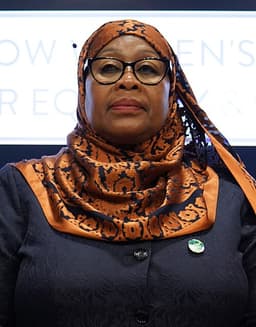
Samia Suluhu
Politician · Modern
52.4Total

Sukarno
Politician · Modern
53.7Total
Basic Information
Born
1960
1901
Died
—
1970
Era
Modern
Modern
Nationality
Tanzania
Indonesia
Occupation
Politician
Politician
Civilization
Other
Eastern
Score Comparison
Military (10%)
50.0
36.6
Political (20%)
45.0
45.0
Influence (20%)
55.0
68.0
Legacy (20%)
52.0
52.0
Leadership (15%)
66.0
53.2
Strategy (15%)
39.7
53.3
TOTAL
52.4
53.7
Samia Suluhu — Complete Timeline
2021 AD
Became First Female President of TanzaniaPolitical Action◆ Major
Suluhu was sworn in as President of Tanzania following the death of President John Magufuli. She became the first female president in Tanzania's history and the first female head of state in East Africa.
PresidencyGender EqualityFirst
Impact: regionalprogressive
Reversed Magufuli's COVID-19 DenialismPolitical Action◆ Major
Suluhu reversed her predecessor's policy of denying COVID-19 and rejecting vaccines. She formed a national COVID-19 task force, encouraged mask-wearing, and accepted vaccine donations, aligning Tanzania with global health protocols.
COVID-19Public HealthPolicy Change
Impact: nationalconstructive
Initiated Political Reconciliation EffortsPolitical Action◆ Major
Suluhu reached out to opposition leaders and invited them for dialogue, signaling a shift from Magufuli's authoritarian approach. She lifted bans on some opposition newspapers and allowed political rallies, easing political tensions.
ReconciliationDemocracyPolitical Freedom
Impact: nationalprogressive
Appointed First Female Chief JusticePolitical Action
Suluhu appointed Justice Ibrahim Juma as Chief Justice, but more notably, she appointed several women to high-ranking positions, including the first female Attorney General and the first female head of the civil service.
AppointmentsGender EqualityJudiciary
Impact: nationalprogressive
Sukarno — Complete Timeline
1945 AD
Proclamation of Indonesian IndependencePolitical Action
Sukarno, with Mohammad Hatta, proclaimed Indonesia's independence from Dutch colonial rule. This declaration sparked the Indonesian National Revolution, a four-year struggle against Dutch reoccupation.
IndependenceIndonesiaDecolonization
Impact: nationalconstructive
1955 AD
Bandung ConferencePolitical Action◆ Major
Sukarno hosted the Bandung Conference, bringing together 29 Asian and African nations. The conference promoted non-alignment and anti-colonialism, leading to the formation of the Non-Aligned Movement.
Non-Aligned MovementDecolonizationDiplomacy
Impact: globalconstructive
1959 AD
Guided Democracy DeclarationPolitical Action◆ Major
Sukarno dissolved the Constituent Assembly and reinstated the 1945 constitution, establishing 'Guided Democracy'. This centralized power in the presidency, curtailed parliamentary democracy, and increased military influence.
AuthoritarianismIndonesiaConstitutional Change
Impact: nationaldestructive
1963 AD
Confrontation with MalaysiaWar◆ Major
Sukarno launched a policy of 'Konfrontasi' against the formation of Malaysia, which he viewed as a neo-colonial project. This led to a three-year undeclared war involving guerrilla raids and diplomatic tensions with Britain and Malaysia.
KonfrontasiMalaysiaRegional Conflict
Impact: regionaldestructive
1965 AD
30 September Movement and Fall from PowerPolitical Action
An abortive coup by leftist military officers led to a violent anti-communist purge. Sukarno's authority was undermined, and General Suharto gradually seized power, forcing Sukarno to transfer executive authority in 1966 and placing him under house arrest.
CoupSuhartoIndonesia
Impact: nationaltragic
Expert Analysis
Origins
Samia Suluhu Hassan was born on January 27, 1960, in the Sultanate of Zanzibar, now part of Tanzania. She came from a modest family; her father was a teacher, and she attended local schools. She studied public administration at the Institute of Development Management in Mzumbe and later earned a master's degree in economic development from the Open University of Tanzania. Her early career included work in the Zanzibar government as a civil servant.
Sukarno was born on June 6, 1901, in Surabaya, Dutch East Indies. His father was a Javanese nobleman and teacher, his mother from Bali. He studied civil engineering at the Technische Hoogeschool te Bandoeng (now Bandung Institute of Technology). During his studies, he became involved in nationalist activities, founding the study club Algemeene Studie Club in 1926. His early exposure to anti-colonial thought shaped his lifelong commitment to Indonesian independence.
Rise to Power
Suluhu entered politics in the 1980s, serving in the Zanzibar House of Representatives. She held various ministerial posts in Zanzibar, including Minister of Tourism and Minister of Labor. In 2010, she was elected Vice President of Tanzania under President Jakaya Kikwete, becoming the first female vice president. In 2015, she was re-elected as Vice President under President John Magufuli. Following Magufuli's sudden death on March 17, 2021, Suluhu was sworn in as President, becoming the first female head of state of Tanzania and East Africa.
Sukarno rose to prominence as a student activist. He was arrested by Dutch authorities in 1929 and sentenced to four years in prison, where he wrote his famous defense speech "Indonesia Menggugat" (Indonesia Accuses). After release, he continued leading nationalist movements. During the Japanese occupation of Indonesia (1942-1945), Sukarno collaborated with the Japanese, which allowed him to build a nationalist network. On August 17, 1945, two days after Japan's surrender, Sukarno and Mohammad Hatta proclaimed Indonesia's independence. He became the first president, leading the country through the Indonesian National Revolution against Dutch re-colonization until independence was recognized in 1949.
Leadership & Governance
Suluhu's leadership style is conciliatory and reformist. Her political score is 45.0, reflecting her pragmatic approach in a challenging political environment. She reversed Magufuli's COVID-19 denialism, forming a national task force and securing vaccines. She also initiated political reconciliation by meeting with opposition leader Freeman Mbowe and lifting bans on some media outlets. She appointed the first female Chief Justice and several women to high positions. However, her governance has faced criticism for continuing some repressive laws, such as the Cybercrimes Act, and for slow economic reforms.
Sukarno's leadership was charismatic and nationalist. His strategy score is 53.3, but his political maneuvering was often erratic. He introduced "Guided Democracy" in 1959, dissolving parliament and centralizing power. He pursued a foreign policy of non-alignment, hosting the Bandung Conference in 1955, which scored him 68.0 in influence. Domestically, his policies led to economic decline and political instability. He also launched the "Konfrontasi" against Malaysia from 1963 to 1966, a costly military confrontation. His governance was marked by a blend of nationalism, religion, and communism (NASAKOM), which ultimately alienated conservative military and Islamic groups.
Triumph & Tragedy
Suluhu's greatest triumph is her successful handling of the COVID-19 pandemic, restoring public health measures and vaccine rollout, which significantly reduced case numbers. Her political reconciliation efforts are also a success, as they have reduced political tensions. However, her tragedy lies in the limitations of her reforms; she has been unable to fully dismantle Magufuli's authoritarian structures, and her government has faced criticism for human rights abuses, including the arrest of opposition figures. Her legacy score of 52.0 reflects these mixed results.
Sukarno's triumph is undoubtedly his role in achieving Indonesian independence, a monumental achievement that scored him 68.0 in influence. The Bandung Conference established him as a leader of the Global South. His tragedy is his downfall: the 30 September Movement in 1965 led to a violent anti-communist purge, and General Suharto gradually stripped him of power, forcing him to resign in 1967. Sukarno was placed under house arrest until his death in 1970. His economic mismanagement and political instability during Guided Democracy are key failures.
Character & Destiny
Suluhu is known for her calm, pragmatic, and consensus-building personality. She scored 66.0 in leadership, indicating her ability to navigate crises with measured decisions. Her character has allowed her to survive in a male-dominated political environment and to steer Tanzania away from Magufuli's hardline policies. However, her cautious approach may limit the pace of change.
Sukarno was charismatic, visionary, and sometimes impulsive. His leadership score of 53.2 reflects his ability to inspire masses but also his flaws in governance. He was a master orator who could mobilize support, but his grand visions often clashed with practical realities. His destiny was shaped by his refusal to adapt to changing political dynamics, leading to his ouster by Suharto. His character was both his greatest asset and his fatal flaw.
Legacy
Suluhu's legacy is still being written, but she has already made history as Tanzania's first female president and has set a precedent for women in leadership in East Africa. Her reversal of COVID-19 denialism saved lives and restored international trust. She has promoted gender equality through appointments, but her impact on systemic reforms remains limited. If she continues her reformist path, she could be remembered as a transitional figure who brought Tanzania back to democratic norms.
Sukarno's legacy is monumental. He is revered as the "Father of the Nation" in Indonesia. The Bandung Conference laid the foundation for the Non-Aligned Movement. His concept of Pancasila remains the state philosophy. However, his legacy is also tainted by the authoritarian turn of Guided Democracy and the chaos that led to Suharto's New Order. His influence score of 68.0 reflects his global impact, but his legacy score of 52.0 balances it with his failures.
Conclusion
Sukarno had a greater impact on world history than Samia Suluhu. Despite scoring only 1.3 points higher overall (53.7 vs 52.4), his role in founding Indonesia, a nation of 270 million people, and his leadership in the Non-Aligned Movement shaped global geopolitics. Suluhu's reforms are significant regionally but lack the transformative scope of Sukarno's independence struggle. Sukarno's influence and legacy scores (68.0 and 52.0) outrank Suluhu's (55.0 and 52.0), demonstrating his broader reach. While Suluhu's leadership score (66.0) is higher, Sukarno's strategic score (53.3) and political impact secure his place as the more consequential figure. In the balance of historical weight, Sukarno's founding of a nation outweighs Suluhu's important but more limited achievements.
Rankings
🥇
SukarnoLeader
Mil: 36.6Pol: 45.0Inf: 68.0
53.7
🥈
Samia Suluhu
Mil: 50.0Pol: 45.0Inf: 55.0
52.4
+1.3 behind
How This Comparison Works
Algorithm
Each figure is scored on 6 dimensions (0—100 scale) based on structured historical data: Military (10%), Political (20%), Influence (20%), Legacy (20%), Leadership (15%), Strategy (15%). The weighted total produces the final ranking.
Data Sources
Scores are computed from structured sub-indicators in the database. Scale factors adjust for era (Ancient ×0.85, Modern ×1.0) and civilization size (Eastern ×1.05, Other ×0.80) to account for differences in population and military scale.
Maximum 3 Figures
Comparisons are limited to 2—3 figures to ensure readability and statistical meaningfulness.
Error Margins
±5 points per dimension — Sub-scores are derived from historical records with inherent uncertainty. Two figures within 5 points on a dimension should be considered roughly equivalent in that area.
Total Score Accuracy
±3 points overall — The weighted combination of 6 dimensions produces a total score with approximately ±3 points of uncertainty. Differences of less than 3 points are not statistically significant— the figures are effectively tied.
Known Limitations
- Historical records are incomplete and uneven across civilizations
- Figures from oral-tradition societies may be underrepresented
- Occupation labels can misclassify multi-role figures
- Scores measure capability and impact, not moral character
- Quantitative scoring is a comparison tool, not absolute truth
Capability Radar
Military (10%) — Battles & Warfare
Battles
24
5
Win Rate
25
5
Expansion
30
5
Political (20%) — Governance & Reform
Reform
60
65
Diplomacy
65
75
Economy
55
40
Influence (20%) — Cultural & Global Reach
Cultural
50
70
Global
55
65
Legacy (20%) — Historical Impact
Historical
55
75
Longevity
45
60
Leadership (15%) — Power & Stability
Tenure
55
70
Stability
60
30
Strategy (15%) — Tactics & Innovation
Strategy
33
10
Tactics
36
5
Reform
35
10
Similar Comparisons
Comments & Discussion
No comments yet. Be the first to share your thoughts!