Loading...
Saparmurat Niyazov vs Zviad Gamsakhurdia
Zviad Gamsakhurdia leads by 6.5 pts · 2 figures compared
…

Saparmurat Niyazov
Politician · Modern
39.3Total
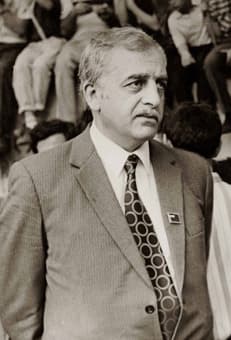
Zviad Gamsakhurdia
Politician · Modern
45.8Total
Basic Information
Born
1940
1939
Died
—
—
Era
Modern
Modern
Nationality
Turkmenistan
Georgia
Occupation
Politician
Politician
Civilization
Eastern
Western
Score Comparison
Military (10%)
13.7
48.6
Political (20%)
27.9
37.9
Influence (20%)
47.9
53.3
Legacy (20%)
34.2
41.7
Leadership (15%)
65.0
48.4
Strategy (15%)
35.1
42.1
TOTAL
39.3
45.8
Saparmurat Niyazov — Complete Timeline
1991 AD
Became First President of TurkmenistanPolitical Action◆ Major
Saparmurat Niyazov was elected as the first president of independent Turkmenistan after the dissolution of the Soviet Union. He had previously served as the First Secretary of the Communist Party of Turkmenistan. His presidency established a highly authoritarian and personality cult-driven regime.
IndependenceAuthoritarian RegimePost-Soviet Transition
Impact: national
1993 AD
Established Personality CultCultural◆ Major
Niyazov adopted the title 'Turkmenbashi' (Leader of all Turkmen) and initiated a massive personality cult. He renamed months and days after himself and his family, erected golden statues of himself, and required citizens to read his spiritual guide, the Ruhnama. The cult permeated all aspects of life.
Personality CultAuthoritarianismCultural Manipulation
Impact: nationaldestructive
1995 AD
Implemented Isolationist PoliciesPolitical Action◆ Major
Niyazov pursued a policy of 'positive neutrality,' keeping Turkmenistan isolated from international affairs. He restricted foreign travel, limited internet access, and maintained a closed economy. The country became one of the most isolated in the world, with limited diplomatic relations.
IsolationismNeutralityClosed Society
Impact: nationaldestructive
2001 AD
Published the RuhnamaCultural◆ Major
Niyazov published the Ruhnama, a spiritual and moral guide that he claimed was divinely inspired. The book became mandatory reading in schools and universities, and was used to justify his policies. It blended Turkmen history, mythology, and Niyazov's own philosophy, serving as a tool of ideological control.
Book PublicationIdeological ControlCultural Policy
Impact: nationaldestructive
2006 AD
Died in OfficePolitical Action◆ Major
Niyazov died suddenly in office at the age of 66 from heart failure. His death ended 15 years of eccentric and authoritarian rule. He was succeeded by Gurbanguly Berdimuhamedow, who continued many of his policies while gradually reducing the most extreme aspects of the personality cult.
Death in OfficeSuccessionEnd of Era
Impact: national
Zviad Gamsakhurdia — Complete Timeline
1990 AD
Elected Chairman of the Supreme Council of GeorgiaPolitical Action◆ Major
Gamsakhurdia was elected Chairman of the Supreme Council of Georgia, effectively becoming the head of state. He led Georgia's declaration of independence from the Soviet Union in 1991, ending 70 years of Soviet rule.
Georgian IndependenceSoviet DissolutionNationalism
Impact: nationalconstructive
1991 AD
Elected First President of GeorgiaPolitical Action◆ Major
Gamsakhurdia won the first direct presidential election in Georgia with 86% of the vote. He became the first democratically elected president of the country. His presidency focused on consolidating independence and asserting Georgian sovereignty.
Georgian IndependenceDemocracyPresidency
Impact: nationalconstructive
1992 AD
Overthrow in a Coup d'ÉtatPolitical Action◆ Major
Gamsakhurdia was overthrown by a military coup backed by paramilitary groups and former allies. He fled to Chechnya. The coup led to a civil war and the rise of Eduard Shevardnadze. Gamsakhurdia's authoritarian style and nationalist policies had alienated many.
Georgian Civil WarCoupPolitical Crisis
Impact: nationaldestructive
1993 AD
Death in a Rebellion AttemptWar◆ Major
Gamsakhurdia returned to Georgia to lead an armed rebellion against Shevardnadze's government. He died in unclear circumstances in a village in western Georgia, reportedly by suicide or assassination. His death ended the rebellion.
Georgian Civil WarRebellionDeath
Impact: nationaltragic
Expert Analysis
Origins
Saparmurat Niyazov was born on February 19, 1940, in Ashgabat, Turkmenistan, into a family that suffered heavily during World War II. His father died in the war, and his mother perished in the 1948 Ashgabat earthquake, leaving him an orphan. He was raised in a state orphanage, an experience that shaped his later emphasis on stability and control. Niyazov studied at the Leningrad Polytechnic Institute and worked in the Communist Party apparatus, gradually rising through the ranks of the Turkmen SSR.
Zviad Gamsakhurdia was born on March 31, 1939, in Tbilisi, Georgia, into a prominent literary family. His father, Konstantine Gamsakhurdia, was a famous Georgian novelist. Zviad studied philology at Tbilisi State University and became a dissident in the Soviet era, advocating for Georgian national rights and human rights. He was arrested multiple times for his activism, which built his reputation as a principled nationalist leader.
Rise to Power
Niyazov rose to power within the Soviet system. He became First Secretary of the Communist Party of Turkmenistan in 1985, a position he used to consolidate control. When the Soviet Union collapsed in 1991, he was elected President of independent Turkmenistan in an uncontested election, winning 99.5% of the vote. He quickly eliminated political rivals and established a single-party system.
Gamsakhurdia's rise was fueled by nationalist fervor. In 1990, he was elected Chairman of the Supreme Council of Georgia, leading the declaration of independence from the USSR in April 1991. In May 1991, he won the first direct presidential election with 86% of the vote, becoming Georgia's first democratically elected president. His platform centered on Georgian sovereignty and cultural revival.
Leadership & Governance
Niyazov's leadership was defined by extreme authoritarianism and a bizarre personality cult. He adopted the title 'Turkmenbashi' (Leader of all Turkmen) and renamed months and days after himself and his family. He published the Ruhnama, a spiritual guide that became mandatory reading, replacing history and literature in schools. He pursued 'positive neutrality,' isolating Turkmenistan from international affairs, restricting foreign travel, and limiting internet access. His governance score is 65.0, reflecting his firm control, but his political score is only 27.9 due to lack of democratic legitimacy.
Gamsakhurdia's governance was chaotic and increasingly authoritarian. He centralized power, suppressed opposition, and alienated key allies, including the National Guard. His leadership score of 48.4 reflects his initial democratic mandate but subsequent failure to govern inclusively. He faced armed opposition from paramilitary groups like the Mkhedrioni, and his policies led to economic decline and ethnic tensions in South Ossetia and Abkhazia.
Triumph & Tragedy
Niyazov's greatest triumph was maintaining stability and independence for Turkmenistan during the turbulent post-Soviet years. He used natural gas revenues to provide free utilities and subsidies, buying social peace. However, his greatest tragedy was the suppression of intellectual life, the imposition of the Ruhnama cult, and the isolation of his country from global progress. His legacy score of 34.2 reflects the mixed outcomes.
Gamsakhurdia's triumph was leading Georgia to independence from the Soviet Union, a goal he had pursued for decades. He was a symbol of national revival. His tragedy was his downfall: in December 1991, he was overthrown in a military coup backed by former allies, leading to a civil war that killed thousands. He died in 1993 while attempting to regain power, under unclear circumstances—likely suicide or murder. His influence score of 53.3 captures his symbolic importance, but his political score of 37.9 reflects his failed governance.
Character & Destiny
Niyazov was paranoid, megalomaniacal, and detached from reality. His orphan background may have driven his need for adulation and control. He distrusted foreigners and intellectuals, leading to his isolationist policies. His character directly shaped his destiny: he died in office, still in control, but his regime collapsed into obscurity after his death.
Gamsakhurdia was idealistic, stubborn, and confrontational. His dissident background made him uncompromising, which alienated moderate allies. He misjudged the loyalty of his security forces and the strength of his opponents. His character led to his overthrow and tragic death. Historians often view him as a tragic figure whose vision exceeded his political capacity.
Legacy
Niyazov's legacy is largely negative. His personality cult was dismantled after his death, and his successor, Gurbanguly Berdimuhamedow, quietly reversed many of his eccentric policies. The Ruhnama was removed from schools. Turkmenistan remains authoritarian, but without the cult. Niyazov's total score of 39.3 reflects his limited lasting impact.
Gamsakhurdia's legacy is contested. In Georgia, he is honored as a national hero and first president, but his role in the civil war is criticized. His successor, Eduard Shevardnadze, and later Mikheil Saakashvili, built on his nationalist foundation. Georgia's pro-Western orientation owes much to his initial push for independence. His total score of 45.8 indicates a slightly greater impact, though marred by failure.
Conclusion
While Gamsakhurdia's total score of 45.8 exceeds Niyazov's 39.3, the comparison is nuanced. Niyazov's rule was more stable and enduring, but his impact was isolated to Turkmenistan and largely negative. Gamsakhurdia's brief tenure had wider implications for Georgia's independence and subsequent democratic trajectory. However, his inability to govern effectively and his role in the civil war diminish his legacy. In terms of lasting influence on national identity and independence, Gamsakhurdia had a greater impact. He scored higher in influence (53.3 vs. 47.9) and legacy (41.7 vs. 34.2). Therefore, despite his failure, Zviad Gamsakhurdia's impact on Georgia's history is more significant than Niyazov's on Turkmenistan.
Rankings
🥇
Zviad GamsakhurdiaLeader
Mil: 48.6Pol: 37.9Inf: 53.3
45.8
🥈
Saparmurat Niyazov
Mil: 13.7Pol: 27.9Inf: 47.9
39.3
+6.5 behind
How This Comparison Works
Algorithm
Each figure is scored on 6 dimensions (0—100 scale) based on structured historical data: Military (10%), Political (20%), Influence (20%), Legacy (20%), Leadership (15%), Strategy (15%). The weighted total produces the final ranking.
Data Sources
Scores are computed from structured sub-indicators in the database. Scale factors adjust for era (Ancient ×0.85, Modern ×1.0) and civilization size (Eastern ×1.05, Other ×0.80) to account for differences in population and military scale.
Maximum 3 Figures
Comparisons are limited to 2—3 figures to ensure readability and statistical meaningfulness.
Error Margins
±5 points per dimension — Sub-scores are derived from historical records with inherent uncertainty. Two figures within 5 points on a dimension should be considered roughly equivalent in that area.
Total Score Accuracy
±3 points overall — The weighted combination of 6 dimensions produces a total score with approximately ±3 points of uncertainty. Differences of less than 3 points are not statistically significant— the figures are effectively tied.
Known Limitations
- Historical records are incomplete and uneven across civilizations
- Figures from oral-tradition societies may be underrepresented
- Occupation labels can misclassify multi-role figures
- Scores measure capability and impact, not moral character
- Quantitative scoring is a comparison tool, not absolute truth
Capability Radar
Military (10%) — Battles & Warfare
Battles
11
31
Win Rate
18
31
Expansion
22
36
Political (20%) — Governance & Reform
Reform
5
40
Diplomacy
15
25
Economy
10
20
Influence (20%) — Cultural & Global Reach
Cultural
15
35
Global
10
25
Legacy (20%) — Historical Impact
Historical
10
30
Longevity
5
20
Leadership (15%) — Power & Stability
Tenure
60
30
Stability
20
10
Strategy (15%) — Tactics & Innovation
Strategy
26
37
Tactics
26
39
Reform
27
45
Similar Comparisons
Comments & Discussion
No comments yet. Be the first to share your thoughts!