Loading...
This comparison has not been analyzed yet.
One-time AI generation (~1 minute). Scores and timeline are already available below.
Sawai Jai Singh II vs Tribhuvan of Nepal
Sawai Jai Singh II leads by 6.9 pts · 2 figures compared
…

Sawai Jai Singh II
Emperor · Modern
60.3Total
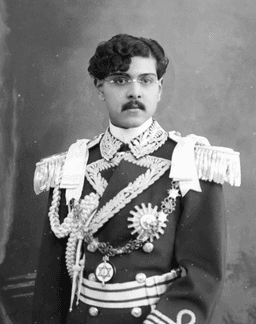
Tribhuvan of Nepal
Emperor · Modern
53.4Total
Basic Information
Born
1688
1906
Died
1743
1955
Era
Modern
Modern
Nationality
India
Nepal
Occupation
Emperor
Emperor
Civilization
Indian
Indian
Score Comparison
Military (10%)
55.0
48.7
Political (20%)
72.0
45.0
Influence (20%)
62.0
54.9
Legacy (20%)
52.0
49.2
Leadership (15%)
79.8
74.6
Strategy (15%)
35.0
45.8
TOTAL
60.3
53.4
Sawai Jai Singh II — Complete Timeline
1727 AD
Founded the City of JaipurCultural◆ Major
Sawai Jai Singh II founded the planned city of Jaipur, designed by architect Vidyadhar Bhattacharya. The city was built according to Vastu Shastra and became a major center of trade and culture.
City PlanningArchitectureJaipur
Impact: regionalconstructive
1728 AD
Built the Jantar Mantar ObservatoriesInvention◆ Major
Jai Singh II constructed five astronomical observatories called Jantar Mantar in Delhi, Jaipur, Ujjain, Mathura, and Varanasi. These instruments were used to measure time, track celestial bodies, and update astronomical tables.
AstronomyScienceObservatory
Impact: globalconstructive
1730 AD
Battle of Jai Singh's CampaignsWar
Jai Singh II led campaigns against the Marathas and Jats to protect his kingdom. He successfully defended Jaipur from Maratha raids but was forced to pay tribute to the Marathas later.
Maratha WarsDefenseJaipur
Impact: regional
1733 AD
Compiled the Zij-i Muhammad ShahiCultural◆ Major
Jai Singh II compiled a new set of astronomical tables, the Zij-i Muhammad Shahi, based on his observations. This work corrected errors in earlier Islamic and Hindu astronomical texts.
AstronomyScienceTables
Impact: globalconstructive
Tribhuvan of Nepal — Complete Timeline
1950 AD
Fled to India to organize opposition to Rana rulePolitical Action
King Tribhuvan, facing suppression by the ruling Rana dynasty, fled to the Indian embassy in Kathmandu and then to India. This act galvanized the Nepali Congress and Indian support, leading to the end of Rana oligarchy.
Rana regimeExileDemocracy movement
Impact: nationalconstructive
1951 AD
Signed the Delhi CompromisePolitical Action◆ Major
Tribhuvan, along with the Nepali Congress and Rana representatives, signed the Delhi Compromise in India. This agreement ended the Rana regime, restored the Shah monarchy, and established a transitional government leading to democratic elections.
DemocracyCompromiseRana regime
Impact: nationalconstructive
Returned to Nepal as sovereign monarchPolitical Action◆ Major
After the Delhi Compromise, King Tribhuvan returned to Nepal from India. He was restored as the sovereign monarch, ending 104 years of Rana hereditary rule and initiating a period of democratic governance.
Monarchy restoredDemocracyRana regime
Impact: nationalconstructive
This comparison has not been analyzed yet.
One-time AI generation (~1 minute). Scores and timeline are already available below.
Rankings
🥇
Sawai Jai Singh IILeader
Mil: 55.0Pol: 72.0Inf: 62.0
60.3
🥈
Tribhuvan of Nepal
Mil: 48.7Pol: 45.0Inf: 54.9
53.4
+6.9 behind
How This Comparison Works
Algorithm
Each figure is scored on 6 dimensions (0—100 scale) based on structured historical data: Military (10%), Political (20%), Influence (20%), Legacy (20%), Leadership (15%), Strategy (15%). The weighted total produces the final ranking.
Data Sources
Scores are computed from structured sub-indicators in the database. Scale factors adjust for era (Ancient ×0.85, Modern ×1.0) and civilization size (Eastern ×1.05, Other ×0.80) to account for differences in population and military scale.
Maximum 3 Figures
Comparisons are limited to 2—3 figures to ensure readability and statistical meaningfulness.
Error Margins
±5 points per dimension — Sub-scores are derived from historical records with inherent uncertainty. Two figures within 5 points on a dimension should be considered roughly equivalent in that area.
Total Score Accuracy
±3 points overall — The weighted combination of 6 dimensions produces a total score with approximately ±3 points of uncertainty. Differences of less than 3 points are not statistically significant— the figures are effectively tied.
Known Limitations
- Historical records are incomplete and uneven across civilizations
- Figures from oral-tradition societies may be underrepresented
- Occupation labels can misclassify multi-role figures
- Scores measure capability and impact, not moral character
- Quantitative scoring is a comparison tool, not absolute truth
Capability Radar
Military (10%) — Battles & Warfare
Battles
30
29
Win Rate
35
31
Expansion
25
34
Political (20%) — Governance & Reform
Reform
75
70
Diplomacy
70
65
Economy
65
30
Influence (20%) — Cultural & Global Reach
Cultural
65
30
Global
45
30
Legacy (20%) — Historical Impact
Historical
70
55
Longevity
60
40
Leadership (15%) — Power & Stability
Tenure
70
49
Stability
60
40
Strategy (15%) — Tactics & Innovation
Strategy
45
36
Tactics
40
40
Reform
30
45
Similar Comparisons
Comments & Discussion
No comments yet. Be the first to share your thoughts!