Loading...
Idris Alooma vs Tribhuvan of Nepal
Idris Alooma leads by 11.2 pts · 2 figures compared
…

Idris Alooma
Emperor · Modern
64.6Total
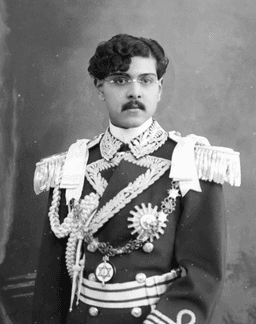
Tribhuvan of Nepal
Emperor · Modern
53.4Total
Basic Information
Born
1542
1906
Died
1603
1955
Era
Modern
Modern
Nationality
Kanem-Bornu
Nepal
Occupation
Emperor
Emperor
Civilization
Other
Indian
Score Comparison
Military (10%)
65.0
48.7
Political (20%)
78.0
45.0
Influence (20%)
59.0
54.9
Legacy (20%)
52.0
49.2
Leadership (15%)
78.0
74.6
Strategy (15%)
69.1
45.8
TOTAL
64.6
53.4
Idris Alooma — Complete Timeline
1570 AD
Military Reforms with FirearmsReform◆ Major
Idris Alooma introduced firearms, including muskets and cannons, to the Kanem-Bornu army. He hired Turkish and North African mercenaries to train his troops, creating a professional standing army that gave Bornu a military advantage.
Military ReformFirearmsStanding Army
Impact: regionalconstructive
1571 AD
Pilgrimage to MeccaCultural
Idris Alooma made a pilgrimage to Mecca, traveling through Egypt and Arabia. He established diplomatic ties with the Ottoman Empire and secured support for his military reforms, including the supply of firearms.
PilgrimageMeccaOttoman Alliance
Impact: regionalconstructive
1575 AD
Conquest of the SaoWar
Idris Alooma led campaigns against the Sao people, who had long raided Bornu. He defeated them and incorporated their territory, securing the empire's southern borders and gaining control over trade routes.
ConquestSaoBorder Security
Impact: regional
1580 AD
Construction of Fortified CampsReform
Idris Alooma built fortified military camps (ribats) along Bornu's borders. These camps housed garrisons and served as bases for campaigns, improving defense against raids from the Tuareg and other groups.
FortificationsDefenseMilitary
Impact: regionalconstructive
1585 AD
Legal and Administrative ReformsReform◆ Major
Idris Alooma codified Islamic law and established a system of courts in Bornu. He appointed qadis (judges) and standardized legal procedures, strengthening the rule of law and centralizing authority.
Legal ReformIslamic LawCourts
Impact: regionalconstructive
Tribhuvan of Nepal — Complete Timeline
1950 AD
Fled to India to organize opposition to Rana rulePolitical Action
King Tribhuvan, facing suppression by the ruling Rana dynasty, fled to the Indian embassy in Kathmandu and then to India. This act galvanized the Nepali Congress and Indian support, leading to the end of Rana oligarchy.
Rana regimeExileDemocracy movement
Impact: nationalconstructive
1951 AD
Signed the Delhi CompromisePolitical Action◆ Major
Tribhuvan, along with the Nepali Congress and Rana representatives, signed the Delhi Compromise in India. This agreement ended the Rana regime, restored the Shah monarchy, and established a transitional government leading to democratic elections.
DemocracyCompromiseRana regime
Impact: nationalconstructive
Returned to Nepal as sovereign monarchPolitical Action◆ Major
After the Delhi Compromise, King Tribhuvan returned to Nepal from India. He was restored as the sovereign monarch, ending 104 years of Rana hereditary rule and initiating a period of democratic governance.
Monarchy restoredDemocracyRana regime
Impact: nationalconstructive
Expert Analysis
Origins
**Idris Alooma** (c. 1571–1603) was born into the ruling Sayfawa dynasty of the Kanem-Bornu Empire, centered around Lake Chad. His father was Mai Ali, and he likely received military and religious training in preparation for rule. The empire faced threats from the nomadic Sao and internal instability, shaping his later reforms.
**Tribhuvan of Nepal** (1906–1955) was born in Kathmandu as a figurehead monarch under the Rana regime. His father, King Prithvi Bir Bikram Shah, died when Tribhuvan was young, and he was raised in a palace under Rana control. His education was limited, and he experienced the suppression of his family's power.
Rise to Power
Idris Alooma ascended the throne around 1571 after a period of internal strife. He quickly consolidated power by reforming the military, introducing firearms obtained from the Ottoman Empire. By 1580, he had defeated the Sao, securing his reputation as a capable leader. His pilgrimage to Mecca in 1582 further enhanced his prestige and diplomatic ties.
Tribhuvan became king in 1911 at age five, with real power held by the Rana prime ministers. For decades, he was a symbolic ruler. In 1950, he fled to the Indian embassy and then to India, sparking a political crisis. In 1951, the Delhi Compromise restored his authority and ended the Rana oligarchy, making him the sovereign monarch.
Leadership & Governance
Idris Alooma governed with a mix of military force and administrative innovation. He built fortified camps (ribats) along borders, standardized Islamic courts, and codified law. His leadership score of 78.0 reflects his effectiveness in transforming Bornu into a centralized state. He used Turkish mercenaries to train his army, achieving a military score of 65.0.
Tribhuvan's leadership score of 74.6 comes from his symbolic role in ending the Rana regime. He did not directly govern; instead, he supported the Nepali Congress and negotiated the compromise. His political score of 45.0 indicates limited administrative impact, but his influence score of 54.9 shows his importance as a unifying figure.
Triumph & Tragedy
Idris Alooma's greatest success was his military modernization, which allowed Bornu to dominate the region. His legal reforms strengthened the empire's unity. However, his reliance on firearms and mercenaries created dependency on external sources, and after his death, the empire declined. He scored 52.0 in legacy, as his reforms did not endure.
Tribhuvan's triumph was ending 104 years of Rana rule and restoring the monarchy. His flight to India was a turning point that galvanized opposition. His tragedy was that his reign was short; he died in 1955, and his son Mahendra later reversed democratic gains by imposing direct rule. His legacy score of 49.2 reflects the mixed outcomes.
Character & Destiny
Idris Alooma was pragmatic and forward-thinking, embracing new technology and administration. His decision to undertake the Hajj showed diplomatic acumen. His character shaped a strong, centralized empire, but his focus on military might left little institutional resilience.
Tribhuvan was patient and strategic, enduring decades of subjugation before acting. His flight was a calculated risk that succeeded. However, he was not a strong ruler afterward, and his health declined. His destiny was to be a transitional figure between autocracy and democracy.
Legacy
Idris Alooma's legacy is as a reformer who briefly elevated Bornu to a regional power. His use of firearms influenced Sahelian warfare, but his empire fragmented after his death. He is remembered in West African history as a great mai.
Tribhuvan is revered in Nepal as the king who freed the country from Rana tyranny. His actions led to a brief democratic experiment, but the monarchy later reasserted control. His legacy is tied to the end of the oligarchy, not the establishment of lasting democracy.
Conclusion
Idris Alooma had a greater impact on his state's immediate power and regional dynamics, scoring a total of 64.6 compared to Tribhuvan's 53.4. His military and political reforms were transformative for Kanem-Bornu, even if temporary. Tribhuvan's role was crucial for Nepal's political evolution, but his influence was more symbolic than structural. Idris Alooma's achievements in military innovation and governance outweigh Tribhuvan's, making him the more consequential figure.
Rankings
🥇
Idris AloomaLeader
Mil: 65.0Pol: 78.0Inf: 59.0
64.6
🥈
Tribhuvan of Nepal
Mil: 48.7Pol: 45.0Inf: 54.9
53.4
+11.2 behind
How This Comparison Works
Algorithm
Each figure is scored on 6 dimensions (0—100 scale) based on structured historical data: Military (10%), Political (20%), Influence (20%), Legacy (20%), Leadership (15%), Strategy (15%). The weighted total produces the final ranking.
Data Sources
Scores are computed from structured sub-indicators in the database. Scale factors adjust for era (Ancient ×0.85, Modern ×1.0) and civilization size (Eastern ×1.05, Other ×0.80) to account for differences in population and military scale.
Maximum 3 Figures
Comparisons are limited to 2—3 figures to ensure readability and statistical meaningfulness.
Error Margins
±5 points per dimension — Sub-scores are derived from historical records with inherent uncertainty. Two figures within 5 points on a dimension should be considered roughly equivalent in that area.
Total Score Accuracy
±3 points overall — The weighted combination of 6 dimensions produces a total score with approximately ±3 points of uncertainty. Differences of less than 3 points are not statistically significant— the figures are effectively tied.
Known Limitations
- Historical records are incomplete and uneven across civilizations
- Figures from oral-tradition societies may be underrepresented
- Occupation labels can misclassify multi-role figures
- Scores measure capability and impact, not moral character
- Quantitative scoring is a comparison tool, not absolute truth
Capability Radar
Military (10%) — Battles & Warfare
Battles
65
29
Win Rate
70
31
Expansion
60
34
Political (20%) — Governance & Reform
Reform
80
70
Diplomacy
70
65
Economy
65
30
Influence (20%) — Cultural & Global Reach
Cultural
55
30
Global
40
30
Legacy (20%) — Historical Impact
Historical
60
55
Longevity
50
40
Leadership (15%) — Power & Stability
Tenure
75
49
Stability
70
40
Strategy (15%) — Tactics & Innovation
Strategy
70
36
Tactics
75
40
Reform
85
45
Similar Comparisons
Comments & Discussion
No comments yet. Be the first to share your thoughts!