Loading...
Seti I vs Xiao Xin of Shang
Seti I leads by 9.6 pts · 2 figures compared
…
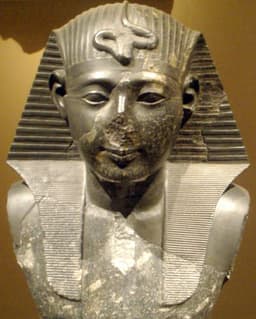
Seti I
Emperor · Ancient
58.3Total

Xiao Xin of Shang
Emperor · Ancient
48.7Total
Basic Information
Born
-1290
-1200
Died
-1279
-1190
Era
Ancient
Ancient
Nationality
Egypt
Shang China
Occupation
Emperor
Emperor
Civilization
Middle Eastern
Eastern
Score Comparison
Military (10%)
74.7
22.6
Political (20%)
62.7
68.0
Influence (20%)
56.7
54.9
Legacy (20%)
54.0
39.2
Leadership (15%)
53.2
44.5
Strategy (15%)
58.0
60.0
TOTAL
58.3
48.7
Seti I — Complete Timeline
1290 BC
Establishment of the 19th Dynasty's Power BasePolitical Action◆ Major
Seti I, son of Ramesses I, solidified the 19th Dynasty's rule by strengthening the military and administrative structures. He appointed his son Ramesses II as co-regent, ensuring a smooth succession and laying the foundation for Ramesses II's long reign.
DynastySuccessionRamesses II
Impact: nationalconstructive
1288 BC
Military Campaigns in Syria and LibyaWar◆ Major
Seti I led military campaigns into Syria to reassert Egyptian control over Canaan and against Libyan tribes in the west. He recaptured the city of Kadesh and defeated the Libyans, securing Egypt's borders and restoring its military reputation.
MilitarySyriaLibya
Impact: regional
1285 BC
Construction of the Temple of AbydosCultural◆ Major
Seti I built the magnificent Temple of Abydos, dedicated to Osiris. The temple features exquisite reliefs and the famous King List, which records the names of 76 pharaohs from Menes to Seti I, providing a crucial chronological record.
ArchitectureAbydosKing List
Impact: globalconstructive
1280 BC
Construction of the Great Hypostyle Hall at Karnak (Completion)Cultural◆ Major
Seti I completed the Great Hypostyle Hall at Karnak, begun by Horemheb. The hall's 134 columns are covered with reliefs depicting Seti I's military victories and religious ceremonies, making it a masterpiece of New Kingdom architecture.
ArchitectureKarnakHypostyle Hall
Impact: globalconstructive
Xiao Xin of Shang — Complete Timeline
1200 BC
Succeeded Pan Geng as kingPolitical Action
Xiao Xin succeeded his brother Pan Geng as king of Shang. His reign was brief and is poorly documented, with no major events recorded. He maintained the stability established by his predecessor.
SuccessionBrief Rule
Impact: national
Expert Analysis
Origins
Seti I was born around 1323 BCE, the son of Ramesses I, founder of the 19th Dynasty. His father served as a vizier under Horemheb before taking the throne. Seti grew up in a military and administrative elite, likely accompanying his father on campaigns. He married Tuya, and their son Ramesses II would become one of Egypt's most famous pharaohs. In contrast, Xiao Xin of Shang reigned around 1300 BCE in ancient China, succeeding his brother Pan Geng. He was a member of the Shang royal clan, but little is known about his early life. The Shang dynasty was a bronze-age civilization centered on the Yellow River, with a complex system of divination and ancestor worship. Xiao Xin's reign is barely recorded in historical texts, with only brief mentions in the Bamboo Annals and Sima Qian's Records of the Grand Historian.
Rise to Power
Seti I ascended the throne after his father's brief reign of about one to two years. He quickly moved to consolidate power by launching military campaigns to restore Egyptian influence in Canaan and Libya. In his first year, he led an expedition to recapture the city of Kadesh, though he did not hold it permanently. He also campaigned against the Shasu Bedouin in the Sinai. His rise was marked by a focus on building projects and military strength, securing the dynasty's legitimacy. Xiao Xin, however, rose to power simply by being the brother of the previous king. Pan Geng had moved the Shang capital to Yin (modern Anyang), stabilizing the dynasty. Xiao Xin inherited the throne but did not undertake any significant military or political initiatives. His reign is described as uneventful, and he was succeeded by his brother Xiao Yi.
Leadership & Governance
Seti I governed as a traditional pharaoh, emphasizing military strength and monumental construction. He completed the Great Hypostyle Hall at Karnak, begun by Horemheb, covering its 134 columns with reliefs depicting his victories. He also built the Temple of Abydos, a masterpiece of New Kingdom architecture, featuring the Abydos King List. His administrative reforms included appointing his son Ramesses as co-regent to ensure a smooth succession. Seti's leadership scored 53.2 in leadership, reflecting his effective but not revolutionary governance. Xiao Xin, scoring 44.5 in leadership, maintained the status quo. He likely continued the policies of Pan Geng, but without any recorded innovations. The Shang dynasty's governance relied on a king who served as the high priest, performing divinations on oracle bones. Xiao Xin's brief rule left no mark on this system.
Triumph & Tragedy
Seti I's greatest triumph was the construction of the Temple of Abydos, which remains one of the best-preserved temples in Egypt. His military campaigns, though not permanently expanding the empire, reasserted Egyptian control over key trade routes. His tragedy was that his son Ramesses II overshadowed him, reducing his historical visibility. Additionally, his failure to permanently hold Kadesh foreshadowed the later conflict with the Hittites. Xiao Xin's triumph is simply that he maintained stability after Pan Geng's relocation. His tragedy is his obscurity: he has no known achievements, and his reign is a blank spot in history. He scored 22.6 in military, reflecting no campaigns, and 39.2 in legacy, indicating minimal impact.
Character & Destiny
Seti I is depicted in reliefs as a confident, martial king. His building projects show a concern for legacy and piety. His decision to appoint Ramesses as co-regent demonstrates strategic thinking. Historical assessments by modern scholars like Kenneth Kitchen note Seti's effective consolidation of the 19th Dynasty. Xiao Xin, by contrast, is a shadowy figure. The lack of records suggests a passive or brief rule. His destiny was to be a footnote, overshadowed by his brother Pan Geng and his nephew Wu Ding, who would become a major Shang king. Xiao Xin's character cannot be assessed due to lack of evidence, but his lack of action likely contributed to his anonymity.
Legacy
Seti I's legacy is tangible in stone. The Temple of Abydos and the Hypostyle Hall at Karnak are major tourist sites today. His king list is a key historical document. He scored 54.0 in legacy, reflecting his enduring monuments. Xiao Xin's legacy is minimal. He appears only in king lists and brief chronicles. The Shang dynasty's legacy is immense—early Chinese writing and bronze casting—but Xiao Xin contributed nothing to it. His legacy score of 39.2 is among the lowest for Shang kings.
Conclusion
Seti I had a significantly greater impact than Xiao Xin. With a total score of 58.3 versus 48.7, Seti excelled in military (74.7 vs 22.6) and legacy (54.0 vs 39.2). While Xiao Xin's political score (68.0) is slightly higher than Seti's (62.7), this reflects the stability of the Shang system rather than his own actions. Seti's monuments and campaigns shaped Egypt's history, while Xiao Xin's reign was a blank. Therefore, Seti I is the more consequential figure.
Rankings
🥇
Seti ILeader
Mil: 74.7Pol: 62.7Inf: 56.7
58.3
🥈
Xiao Xin of Shang
Mil: 22.6Pol: 68.0Inf: 54.9
48.7
+9.6 behind
How This Comparison Works
Algorithm
Each figure is scored on 6 dimensions (0—100 scale) based on structured historical data: Military (10%), Political (20%), Influence (20%), Legacy (20%), Leadership (15%), Strategy (15%). The weighted total produces the final ranking.
Data Sources
Scores are computed from structured sub-indicators in the database. Scale factors adjust for era (Ancient ×0.85, Modern ×1.0) and civilization size (Eastern ×1.05, Other ×0.80) to account for differences in population and military scale.
Maximum 3 Figures
Comparisons are limited to 2—3 figures to ensure readability and statistical meaningfulness.
Error Margins
±5 points per dimension — Sub-scores are derived from historical records with inherent uncertainty. Two figures within 5 points on a dimension should be considered roughly equivalent in that area.
Total Score Accuracy
±3 points overall — The weighted combination of 6 dimensions produces a total score with approximately ±3 points of uncertainty. Differences of less than 3 points are not statistically significant— the figures are effectively tied.
Known Limitations
- Historical records are incomplete and uneven across civilizations
- Figures from oral-tradition societies may be underrepresented
- Occupation labels can misclassify multi-role figures
- Scores measure capability and impact, not moral character
- Quantitative scoring is a comparison tool, not absolute truth
Capability Radar
Military (10%) — Battles & Warfare
Battles
70
31
Win Rate
75
36
Expansion
65
39
Political (20%) — Governance & Reform
Reform
60
0
Diplomacy
65
0
Economy
60
0
Influence (20%) — Cultural & Global Reach
Cultural
70
0
Global
55
0
Legacy (20%) — Historical Impact
Historical
65
5
Longevity
60
0
Leadership (15%) — Power & Stability
Tenure
55
10
Stability
65
10
Strategy (15%) — Tactics & Innovation
Strategy
70
42
Tactics
65
45
Reform
60
50
Similar Comparisons
Comments & Discussion
No comments yet. Be the first to share your thoughts!