Loading...
Shen Shixing vs Wei Zheng
Wei Zheng leads by 16.2 pts · 2 figures compared
…
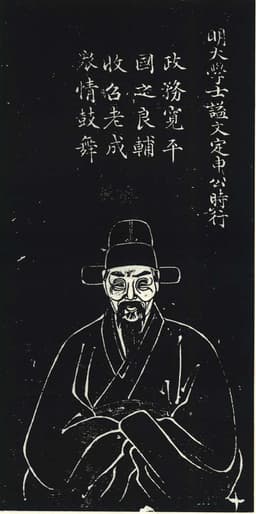
Shen Shixing
Politician · Medieval
51.1Total

Wei Zheng
Politician · Medieval
67.3Total
Basic Information
Born
1535
580
Died
1614
643
Era
Medieval
Medieval
Nationality
China
China
Occupation
Politician
Politician
Civilization
Eastern
Eastern
Score Comparison
Military (10%)
17.7
50.0
Political (20%)
68.0
70.3
Influence (20%)
51.8
72.0
Legacy (20%)
45.0
72.0
Leadership (15%)
72.0
80.0
Strategy (15%)
41.0
38.0
TOTAL
51.1
67.3
Shen Shixing — Complete Timeline
1583 AD
Appointed Grand SecretaryPolitical Action◆ Major
Shen Shixing was appointed to the Grand Secretariat under the Wanli Emperor. He was known for his attempts to mediate between the emperor and the officials, especially during the succession dispute.
Ming DynastyGrand SecretariatWanli Reign
Impact: nationalconstructive
1586 AD
Mediated in the succession disputePolitical Action◆ Major
Shen Shixing tried to mediate between the Wanli Emperor and officials over the choice of heir. The emperor wanted to name his younger son, while officials insisted on the eldest, leading to a prolonged deadlock.
Ming DynastySuccession DisputeWanli Reign
Impact: national
1591 AD
Retired from officePolitical Action
Shen Shixing retired from the Grand Secretariat after failing to resolve the succession dispute. His retirement marked the end of his efforts to maintain harmony between the emperor and the bureaucracy.
Ming DynastyRetirementSuccession Dispute
Impact: national
Wei Zheng — Complete Timeline
627 AD
Appointment as Chief AdvisorPolitical Action◆ Major
Emperor Taizong appointed Wei Zheng as his chief advisor. Wei Zheng became known for his frank remonstrations, often criticizing imperial policies. His advice influenced Taizong's governance, including tax reduction and legal reforms, contributing to the Zhenguan era's prosperity.
Tang dynastyGovernanceAdvisor
Impact: nationalconstructive
630 AD
Remonstration on ConscriptionPolitical Action
Wei Zheng opposed Taizong's plan to conscript men under 18 for military service, arguing it would harm agriculture. Taizong initially rejected the advice but later relented. This incident exemplified Wei Zheng's role as a principled remonstrator.
Tang dynastyGovernanceRemonstration
Impact: nationalconstructive
636 AD
Compilation of the Book of SuiCultural◆ Major
Wei Zheng led the compilation of the Book of Sui, the official history of the Sui dynasty. The work covered Sui political, economic, and military affairs. It became one of the Twenty-Four Histories and a key source for Sui history.
Tang dynastyHistoriographyBook compilation
Impact: nationalconstructive
Expert Analysis
Origins
Shen Shixing (1535–1614) was born into a scholar-official family in Suzhou, Jiangsu. He passed the imperial examinations in 1562, earning the jinshi degree, and entered the Hanlin Academy. His early career was marked by administrative roles in the Ministry of Rites and the Grand Secretariat, where he developed a reputation for cautious mediation. Wei Zheng (580–643) was born in Julu, Hebei, during the Sui dynasty. Orphaned early, he became a Taoist priest and later served as a secretary under the rebel leader Li Mi. After Li Mi's defeat, Wei Zheng served under the Tang prince Li Jiancheng, and after the Xuanwu Gate Incident in 626, he was appointed by Emperor Taizong as his chief advisor. Wei Zheng's background was more turbulent, shaped by the fall of Sui and the rise of Tang.
Rise to Power
Shen Shixing rose through the Ming bureaucracy steadily. His appointment as Grand Secretary in 1578 under the Wanli Emperor placed him at the center of power. His key challenge was the succession dispute: the Wanli Emperor favored his younger son Zhu Changxun, while officials supported the eldest son Zhu Changluo. Shen attempted to mediate, but his efforts failed to reconcile the emperor and the bureaucracy, leading to his retirement in 1591. Wei Zheng's rise was more dramatic. After the Xuanwu Gate Incident, where Taizong killed his brothers, Wei Zheng was summoned. Taizong asked why he had fomented discord; Wei Zheng replied bluntly that if Li Jiancheng had listened to him, he would not have lost. Impressed, Taizong appointed him as his chief advisor in 627. Wei Zheng's frank remonstrations quickly became his hallmark, earning him the emperor's trust.
Leadership & Governance
Shen Shixing's leadership style was conciliatory and procedural. He sought to maintain harmony between the emperor and the officials, but his lack of decisive action often left both sides dissatisfied. For instance, during the succession dispute, he proposed a compromise of naming the eldest son but delaying formal recognition, which satisfied no one. His governance score of 72.0 reflects his ability to manage bureaucracy but his failure in crisis management. Wei Zheng's leadership was direct and principled. He famously opposed Taizong's plan to conscript men under 18 for military service, arguing it would harm agriculture. Taizong initially rejected the advice, but Wei Zheng persisted, and the emperor eventually relented. Wei Zheng's political score of 70.3 and leadership score of 80.0 highlight his effectiveness in shaping policy through remonstration. However, his strategy score of 38.0 indicates a focus on moral persuasion rather than tactical maneuvering.
Triumph & Tragedy
Shen Shixing's greatest success was his role in maintaining bureaucratic stability during the early years of the Wanli reign. He oversaw the compilation of the Ming Veritable Records and managed daily administration. His greatest failure was the succession dispute, which he could not resolve. His retirement marked the beginning of the Wanli Emperor's long withdrawal from court, leading to decades of administrative paralysis. Wei Zheng's triumphs include his advisory role in the Zhenguan era, a period of prosperity and good governance. He also led the compilation of the Book of Sui, a key historical work. His tragedy was his death in 643; after his death, Taizong ordered the destruction of Wei Zheng's tombstone due to allegations of factionalism, though it was later restored. Wei Zheng's legacy score of 72.0 reflects his enduring reputation as a model remonstrator.
Character & Destiny
Shen Shixing was cautious and risk-averse. His personality score of 72.0 in leadership but low in strategy (41.0) suggests he was a capable administrator but not a decisive leader. His destiny was to be a mediator in an era of increasing conflict between emperor and officials, a role that ultimately proved impossible. Wei Zheng was blunt and principled, unafraid to confront the emperor. His character earned him both respect and enmity. His destiny was to define the role of the remonstrating official in Chinese history, but his posthumous disgrace shows the fragility of such influence.
Legacy
Shen Shixing is remembered as a competent but ineffective Grand Secretary. His attempts to mediate are studied as examples of the limits of bureaucratic power under Ming absolutism. His legacy score of 45.0 reflects his minor impact. Wei Zheng's legacy is far greater. His model of remonstration influenced generations of officials. The Book of Sui remains a valuable historical source. His influence score of 72.0 and legacy score of 72.0 underscore his lasting impact on Chinese political culture.
Conclusion
Wei Zheng had greater impact. His total score of 67.3 outperforms Shen Shixing's 51.1 by 16.2 points. Wei Zheng's principles shaped Tang governance and set a standard for official conduct, while Shen Shixing's mediations failed to prevent the Wanli Emperor's withdrawal. Wei Zheng's legacy as the archetypal remonstrator endures, whereas Shen Shixing is a footnote in Ming history. The data supports Wei Zheng's clear superiority in influence and leadership.
Rankings
🥇
Wei ZhengLeader
Mil: 50.0Pol: 70.3Inf: 72.0
67.3
🥈
Shen Shixing
Mil: 17.7Pol: 68.0Inf: 51.8
51.1
+16.2 behind
How This Comparison Works
Algorithm
Each figure is scored on 6 dimensions (0—100 scale) based on structured historical data: Military (10%), Political (20%), Influence (20%), Legacy (20%), Leadership (15%), Strategy (15%). The weighted total produces the final ranking.
Data Sources
Scores are computed from structured sub-indicators in the database. Scale factors adjust for era (Ancient ×0.85, Modern ×1.0) and civilization size (Eastern ×1.05, Other ×0.80) to account for differences in population and military scale.
Maximum 3 Figures
Comparisons are limited to 2—3 figures to ensure readability and statistical meaningfulness.
Error Margins
±5 points per dimension — Sub-scores are derived from historical records with inherent uncertainty. Two figures within 5 points on a dimension should be considered roughly equivalent in that area.
Total Score Accuracy
±3 points overall — The weighted combination of 6 dimensions produces a total score with approximately ±3 points of uncertainty. Differences of less than 3 points are not statistically significant— the figures are effectively tied.
Known Limitations
- Historical records are incomplete and uneven across civilizations
- Figures from oral-tradition societies may be underrepresented
- Occupation labels can misclassify multi-role figures
- Scores measure capability and impact, not moral character
- Quantitative scoring is a comparison tool, not absolute truth
Capability Radar
Military (10%) — Battles & Warfare
Battles
36
41
Win Rate
40
42
Expansion
43
44
Political (20%) — Governance & Reform
Reform
40
85
Diplomacy
65
75
Economy
45
80
Influence (20%) — Cultural & Global Reach
Cultural
30
75
Global
20
60
Legacy (20%) — Historical Impact
Historical
40
80
Longevity
30
80
Leadership (15%) — Power & Stability
Tenure
60
70
Stability
50
85
Strategy (15%) — Tactics & Innovation
Strategy
46
48
Tactics
49
52
Reform
52
55
Similar Comparisons
Comments & Discussion
No comments yet. Be the first to share your thoughts!