Loading...
Shukri al-Quwatli vs Wilfrid Laurier
Wilfrid Laurier leads by 6.5 pts · 2 figures compared
…
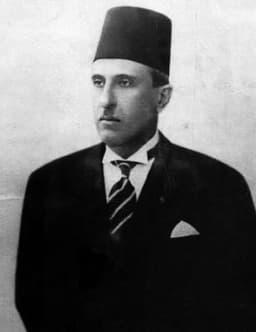
Shukri al-Quwatli
Politician · Modern
52.0Total

Wilfrid Laurier
Politician · Modern
58.5Total
Basic Information
Born
1891
1841
Died
1967
1919
Era
Modern
Modern
Nationality
Syria
Canada
Occupation
Politician
Politician
Civilization
Middle Eastern
Western
Score Comparison
Military (10%)
48.6
50.0
Political (20%)
61.3
72.0
Influence (20%)
51.0
55.0
Legacy (20%)
45.0
52.0
Leadership (15%)
65.0
78.0
Strategy (15%)
42.2
42.9
TOTAL
52.0
58.5
Shukri al-Quwatli — Complete Timeline
1943 AD
Elected first president of independent SyriaPolitical Action
Shukri al-Quwatli was elected as the first president of Syria after the country gained independence from Vichy France. He led the nationalist movement and worked to consolidate Syrian sovereignty, serving from 1943 to 1949.
IndependenceNationalismPresidency
Impact: nationalconstructive
1949 AD
Overthrown in the 1949 Syrian coup d'étatPolitical Action◆ Major
President al-Quwatli was overthrown by a military coup led by Husni al-Zaim on March 30, 1949. The coup was the first in Syria's modern history and ended civilian rule, leading to a period of military interventions in politics.
CoupMilitaryOverthrow
Impact: nationaldestructive
1955 AD
Returned to presidency after Adib Shishakli's fallPolitical Action◆ Major
Al-Quwatli was re-elected as president of Syria in 1955 after the fall of the military regime of Adib Shishakli. He returned to power during a period of political instability and growing influence of the Ba'ath Party.
Return to PowerPresidencyPolitical Instability
Impact: national
1958 AD
Signed the agreement forming the United Arab RepublicPolitical Action◆ Major
President al-Quwatli signed the agreement with Egyptian President Gamal Abdel Nasser to form the United Arab Republic, a union of Syria and Egypt. The union was intended to strengthen Arab unity but lasted only until 1961.
Arab UnityUnionNasser
Impact: regionalconstructive
1961 AD
Resigned after Syrian secession from the UARPolitical Action
After a military coup in Syria ended the United Arab Republic, al-Quwatli resigned from the presidency. He went into exile and died in 1967, having failed to restore his political influence.
ResignationExileUAR Collapse
Impact: nationaltragic
Wilfrid Laurier — Complete Timeline
1896 AD
Became first francophone Prime Minister of CanadaPolitical Action
Laurier became the seventh Prime Minister of Canada and the first of French-Canadian heritage. His victory marked a shift in Canadian politics, as he led the Liberal Party to power and promoted national unity between English and French Canadians.
Government FormationFrench CanadaUnity
Impact: nationalconstructive
1905 AD
Oversaw creation of Alberta and SaskatchewanPolitical Action◆ Major
Laurier's government passed the Autonomy Acts, creating the provinces of Alberta and Saskatchewan from the Northwest Territories. This expanded the Canadian federation and promoted western settlement.
Provincial CreationExpansionWestern Canada
Impact: nationalconstructive
1910 AD
Established the Royal Canadian NavyPolitical Action◆ Major
Laurier's government passed the Naval Service Act, creating the Royal Canadian Navy. The decision was controversial, with nationalists opposing it as too imperialist and imperialists arguing it was insufficient to support Britain.
MilitaryNavyDefense
Impact: nationalconstructive
1911 AD
Lost 1911 election over reciprocity with the United StatesPolitical Action◆ Major
Laurier's government was defeated in the federal election after proposing a reciprocity (free trade) agreement with the United States. The issue divided the country, with Conservatives and some Liberals opposing closer economic ties with the U.S.
ElectionTradeReciprocity
Impact: national
Expert Analysis
Origins
Shukri al-Quwatli was born in 1891 in Damascus, then part of the Ottoman Empire. He came from a middle-class Sunni Muslim family and studied at the Ottoman Military Academy, but soon became involved in Arab nationalist movements. His early career included working with the secret society al-Fatat, which sought independence from Ottoman rule. After World War I, he was active in the Syrian National Congress and opposed French mandates.
Wilfrid Laurier was born in 1841 in Saint-Lin, Quebec, Canada, into a French-Canadian family. He studied law at McGill University and became a lawyer. His early political involvement was with the Parti rouge, advocating for liberal reforms. He entered federal politics in 1874 as a Member of Parliament, rising through the Liberal Party ranks.
Rise to Power
Al-Quwatli's rise came through his leadership in the nationalist movement against French rule. He was a key figure in the Syrian independence movement, and after France left in 1946, he was elected as the first president of independent Syria on April 17, 1946. His presidency was marked by efforts to consolidate power and navigate Cold War pressures.
Laurier became Prime Minister in 1896, leading the Liberal Party to victory over the Conservatives. He was the first French-Canadian to hold the office, a turning point in Canadian politics. His rise was aided by his strong oratory and ability to bridge French and English Canada. He held power for 15 years, winning four consecutive elections.
Leadership & Governance
Al-Quwatli governed Syria as a civilian leader in a turbulent region. He pursued a policy of neutrality and pan-Arabism, but his leadership was weak in the face of military pressures. He scored 65.0 in leadership, but his political score of 61.3 reflects his inability to stabilize Syria. He emphasized independence but failed to build strong institutions.
Laurier scored 72.0 in politics and 78.0 in leadership. He governed with a focus on national unity, promoting compromise between French and English Canadians. His policies included expanding the railway, creating the provinces of Alberta and Saskatchewan in 1905, and establishing the Royal Canadian Navy in 1910. He handled the Boer War crisis by sending volunteers, avoiding a full commitment that would anger Quebec.
Triumph & Tragedy
Al-Quwatli's greatest triumph was leading Syria to independence and becoming its first president. However, his tragedy was being overthrown in the 1949 coup d'état by Husni al-Zaim, the first military coup in Syria's modern history. He returned to power in 1955, but his decision to form the United Arab Republic with Egypt in 1958 backfired when Syria seceded in 1961, forcing his resignation. He died in exile in 1967.
Laurier's triumphs include the creation of Alberta and Saskatchewan, expanding Canada's territory, and establishing the Royal Canadian Navy. His tragedy was losing the 1911 election over his proposal for reciprocity with the United States, which divided the country. He also struggled with conscription during World War I, splitting the Liberal Party. He died in 1919, still leading the opposition.
Character & Destiny
Al-Quwatli was a nationalist idealist but lacked the military backing to survive in a region dominated by coups. His character was cautious and diplomatic, but his destiny was to be overthrown by stronger forces. Historians view him as a transitional figure who failed to build a stable state.
Laurier was a pragmatic compromiser, known for his optimism and eloquence. His character shaped his destiny as a unifier, but his inability to resolve the conscription crisis tarnished his legacy. He is remembered as a great conciliator.
Legacy
Al-Quwatli's legacy is mixed. He is remembered as the first president of independent Syria, but his failures led to decades of instability. His score of 45.0 in legacy reflects his limited impact. The United Arab Republic experiment showed his commitment to pan-Arabism, but it ended in failure.
Laurier's legacy is stronger, with a score of 52.0. He is celebrated as a nation-builder who expanded Canada's territory and fostered national unity. The Royal Canadian Navy and the provinces he created endure. His vision of a bilingual Canada influenced future generations.
Conclusion
Wilfrid Laurier had greater impact than Shukri al-Quwatli. With a total score of 58.5 to 52.0, Laurier's leadership and political skills built lasting institutions in Canada. Al-Quwatli's presidency was marred by instability and ended in failure. While both faced challenges, Laurier's legacy of national unity and territorial expansion outweighs al-Quwatli's brief independence.
Rankings
🥇
Wilfrid LaurierLeader
Mil: 50.0Pol: 72.0Inf: 55.0
58.5
🥈
Shukri al-Quwatli
Mil: 48.6Pol: 61.3Inf: 51.0
52.0
+6.5 behind
How This Comparison Works
Algorithm
Each figure is scored on 6 dimensions (0—100 scale) based on structured historical data: Military (10%), Political (20%), Influence (20%), Legacy (20%), Leadership (15%), Strategy (15%). The weighted total produces the final ranking.
Data Sources
Scores are computed from structured sub-indicators in the database. Scale factors adjust for era (Ancient ×0.85, Modern ×1.0) and civilization size (Eastern ×1.05, Other ×0.80) to account for differences in population and military scale.
Maximum 3 Figures
Comparisons are limited to 2—3 figures to ensure readability and statistical meaningfulness.
Error Margins
±5 points per dimension — Sub-scores are derived from historical records with inherent uncertainty. Two figures within 5 points on a dimension should be considered roughly equivalent in that area.
Total Score Accuracy
±3 points overall — The weighted combination of 6 dimensions produces a total score with approximately ±3 points of uncertainty. Differences of less than 3 points are not statistically significant— the figures are effectively tied.
Known Limitations
- Historical records are incomplete and uneven across civilizations
- Figures from oral-tradition societies may be underrepresented
- Occupation labels can misclassify multi-role figures
- Scores measure capability and impact, not moral character
- Quantitative scoring is a comparison tool, not absolute truth
Capability Radar
Military (10%) — Battles & Warfare
Battles
20
29
Win Rate
27
33
Expansion
27
32
Political (20%) — Governance & Reform
Reform
45
75
Diplomacy
55
80
Economy
30
70
Influence (20%) — Cultural & Global Reach
Cultural
25
65
Global
20
55
Legacy (20%) — Historical Impact
Historical
40
70
Longevity
30
60
Leadership (15%) — Power & Stability
Tenure
60
85
Stability
20
75
Strategy (15%) — Tactics & Innovation
Strategy
30
39
Tactics
36
42
Reform
36
43
Similar Comparisons
Comments & Discussion
No comments yet. Be the first to share your thoughts!