Loading...
This comparison has not been analyzed yet.
One-time AI generation (~1 minute). Scores and timeline are already available below.
Tai Wu of Shang vs Yu the Great
Yu the Great leads by 7.1 pts · 2 figures compared
…

Tai Wu of Shang
Emperor · Ancient
58.5Total
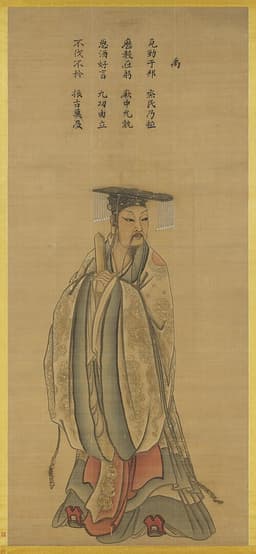
Yu the Great
Emperor · Ancient
65.6Total
Basic Information
Born
-1480
-2123
Died
-1400
-2055
Era
Ancient
Ancient
Nationality
Shang China
China
Occupation
Emperor
Emperor
Civilization
Eastern
Eastern
Score Comparison
Military (10%)
55.0
25.9
Political (20%)
68.0
65.0
Influence (20%)
54.1
65.0
Legacy (20%)
49.2
90.0
Leadership (15%)
80.0
72.0
Strategy (15%)
50.0
36.8
TOTAL
58.5
65.6
Tai Wu of Shang — Complete Timeline
1460 BC
Appointment of Wu Xian as MinisterPolitical Action◆ Major
Tai Wu appointed the virtuous minister Wu Xian, who helped restore moral governance. This appointment is credited with reviving the dynasty's fortunes after a period of decline, emphasizing meritocratic appointments.
Ministerial AppointmentMoral Revival
Impact: regionalconstructive
1450 BC
Moral Revival and Ritual RectificationReform◆ Major
Under Tai Wu's direction, the Shang court reinstituted proper ancestral rituals and moral codes. This reform reversed perceived decadence, restored divine favor, and led to a period of prosperity and stability lasting decades.
Moral ReformRitualProsperity
Impact: regionalconstructive
1400 BC
Long Reign of 75 YearsPolitical Action
Tai Wu reigned for approximately 75 years, the longest of any Shang king. This extended period of stable rule allowed for the consolidation of Shang institutions and the peaceful transmission of power to his successors.
Long ReignStability
Impact: regionalconstructive
Yu the Great — Complete Timeline
2100 BC
Flood Control of the Yellow RiverOther◆ Major
According to legend, Yu the Great devised a system of dredging and channeling to control the catastrophic flooding of the Yellow River. His success in flood control earned him the favor of the sage-king Shun, who later abdicated in his favor.
Flood ControlLegendXia Dynasty
Impact: regionalconstructive
2070 BC
Founding of the Xia DynastyPolitical Action
Yu the Great established the Xia dynasty, traditionally considered the first dynasty in Chinese history. He divided the realm into nine provinces and instituted a hereditary succession, breaking the previous system of abdication to the most capable.
Xia DynastyFoundingHereditary Rule
Impact: regionalconstructive
Casting of the Nine Tripod CauldronsCultural
Yu the Great ordered the casting of nine bronze tripod cauldrons, each symbolizing one of the nine provinces of China. These cauldrons became symbols of imperial authority and were passed down through successive dynasties.
SymbolismBronze AgeImperial Authority
Impact: regionalconstructive
This comparison has not been analyzed yet.
One-time AI generation (~1 minute). Scores and timeline are already available below.
Rankings
🥇
Yu the GreatLeader
Mil: 25.9Pol: 65.0Inf: 65.0
65.6
🥈
Tai Wu of Shang
Mil: 55.0Pol: 68.0Inf: 54.1
58.5
+7.1 behind
How This Comparison Works
Algorithm
Each figure is scored on 6 dimensions (0—100 scale) based on structured historical data: Military (10%), Political (20%), Influence (20%), Legacy (20%), Leadership (15%), Strategy (15%). The weighted total produces the final ranking.
Data Sources
Scores are computed from structured sub-indicators in the database. Scale factors adjust for era (Ancient ×0.85, Modern ×1.0) and civilization size (Eastern ×1.05, Other ×0.80) to account for differences in population and military scale.
Maximum 3 Figures
Comparisons are limited to 2—3 figures to ensure readability and statistical meaningfulness.
Error Margins
±5 points per dimension — Sub-scores are derived from historical records with inherent uncertainty. Two figures within 5 points on a dimension should be considered roughly equivalent in that area.
Total Score Accuracy
±3 points overall — The weighted combination of 6 dimensions produces a total score with approximately ±3 points of uncertainty. Differences of less than 3 points are not statistically significant— the figures are effectively tied.
Known Limitations
- Historical records are incomplete and uneven across civilizations
- Figures from oral-tradition societies may be underrepresented
- Occupation labels can misclassify multi-role figures
- Scores measure capability and impact, not moral character
- Quantitative scoring is a comparison tool, not absolute truth
Capability Radar
Military (10%) — Battles & Warfare
Battles
30
10
Win Rate
30
10
Expansion
20
10
Political (20%) — Governance & Reform
Reform
60
80
Diplomacy
50
70
Economy
50
70
Influence (20%) — Cultural & Global Reach
Cultural
55
85
Global
30
70
Legacy (20%) — Historical Impact
Historical
55
90
Longevity
60
90
Leadership (15%) — Power & Stability
Tenure
85
60
Stability
70
70
Strategy (15%) — Tactics & Innovation
Strategy
25
10
Tactics
25
10
Reform
20
10
Similar Comparisons
Comments & Discussion
No comments yet. Be the first to share your thoughts!