Loading...
Toomas Hendrik Ilves vs U Nu
Toomas Hendrik Ilves leads by 10.1 pts · 2 figures compared
…
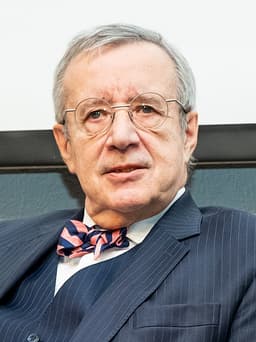
Toomas Hendrik Ilves
Politician · Modern
55.8Total

U Nu
Politician · Modern
45.7Total
Basic Information
Born
1953
1907
Died
—
1995
Era
Modern
Modern
Nationality
Estonia
Myanmar
Occupation
Politician
Politician
Civilization
Western
Eastern
Score Comparison
Military (10%)
49.0
14.2
Political (20%)
72.0
46.6
Influence (20%)
53.3
53.3
Legacy (20%)
42.5
43.3
Leadership (15%)
79.8
64.0
Strategy (15%)
41.7
35.4
TOTAL
55.8
45.7
Toomas Hendrik Ilves — Complete Timeline
1996 AD
Appointed Minister of Foreign Affairs of EstoniaPolitical Action◆ Major
Ilves was appointed Minister of Foreign Affairs, serving until 1998 and again from 1999 to 2002. He was instrumental in advancing Estonia's NATO and EU membership bids, advocating for integration with Western institutions.
Foreign AffairsNATOEU Integration
Impact: nationalconstructive
2006 AD
Elected President of EstoniaPolitical Action◆ Major
Ilves was elected as the third President of Estonia, serving from 2006 to 2016. His presidency focused on digital innovation, cybersecurity, and strengthening Estonia's role in the European Union and NATO.
PresidencyDigital EstoniaCybersecurity
Impact: nationalconstructive
2007 AD
Advocated for Estonia's E-Government InitiativesReform◆ Major
Ilves strongly promoted Estonia's e-government and digital identity systems, including e-voting and e-residency. These initiatives made Estonia a global leader in digital governance and cybersecurity.
E-GovernmentDigital IdentityInnovation
Impact: globalconstructive
Led Estonia's Response to the 2007 CyberattacksPolitical Action
Ilves led Estonia's response to a series of cyberattacks targeting government, media, and banking websites. The attacks were attributed to Russian actors, and Ilves advocated for stronger international cybersecurity cooperation, leading to the creation of NATO's Cooperative Cyber Defence Centre of Excellence.
CybersecurityCyberattackNATO
Impact: global
2011 AD
Re-elected President for Second TermPolitical Action
Ilves was re-elected for a second term as President of Estonia, continuing his focus on digital society and foreign policy. His second term saw Estonia chair the EU Council and host the NATO Cyber Defence Centre.
PresidencyRe-electionDigital Policy
Impact: nationalconstructive
U Nu — Complete Timeline
1948 AD
Became first Prime Minister of independent BurmaPolitical Action◆ Major
U Nu became the first Prime Minister of independent Burma (Myanmar) after the country gained independence from Britain. He led the Anti-Fascist People's Freedom League (AFPFL) government.
IndependencePrime MinisterBurma
Impact: nationalconstructive
1949 AD
Adopted a policy of neutrality in the Cold WarPolitical Action◆ Major
U Nu adopted a policy of neutrality and non-alignment, refusing to join either the US or Soviet blocs. He hosted the first Afro-Asian Conference in Rangoon in 1955, promoting decolonization and peace.
NeutralityCold WarNon-Alignment
Impact: regionalconstructive
1962 AD
Resigned after the 1962 coupPolitical Action◆ Major
U Nu was overthrown in a military coup led by General Ne Win. He was placed under house arrest and later exiled, ending his democratic experiment and ushering in decades of military rule.
CoupExileEnd of Democracy
Impact: nationaltragic
1988 AD
Returned to politics and formed a new partyPolitical Action
During the 8888 Uprising, U Nu returned to politics and formed the League for Democracy and Peace. He attempted to challenge the military regime but was soon placed under house arrest again.
Political ReturnUprisingOpposition
Impact: national
Expert Analysis
Origins
Toomas Hendrik Ilves was born on December 26, 1953, in Stockholm, Sweden, to Estonian refugee parents. His family fled the Soviet occupation of Estonia. He grew up in the United States, graduating from Columbia University with a degree in psychology and later earning a master's in political science from the University of Pennsylvania. His early career included work as a journalist and diplomat for Radio Free Europe, focusing on Eastern European affairs. This background gave him a strong Western orientation and expertise in information warfare.
U Nu was born on May 25, 1907, in Wakema, British Burma, into a middle-class family. He attended the University of Rangoon, where he studied English and became involved in student politics. Initially a teacher, he joined the nationalist movement led by Aung San, becoming a key figure in the Anti-Fascist People's Freedom League. His formative years were shaped by colonial rule and the struggle for independence.
Rise to Power
Ilves entered Estonian politics after the country regained independence in 1991. He served as Estonia's ambassador to the United States from 1993 to 1996, then as Minister of Foreign Affairs from 1996 to 1998 and again from 1999 to 2002. His diplomatic efforts were pivotal in securing Estonia's invitations to join NATO and the European Union. In 2006, he was elected President of Estonia, winning 174 out of 345 votes in the electoral college. His rise was marked by his expertise in foreign policy and digital governance.
U Nu rose to prominence as a close associate of Aung San, the founder of modern Burma. After Aung San's assassination in 1947, U Nu became the leader of the AFPFL and negotiated independence from Britain. On January 4, 1948, he became the first Prime Minister of independent Burma. His rise was rooted in his role as a nationalist leader and his ability to unify diverse political factions.
Leadership & Governance
Ilves led Estonia with a focus on digital innovation and cybersecurity. He championed e-government, e-voting, and e-residency, making Estonia a global leader in digital services. His response to the 2007 cyberattacks, which targeted government and banking websites, set a precedent for cyber defense. He scored 79.8 in leadership, reflecting his proactive governance. Ilves also strengthened Estonia's ties with NATO and the EU, advocating for a unified Western response to Russian aggression.
U Nu governed Burma under a policy of neutrality and non-alignment. He promoted Buddhist socialism and sought to balance relations with both the US and Soviet Union. He hosted the first Afro-Asian Conference in Rangoon in 1955. However, his leadership was marked by political instability, ethnic conflicts, and economic stagnation. His leadership score of 64.0 reflects his idealistic but ineffective governance. He failed to address internal divisions and military dissatisfaction.
Triumph & Tragedy
Ilves's greatest triumph was leading Estonia through the 2007 cyberattacks, which exposed vulnerabilities in digital infrastructure and led to the creation of NATO's Cooperative Cyber Defence Centre of Excellence in Tallinn. He also successfully promoted e-residency, which has attracted over 100,000 digital entrepreneurs globally. However, his presidency was limited by Estonia's parliamentary system, which constrained his domestic influence. Some critics argue his focus on digital issues overshadowed social and economic challenges.
U Nu's triumph was leading Burma to independence and establishing a democratic government. He was a respected figure in the Non-Aligned Movement. However, his tragedy was the 1962 military coup led by General Ne Win, which ended democracy and resulted in decades of military rule. U Nu was placed under house arrest and later exiled. His inability to control the military and ethnic tensions led to his downfall. His political score of 46.6 reflects his limited effectiveness.
Character & Destiny
Ilves was pragmatic, disciplined, and tech-savvy. His American upbringing gave him a global perspective, but some Estonians viewed him as aloof. His focus on cybersecurity and digital identity was prescient, positioning Estonia as a leader in the digital age. His character shaped his destiny as a symbol of modern, tech-driven governance.
U Nu was idealistic, deeply religious, and committed to Buddhist principles. He was a charismatic orator but lacked the ruthlessness to control the military. His naivety in dealing with General Ne Win led to his overthrow. His character, while noble, was ill-suited for the volatile politics of post-colonial Burma.
Legacy
Ilves's legacy is the transformation of Estonia into a digital society. His cybersecurity initiatives have influenced global policy. He scored 42.5 in legacy, reflecting his niche but significant impact. Estonia's e-government model is studied worldwide. Ilves is remembered as a visionary leader who used technology to enhance democracy.
U Nu's legacy is more ambiguous. He is remembered as the father of Burmese democracy, but his tenure was brief and flawed. His neutralist policy failed to protect Burma from internal strife. He scored 43.3 in legacy, slightly above Ilves, but his impact was largely symbolic. The 8888 Uprising and subsequent pro-democracy movements invoked his name, but he never regained power.
Conclusion
Toomas Hendrik Ilves had a greater impact on global governance than U Nu. Ilves's scores in leadership (79.8 vs 64.0) and strategy (41.7 vs 35.4) reflect his more effective governance. While U Nu's legacy as a founding father is significant, his failures led to decades of military oppression. Ilves's digital innovations have practical, enduring effects on cybersecurity and e-governance. In a data-driven comparison, Ilves's total score of 55.8 outweighs U Nu's 45.7. The cyberattacks of 2007 and Estonia's e-residency represent concrete achievements that continue to shape policy. U Nu's vision of neutrality and democracy, while noble, did not survive the realities of Cold War politics. Therefore, Toomas Hendrik Ilves stands as the more impactful leader.
Rankings
🥇
Toomas Hendrik IlvesLeader
Mil: 49.0Pol: 72.0Inf: 53.3
55.8
🥈
U Nu
Mil: 14.2Pol: 46.6Inf: 53.3
45.7
+10.1 behind
How This Comparison Works
Algorithm
Each figure is scored on 6 dimensions (0—100 scale) based on structured historical data: Military (10%), Political (20%), Influence (20%), Legacy (20%), Leadership (15%), Strategy (15%). The weighted total produces the final ranking.
Data Sources
Scores are computed from structured sub-indicators in the database. Scale factors adjust for era (Ancient ×0.85, Modern ×1.0) and civilization size (Eastern ×1.05, Other ×0.80) to account for differences in population and military scale.
Maximum 3 Figures
Comparisons are limited to 2—3 figures to ensure readability and statistical meaningfulness.
Error Margins
±5 points per dimension — Sub-scores are derived from historical records with inherent uncertainty. Two figures within 5 points on a dimension should be considered roughly equivalent in that area.
Total Score Accuracy
±3 points overall — The weighted combination of 6 dimensions produces a total score with approximately ±3 points of uncertainty. Differences of less than 3 points are not statistically significant— the figures are effectively tied.
Known Limitations
- Historical records are incomplete and uneven across civilizations
- Figures from oral-tradition societies may be underrepresented
- Occupation labels can misclassify multi-role figures
- Scores measure capability and impact, not moral character
- Quantitative scoring is a comparison tool, not absolute truth
Capability Radar
Military (10%) — Battles & Warfare
Battles
32
15
Win Rate
32
16
Expansion
33
20
Political (20%) — Governance & Reform
Reform
60
40
Diplomacy
70
45
Economy
55
30
Influence (20%) — Cultural & Global Reach
Cultural
30
30
Global
20
30
Legacy (20%) — Historical Impact
Historical
25
35
Longevity
20
25
Leadership (15%) — Power & Stability
Tenure
65
55
Stability
65
20
Strategy (15%) — Tactics & Innovation
Strategy
37
24
Tactics
39
28
Reform
45
27
Similar Comparisons
Comments & Discussion
No comments yet. Be the first to share your thoughts!