Loading...
This comparison has not been analyzed yet.
One-time AI generation (~1 minute). Scores and timeline are already available below.
Toshiki Kaifu vs Trygve Lie
Trygve Lie leads by 9.3 pts · 2 figures compared
…

Toshiki Kaifu
Politician · Modern
49.4Total
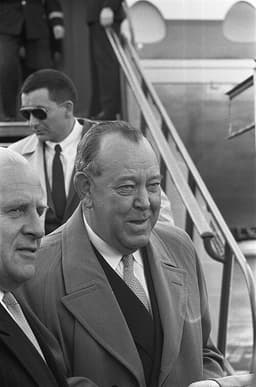
Trygve Lie
Politician · Modern
58.7Total
Basic Information
Born
1931
1896
Died
—
1968
Era
Modern
Modern
Nationality
Japan
Norway
Occupation
Politician
Politician
Civilization
Eastern
Western
Score Comparison
Military (10%)
16.9
49.2
Political (20%)
68.0
68.0
Influence (20%)
53.3
61.0
Legacy (20%)
41.7
52.0
Leadership (15%)
65.0
72.0
Strategy (15%)
40.1
45.3
TOTAL
49.4
58.7
Toshiki Kaifu — Complete Timeline
1990 AD
Failed UN Peace Cooperation BillPolitical Action◆ Major
Kaifu's government proposed the United Nations Peace Cooperation Bill to allow SDF personnel to participate in UN peacekeeping operations. The bill was withdrawn after fierce opposition from the Socialist Party and public protests, marking a major political defeat.
PeacekeepingLegislationPolitical Failure
Impact: national
1991 AD
Gulf War Minesweeper DispatchWar◆ Major
As Prime Minister, Kaifu authorized the dispatch of Japanese Maritime Self-Defense Force minesweepers to the Persian Gulf after the Gulf War ceasefire. This was Japan's first overseas military deployment since World War II, breaking a long-standing taboo and sparking domestic debate.
Gulf WarMilitary DispatchPostwar Japan
Impact: national
Resignation as LDP PresidentPolitical Action
Kaifu lost the Liberal Democratic Party presidential election to Kiichi Miyazawa. His resignation ended his tenure as Prime Minister after two years, triggered by internal party dissatisfaction with his leadership style and the failed peace bill.
LDP PoliticsResignationParty Leadership
Impact: national
Trygve Lie — Complete Timeline
1941 AD
Served as Norwegian Minister of Foreign AffairsPolitical Action
Lie served as Norwegian Minister of Foreign Affairs in the London-based exile government during World War II. He helped maintain Norwegian diplomatic relations and advocated for post-war international cooperation.
World War IINorwegian GovernmentDiplomacy
Impact: nationalconstructive
1946 AD
Elected first Secretary-General of the United NationsPolitical Action◆ Major
Trygve Lie became the first Secretary-General of the United Nations, serving from 1946 to 1952. His appointment was a compromise between the US and Soviet Union, and he helped establish the UN's administrative structure.
UN Secretary-GeneralFoundingPost-War
Impact: globalconstructive
Oversaw the creation of the UN Security CouncilPolitical Action◆ Major
Lie played a key role in establishing the UN Security Council as the primary body for maintaining international peace and security. He helped define its procedures and the veto power of permanent members.
UN Security CouncilInstitution BuildingPeace
Impact: globalconstructive
1948 AD
Mediated the Berlin BlockadePolitical Action◆ Major
Lie attempted to mediate the Berlin Blockade, but the Soviet Union rejected his proposals. The crisis was eventually resolved through the Berlin Airlift, highlighting the limitations of UN diplomacy during the Cold War.
Cold WarBerlinDiplomacy
Impact: global
1952 AD
Resigned as Secretary-GeneralPolitical Action◆ Major
Lie resigned as UN Secretary-General after facing Soviet opposition and criticism for his handling of the Korean War. His resignation paved the way for Dag Hammarskj
ResignationUN PoliticsCold War
Impact: global
This comparison has not been analyzed yet.
One-time AI generation (~1 minute). Scores and timeline are already available below.
Rankings
🥇
Trygve LieLeader
Mil: 49.2Pol: 68.0Inf: 61.0
58.7
🥈
Toshiki Kaifu
Mil: 16.9Pol: 68.0Inf: 53.3
49.4
+9.3 behind
How This Comparison Works
Algorithm
Each figure is scored on 6 dimensions (0—100 scale) based on structured historical data: Military (10%), Political (20%), Influence (20%), Legacy (20%), Leadership (15%), Strategy (15%). The weighted total produces the final ranking.
Data Sources
Scores are computed from structured sub-indicators in the database. Scale factors adjust for era (Ancient ×0.85, Modern ×1.0) and civilization size (Eastern ×1.05, Other ×0.80) to account for differences in population and military scale.
Maximum 3 Figures
Comparisons are limited to 2—3 figures to ensure readability and statistical meaningfulness.
Error Margins
±5 points per dimension — Sub-scores are derived from historical records with inherent uncertainty. Two figures within 5 points on a dimension should be considered roughly equivalent in that area.
Total Score Accuracy
±3 points overall — The weighted combination of 6 dimensions produces a total score with approximately ±3 points of uncertainty. Differences of less than 3 points are not statistically significant— the figures are effectively tied.
Known Limitations
- Historical records are incomplete and uneven across civilizations
- Figures from oral-tradition societies may be underrepresented
- Occupation labels can misclassify multi-role figures
- Scores measure capability and impact, not moral character
- Quantitative scoring is a comparison tool, not absolute truth
Capability Radar
Military (10%) — Battles & Warfare
Battles
12
32
Win Rate
17
30
Expansion
18
34
Political (20%) — Governance & Reform
Reform
40
55
Diplomacy
55
65
Economy
40
40
Influence (20%) — Cultural & Global Reach
Cultural
20
40
Global
30
65
Legacy (20%) — Historical Impact
Historical
25
60
Longevity
15
50
Leadership (15%) — Power & Stability
Tenure
30
60
Stability
50
50
Strategy (15%) — Tactics & Innovation
Strategy
23
37
Tactics
27
38
Reform
30
45
Similar Comparisons
Comments & Discussion
No comments yet. Be the first to share your thoughts!