Loading...
This comparison has not been analyzed yet.
One-time AI generation (~1 minute). Scores and timeline are already available below.
Trygve Lie vs Tui Atua Tupua Tamasese Efi
Trygve Lie leads by 3.7 pts · 2 figures compared
…
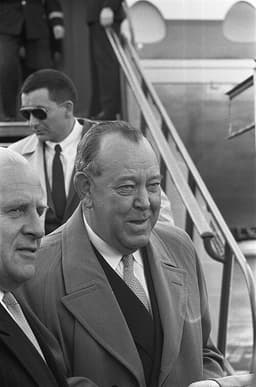
Trygve Lie
Politician · Modern
58.7Total

Tui Atua Tupua Tamasese Efi
Politician · Modern
55.0Total
Basic Information
Born
1896
1938
Died
1968
—
Era
Modern
Modern
Nationality
Norway
Samoa
Occupation
Politician
Politician
Civilization
Western
Other
Score Comparison
Military (10%)
49.2
50.0
Political (20%)
68.0
62.7
Influence (20%)
61.0
55.7
Legacy (20%)
52.0
45.8
Leadership (15%)
72.0
72.0
Strategy (15%)
45.3
44.4
TOTAL
58.7
55.0
Trygve Lie — Complete Timeline
1941 AD
Served as Norwegian Minister of Foreign AffairsPolitical Action
Lie served as Norwegian Minister of Foreign Affairs in the London-based exile government during World War II. He helped maintain Norwegian diplomatic relations and advocated for post-war international cooperation.
World War IINorwegian GovernmentDiplomacy
Impact: nationalconstructive
1946 AD
Elected first Secretary-General of the United NationsPolitical Action◆ Major
Trygve Lie became the first Secretary-General of the United Nations, serving from 1946 to 1952. His appointment was a compromise between the US and Soviet Union, and he helped establish the UN's administrative structure.
UN Secretary-GeneralFoundingPost-War
Impact: globalconstructive
Oversaw the creation of the UN Security CouncilPolitical Action◆ Major
Lie played a key role in establishing the UN Security Council as the primary body for maintaining international peace and security. He helped define its procedures and the veto power of permanent members.
UN Security CouncilInstitution BuildingPeace
Impact: globalconstructive
1948 AD
Mediated the Berlin BlockadePolitical Action◆ Major
Lie attempted to mediate the Berlin Blockade, but the Soviet Union rejected his proposals. The crisis was eventually resolved through the Berlin Airlift, highlighting the limitations of UN diplomacy during the Cold War.
Cold WarBerlinDiplomacy
Impact: global
1952 AD
Resigned as Secretary-GeneralPolitical Action◆ Major
Lie resigned as UN Secretary-General after facing Soviet opposition and criticism for his handling of the Korean War. His resignation paved the way for Dag Hammarskj
ResignationUN PoliticsCold War
Impact: global
Tui Atua Tupua Tamasese Efi — Complete Timeline
1976 AD
Served as Prime Minister of SamoaPolitical Action◆ Major
Tui Atua Tupua Tamasese Efi served as Prime Minister of Samoa from 1976 to 1982. He led the country during a period of political development and economic challenges, focusing on Samoan cultural values.
SamoaGovernmentLeadership
Impact: national
1980 AD
Advocated for the protection of Samoan customary land tenurePolitical Action
Throughout his political career, Tui Atua Tupua Tamasese Efi advocated for the preservation of the Samoan customary land tenure system (fa'amatai). He opposed full privatization of land, arguing it would undermine Samoan social structure.
SamoaLand RightsTradition
Impact: nationalconstructive
2000 AD
Published scholarly works on Samoan culture and traditionCultural
Tui Atua Tupua Tamasese Efi published numerous academic papers and books on Samoan indigenous knowledge, philosophy, and customary law. His work has been influential in Pacific studies and the preservation of Samoan cultural heritage.
SamoaScholarshipCulture
Impact: regionalconstructive
2007 AD
Elected as Head of State of SamoaPolitical Action◆ Major
Tui Atua Tupua Tamasese Efi was elected as the O le Ao o le Malo (Head of State) of Samoa by the Legislative Assembly on 16 June 2007. He succeeded Malietoa Tanumafili II and served until 2017.
SamoaHead of StateElection
Impact: national
This comparison has not been analyzed yet.
One-time AI generation (~1 minute). Scores and timeline are already available below.
Rankings
🥇
Trygve LieLeader
Mil: 49.2Pol: 68.0Inf: 61.0
58.7
🥈
Tui Atua Tupua Tamasese Efi
Mil: 50.0Pol: 62.7Inf: 55.7
55.0
+3.7 behind
How This Comparison Works
Algorithm
Each figure is scored on 6 dimensions (0—100 scale) based on structured historical data: Military (10%), Political (20%), Influence (20%), Legacy (20%), Leadership (15%), Strategy (15%). The weighted total produces the final ranking.
Data Sources
Scores are computed from structured sub-indicators in the database. Scale factors adjust for era (Ancient ×0.85, Modern ×1.0) and civilization size (Eastern ×1.05, Other ×0.80) to account for differences in population and military scale.
Maximum 3 Figures
Comparisons are limited to 2—3 figures to ensure readability and statistical meaningfulness.
Error Margins
±5 points per dimension — Sub-scores are derived from historical records with inherent uncertainty. Two figures within 5 points on a dimension should be considered roughly equivalent in that area.
Total Score Accuracy
±3 points overall — The weighted combination of 6 dimensions produces a total score with approximately ±3 points of uncertainty. Differences of less than 3 points are not statistically significant— the figures are effectively tied.
Known Limitations
- Historical records are incomplete and uneven across civilizations
- Figures from oral-tradition societies may be underrepresented
- Occupation labels can misclassify multi-role figures
- Scores measure capability and impact, not moral character
- Quantitative scoring is a comparison tool, not absolute truth
Capability Radar
Military (10%) — Battles & Warfare
Battles
32
23
Win Rate
30
26
Expansion
34
30
Political (20%) — Governance & Reform
Reform
55
55
Diplomacy
65
65
Economy
40
50
Influence (20%) — Cultural & Global Reach
Cultural
40
45
Global
65
30
Legacy (20%) — Historical Impact
Historical
60
40
Longevity
50
35
Leadership (15%) — Power & Stability
Tenure
60
60
Stability
50
60
Strategy (15%) — Tactics & Innovation
Strategy
37
31
Tactics
38
31
Reform
45
37
Similar Comparisons
Comments & Discussion
No comments yet. Be the first to share your thoughts!