Loading...
Wen Yang vs Zhang Qian
Zhang Qian leads by 5.0 pts · 2 figures compared
…
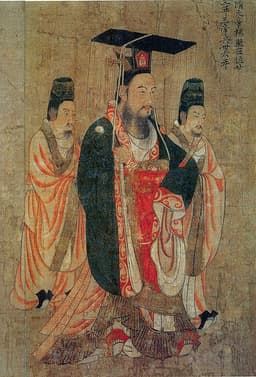
Wen Yang
General · Ancient
41.4Total
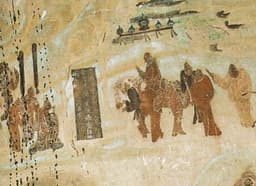
Zhang Qian
Explorer · Ancient
46.4Total
Basic Information
Born
238
-164
Died
291
-114
Era
Ancient
Ancient
Nationality
China
China
Occupation
General
Explorer
Civilization
Eastern
Eastern
Score Comparison
Military (10%)
40.0
40.3
Political (20%)
39.4
26.4
Influence (20%)
44.8
58.3
Legacy (20%)
35.8
55.0
Leadership (15%)
35.4
40.9
Strategy (15%)
60.0
39.5
TOTAL
41.4
46.4
Wen Yang — Complete Timeline
255 AD
Single-Handed Charge at Sima Shi's CampWar◆ Major
During the rebellion of Guanqiu Jian and Wen Qin, Wen Yang, then a young officer, charged alone into Sima Shi's camp, causing chaos and nearly capturing the Wei commander. The feat demonstrated his personal bravery but did not change the battle's outcome.
BattlePersonal ValorThree Kingdoms
Impact: regional
265 AD
Defected to Jin DynastyPolitical Action
After the fall of Wei, Wen Yang surrendered to the Jin dynasty and was given a military post. He later served under Emperor Wu of Jin.
DefectionJin DynastyPolitical Transition
Impact: national
291 AD
Executed by Sima LiangPolitical Action◆ Major
During the War of the Eight Princes, Wen Yang was executed by Sima Liang, who feared his military prowess. His death removed a capable general from the Jin court.
ExecutionWar of the Eight PrincesJin Dynasty
Impact: nationaltragic
Zhang Qian — Complete Timeline
138 BC
First Mission to the Western RegionsPolitical Action◆ Major
Emperor Wu of Han dispatched Zhang Qian as an envoy to seek an alliance with the Yuezhi against the Xiongnu. Zhang Qian was captured by the Xiongnu and held for ten years, but eventually escaped and continued his journey.
Han DynastyDiplomacyExploration
Impact: regional
128 BC
Reached the Yuezhi and BactriaPolitical Action◆ Major
After escaping Xiongnu captivity, Zhang Qian traveled through Ferghana and Sogdiana to reach the Yuezhi in Bactria. The Yuezhi declined an alliance against the Xiongnu, but Zhang Qian gathered detailed intelligence on Central Asian states.
Han DynastyExplorationCentral Asia
Impact: regional
126 BC
Return to Chang'an and Report to Emperor WuPolitical Action◆ Major
Zhang Qian returned to the Han capital after 13 years, bringing detailed accounts of the Western Regions, including the kingdoms of Dayuan, Kangju, and Daxia. His report provided the first reliable Chinese knowledge of Central Asia and spurred Han expansion.
Han DynastyExplorationDiplomacy
Impact: regionalconstructive
115 BC
Second Mission to the WusunPolitical Action◆ Major
Emperor Wu sent Zhang Qian on a second mission to the Wusun in the Ili Valley to secure an alliance against the Xiongnu. Zhang Qian established diplomatic relations and opened the Silk Road trade routes between China and Central Asia.
Han DynastySilk RoadDiplomacy
Impact: regionalconstructive
Expert Analysis
Origins
Wen Yang (born c. 238 AD) was the son of Wen Qin, a general under the Cao Wei state. His family had a strong military tradition, and Wen Yang grew up amid the turbulent Three Kingdoms period. He was known for his exceptional martial prowess from a young age, earning a reputation as a fierce warrior. In contrast, Zhang Qian (born c. 164 BC) was a Han dynasty court official from Hanzhong Commandery. His early life is less documented, but he served as a langzhong (gentleman attendant) in the court of Emperor Wu of Han. Zhang Qian's formative experience was his selection for a diplomatic mission to the Western Regions, a journey that would define his life.
Rise to Power
Wen Yang rose to prominence during the rebellion of Guanqiu Jian and Wen Qin in 255 AD. In a dramatic event, Wen Yang led a single-handed charge into the camp of Sima Shi, the regent of Wei, causing chaos and nearly capturing him. This act of bravery, scoring 60.0 in strategy, made him a legendary figure among the rebels. However, the rebellion failed, and Wen Yang fled to Wu. Later, he defected to the Jin dynasty and served under Emperor Wu of Jin. Zhang Qian's rise was more gradual. In 138 BC, Emperor Wu dispatched him on a mission to the Yuezhi to form an alliance against the Xiongnu. Zhang Qian was captured by the Xiongnu and held for ten years, but he escaped and continued his journey, eventually reaching the Yuezhi in Bactria. His perseverance, scoring 40.9 in leadership, earned him imperial favor upon his return in 125 BC.
Leadership & Governance
Wen Yang's leadership was defined by personal valor and direct action. As a general, he led from the front, inspiring his troops through his own fearlessness. However, his lack of political acumen (scoring 39.4 in political) made him vulnerable to court intrigues. He was executed by Sima Liang during the War of the Eight Princes, who saw him as a threat. Zhang Qian's governance style was diplomatic and exploratory. He did not hold high political office but served as an envoy, establishing relations with Central Asian states. His reports to Emperor Wu, scoring 58.3 in influence, shaped Han foreign policy and spurred the expansion of the Silk Road.
Triumph & Tragedy
Wen Yang's greatest triumph was his single-handed charge at Sima Shi's camp, a feat of military audacity that earned him lasting fame. His tragedy came later: executed by Sima Liang in 291 AD, his potential was cut short. Zhang Qian's triumph was his successful return from the Western Regions with invaluable geographical and cultural knowledge. His mission opened trade routes and established diplomatic ties. However, his second mission to the Wusun failed to secure a military alliance, and he died soon after returning in 113 BC, with some sources suggesting he was captured again by the Xiongnu.
Character & Destiny
Wen Yang was impetuous and brave, but his character made him a liability in the treacherous politics of the Jin court. His reliance on martial skill, scoring 40.0 in military, could not compensate for his lack of political survival instincts. Zhang Qian was patient and determined, enduring years of captivity and hardship. His curiosity and diplomatic skill, scoring 26.4 in political, allowed him to gather intelligence and build relationships. Both were shaped by their eras: Wen Yang by the collapse of the Three Kingdoms, Zhang Qian by the expansionist Han dynasty.
Legacy
Wen Yang's legacy is primarily as a folk hero of the Three Kingdoms period, celebrated for his bravery. His military exploits are remembered in Chinese literature, but his overall impact on history is limited, with a legacy score of 35.8. Zhang Qian's legacy is far-reaching: he is credited with opening the Silk Road, facilitating cultural and economic exchange between China and Central Asia. His influence score of 58.3 reflects his enduring impact on global trade routes. The Han dynasty's expansion into Central Asia was directly influenced by his reports.
Conclusion
While Wen Yang was a remarkable warrior, his impact was confined to a brief period of military history, scoring a total of 41.4. Zhang Qian, with a total score of 46.4, had a broader and more lasting influence on world history. His explorations laid the groundwork for centuries of cross-continental trade and cultural exchange. Therefore, Zhang Qian had greater impact, as his achievements transcended his era and shaped global interactions.
Rankings
🥇
Zhang QianLeader
Mil: 40.3Pol: 26.4Inf: 58.3
46.4
🥈
Wen Yang
Mil: 40.0Pol: 39.4Inf: 44.8
41.4
+5.0 behind
How This Comparison Works
Algorithm
Each figure is scored on 6 dimensions (0—100 scale) based on structured historical data: Military (10%), Political (20%), Influence (20%), Legacy (20%), Leadership (15%), Strategy (15%). The weighted total produces the final ranking.
Data Sources
Scores are computed from structured sub-indicators in the database. Scale factors adjust for era (Ancient ×0.85, Modern ×1.0) and civilization size (Eastern ×1.05, Other ×0.80) to account for differences in population and military scale.
Maximum 3 Figures
Comparisons are limited to 2—3 figures to ensure readability and statistical meaningfulness.
Error Margins
±5 points per dimension — Sub-scores are derived from historical records with inherent uncertainty. Two figures within 5 points on a dimension should be considered roughly equivalent in that area.
Total Score Accuracy
±3 points overall — The weighted combination of 6 dimensions produces a total score with approximately ±3 points of uncertainty. Differences of less than 3 points are not statistically significant— the figures are effectively tied.
Known Limitations
- Historical records are incomplete and uneven across civilizations
- Figures from oral-tradition societies may be underrepresented
- Occupation labels can misclassify multi-role figures
- Scores measure capability and impact, not moral character
- Quantitative scoring is a comparison tool, not absolute truth
Capability Radar
Military (10%) — Battles & Warfare
Battles
15
27
Win Rate
20
28
Expansion
0
31
Political (20%) — Governance & Reform
Reform
0
10
Diplomacy
0
85
Economy
0
30
Influence (20%) — Cultural & Global Reach
Cultural
10
70
Global
5
70
Legacy (20%) — Historical Impact
Historical
15
80
Longevity
10
80
Leadership (15%) — Power & Stability
Tenure
5
10
Stability
0
10
Strategy (15%) — Tactics & Innovation
Strategy
10
37
Tactics
25
37
Reform
0
42
Similar Comparisons
Comments & Discussion
No comments yet. Be the first to share your thoughts!