Loading...
This comparison has not been analyzed yet.
One-time AI generation (~1 minute). Scores and timeline are already available below.
A. B. Vajpayee vs Meles Zenawi
A. B. Vajpayee leads by 1.1 pts · 2 figures compared
…

A. B. Vajpayee
Politician · Modern
58.7Total
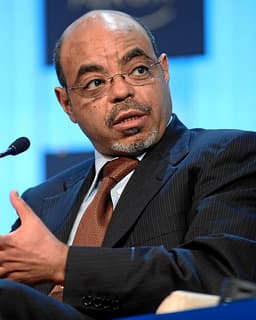
Meles Zenawi
Politician · Modern
57.6Total
Basic Information
Born
1924
1955
Died
—
—
Era
Modern
Modern
Nationality
India
Ethiopia
Occupation
Politician
Politician
Civilization
Indian
Other
Score Comparison
Military (10%)
45.4
36.6
Political (20%)
59.3
65.0
Influence (20%)
62.0
59.0
Legacy (20%)
52.0
48.3
Leadership (15%)
72.0
79.8
Strategy (15%)
60.0
53.5
TOTAL
58.7
57.6
A. B. Vajpayee — Complete Timeline
1998 AD
Elected Prime Minister of IndiaPolitical Action◆ Major
Vajpayee was sworn in as Prime Minister of India for the third time, leading a coalition government of the National Democratic Alliance (NDA). His tenure marked the first non-Congress government to complete a full term.
Prime MinisterNDACoalition
Impact: nationalconstructive
Conducted nuclear tests at Pokhran-IIPolitical Action◆ Major
Vajpayee authorized a series of five nuclear tests at Pokhran, making India a declared nuclear weapons state. The tests drew international sanctions but boosted India's strategic autonomy and national pride.
Nuclear TestsPokhran-IIStrategic Autonomy
Impact: globalconstructive
1999 AD
Led India during the Kargil WarWar◆ Major
Vajpayee led India during the Kargil War against Pakistani infiltrators in the Kargil district of Jammu and Kashmir. The Indian military successfully repelled the incursion, restoring the Line of Control.
Kargil WarMilitary ConflictLine of Control
Impact: regional
Signed the Lahore Declaration with PakistanPolitical Action◆ Major
Vajpayee signed the Lahore Declaration with Pakistani Prime Minister Nawaz Sharif, pledging to resolve the Kashmir dispute peacefully and promote bilateral trade. The declaration was undermined by the Kargil War later that year.
Lahore DeclarationPakistanPeace Process
Impact: regionalconstructive
2001 AD
Launched the Golden Quadrilateral highway projectReform◆ Major
Vajpayee's government launched the Golden Quadrilateral project, a major infrastructure initiative to connect India's four major cities with a network of highways. The project aimed to boost economic growth and connectivity.
InfrastructureHighwaysEconomic Growth
Impact: nationalconstructive
Meles Zenawi — Complete Timeline
1991 AD
EPRDF capture of Addis AbabaWar◆ Major
Meles Zenawi, as leader of the Tigrayan People's Liberation Front (TPLF) and the Ethiopian People's Revolutionary Democratic Front (EPRDF) coalition, led rebel forces to overthrow the Derg regime. This ended the Ethiopian Civil War and installed Meles as president of the transitional government.
Civil WarRegime ChangeRebel Victory
Impact: national
1998 AD
Eritrean-Ethiopian WarWar◆ Major
Meles, as prime minister, led Ethiopia in a two-year border war with Eritrea. The conflict resulted in tens of thousands of deaths and ended with a stalemate, followed by the Algiers Agreement in 2000 and the establishment of the UN peacekeeping mission UNMEE.
Border WarEritreaPeacekeeping
Impact: regionaldestructive
2000 AD
Ethiopian economic reform programReform◆ Major
Meles implemented a series of economic reforms focused on agricultural development, infrastructure investment, and state-led industrialization. These policies contributed to sustained GDP growth averaging over 10% annually from 2004 to 2014, though critics noted limited political freedoms.
Economic DevelopmentAgricultureInfrastructure
Impact: nationalconstructive
2005 AD
2005 Ethiopian general electionPolitical Action◆ Major
Meles's government held multi-party elections that were initially seen as promising but ended in controversy. Opposition parties claimed fraud, leading to protests and a violent crackdown that killed at least 193 people. The event damaged Ethiopia's democratic reputation.
ElectionPolitical ViolenceDemocracy
Impact: nationaldestructive
2012 AD
Death in officeOther◆ Major
Meles Zenawi died on August 20, 2012, in a Brussels hospital from an undisclosed illness. His death ended 21 years of rule and triggered a peaceful transition of power to Deputy Prime Minister Hailemariam Desalegn, though the TPLF retained control.
DeathTransitionSuccession
Impact: national
This comparison has not been analyzed yet.
One-time AI generation (~1 minute). Scores and timeline are already available below.
Rankings
🥇
A. B. VajpayeeLeader
Mil: 45.4Pol: 59.3Inf: 62.0
58.7
🥈
Meles Zenawi
Mil: 36.6Pol: 65.0Inf: 59.0
57.6
+1.1 behind
How This Comparison Works
Algorithm
Each figure is scored on 6 dimensions (0—100 scale) based on structured historical data: Military (10%), Political (20%), Influence (20%), Legacy (20%), Leadership (15%), Strategy (15%). The weighted total produces the final ranking.
Data Sources
Scores are computed from structured sub-indicators in the database. Scale factors adjust for era (Ancient ×0.85, Modern ×1.0) and civilization size (Eastern ×1.05, Other ×0.80) to account for differences in population and military scale.
Maximum 3 Figures
Comparisons are limited to 2—3 figures to ensure readability and statistical meaningfulness.
Error Margins
±5 points per dimension — Sub-scores are derived from historical records with inherent uncertainty. Two figures within 5 points on a dimension should be considered roughly equivalent in that area.
Total Score Accuracy
±3 points overall — The weighted combination of 6 dimensions produces a total score with approximately ±3 points of uncertainty. Differences of less than 3 points are not statistically significant— the figures are effectively tied.
Known Limitations
- Historical records are incomplete and uneven across civilizations
- Figures from oral-tradition societies may be underrepresented
- Occupation labels can misclassify multi-role figures
- Scores measure capability and impact, not moral character
- Quantitative scoring is a comparison tool, not absolute truth
Capability Radar
Military (10%) — Battles & Warfare
Battles
44
5
Win Rate
48
5
Expansion
47
5
Political (20%) — Governance & Reform
Reform
70
70
Diplomacy
75
65
Economy
65
70
Influence (20%) — Cultural & Global Reach
Cultural
55
40
Global
55
45
Legacy (20%) — Historical Impact
Historical
60
50
Longevity
50
30
Leadership (15%) — Power & Stability
Tenure
65
75
Stability
60
55
Strategy (15%) — Tactics & Innovation
Strategy
50
10
Tactics
57
5
Reform
57
15
Similar Comparisons
Comments & Discussion
No comments yet. Be the first to share your thoughts!