Loading...
Abd el-Kader vs Alexander Kolchak
Abd el-Kader leads by 19.0 pts · 2 figures compared
…
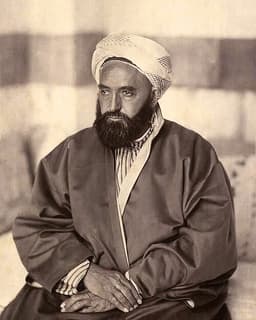
Abd el-Kader
General · Modern
67.1Total

Alexander Kolchak
General · Modern
48.1Total
Basic Information
Born
1808
1874
Died
1883
1920
Era
Modern
Modern
Nationality
Algeria
Russia
Occupation
General
General
Civilization
Middle Eastern
Western
Score Comparison
Military (10%)
60.0
50.0
Political (20%)
78.0
35.1
Influence (20%)
88.0
57.2
Legacy (20%)
40.0
45.0
Leadership (15%)
70.4
48.4
Strategy (15%)
68.7
50.0
TOTAL
67.1
48.1
Abd el-Kader — Complete Timeline
1837 AD
Treaty of TafnaPolitical Action◆ Major
Abd el-Kader signed the Treaty of Tafna with French General Thomas Bugeaud. The treaty recognized Abd el-Kader's control over the interior of western Algeria, temporarily halting French expansion and establishing a defined territory for his emirate.
TreatyAlgerian ResistanceFrench Colonization
Impact: regional
1843 AD
Capture of the SmalaWar◆ Major
French forces under the Duke of Aumale captured Abd el-Kader's mobile camp (smala) at Taguin, taking thousands of prisoners including his family. This defeat destroyed his administrative base and severely weakened his resistance movement.
BattleAlgerian ResistanceFrench Colonization
Impact: regionaltragic
1847 AD
Surrender to FrancePolitical Action◆ Major
Abd el-Kader surrendered to French General Louis de Lamorici
SurrenderAlgerian ResistanceFrench Colonization
Impact: regionaltragic
1860 AD
Protection of Christians in DamascusPolitical Action◆ Major
During sectarian violence in Damascus, Abd el-Kader personally intervened to protect Christian communities, sheltering thousands in his home. His actions saved many lives and earned him international recognition, including the French Legion of Honour.
HumanitarianInterfaithDamascus
Impact: regionalconstructive
Alexander Kolchak — Complete Timeline
1918 AD
Supreme Ruler of RussiaPolitical Action
Kolchak was proclaimed Supreme Ruler of Russia by the White forces in Omsk. He established a government that claimed authority over all anti-Bolshevik forces. His regime was recognized by the Allies and became the main White government in Siberia.
Supreme RulerWhite MovementSiberia
Impact: national
Gold Reserve of the Russian EmpirePolitical Action◆ Major
Kolchak's government gained control of a large portion of the Russian Empire's gold reserve, which had been captured by the Czechoslovak Legion. The gold was used to finance his government and purchase supplies. Its fate after Kolchak's defeat remains a subject of speculation.
Gold ReserveWhite MovementFinance
Impact: national
1919 AD
Spring Offensive of 1919War◆ Major
Kolchak launched a major offensive westward from Siberia, aiming to link up with Denikin's forces and march on Moscow. The offensive initially captured large areas, including Perm and Ufa, but was halted by the Red Army and turned into a retreat.
Spring OffensiveWhite ArmyRussian Civil War
Impact: national
1920 AD
Capture and Execution by the BolsheviksPolitical Action
After the collapse of his government, Kolchak was captured by the Czechoslovak Legion and handed over to the Bolsheviks in Irkutsk. He was executed by firing squad on February 7, 1920, and his body was thrown into the Angara River.
ExecutionWhite ArmyBolsheviks
Impact: nationaltragic
Expert Analysis
Origins
Abd el-Kader was born in 1808 near Mascara, Algeria, into a religious family of the Qadiriyya Sufi order. His father, Muhyi al-Din, was a respected marabout. Abd el-Kader received a traditional education in Islamic sciences, horsemanship, and warfare. He accompanied his father on pilgrimages and learned leadership from tribal elders.
Alexander Kolchak was born in 1874 in Saint Petersburg, Russia, into a military family. His father was a naval officer. Kolchak attended the Naval Cadet Corps and later specialized in oceanography and hydrography. He participated in Arctic expeditions and became a noted scientist before his military career.
Rise to Power
Abd el-Kader emerged as a leader in 1832 when tribal elders elected him emir to lead resistance against French colonization. He quickly organized tribes into a cohesive force, using guerrilla tactics and establishing a network of forts. By 1834, he signed the Treaty of Desmichels, gaining French recognition of his authority over western Algeria. The Treaty of Tafna in 1837 expanded his control to include most of the interior.
Kolchak rose to prominence as a naval officer in the Russo-Japanese War (1904-1905), where he commanded a destroyer and later served on the Vladivostok squadron. He became a hero for his actions at Port Arthur. During World War I, he commanded the Black Sea Fleet, scoring successes against Ottoman shipping. After the Bolshevik Revolution, he fled to Siberia and in November 1918 was proclaimed Supreme Ruler of Russia by the White forces in Omsk, backed by Allied powers.
Leadership & Governance
Abd el-Kader's leadership score of 70.4 reflects his ability to unite fractious tribes under a centralized state. He established a government with ministers, a treasury, and a standing army. He implemented Islamic law and promoted education. His strategy score of 68.7 indicates his effective use of mobile warfare and diplomacy. He alternated between military campaigns and treaties, exploiting French divisions.
Kolchak's leadership score is 48.4, reflecting his authoritarian and unpopular rule. He rejected negotiations with Bolsheviks and socialists, relying on military force. His government was plagued by corruption, poor logistics, and alienating peasants through forced conscription and requisitions. His political score of 35.1 shows his inability to build a broad coalition. He failed to secure support from non-Russian nationalities or moderate socialists.
Triumph & Tragedy
Abd el-Kader's greatest triumph was his 15-year resistance against a major European power. He defeated French forces at the Battle of Macta (1835) and the Battle of Sidi Yacoub (1839). His state-building created a proto-national identity. However, his tragedy came in 1847 when he surrendered after the capture of his smala (mobile camp) in 1843 and relentless French campaigns. He was imprisoned in France until 1852, then exiled.
Kolchak's triumph was his Spring Offensive of 1919, which advanced to within 500 kilometers of Moscow, threatening the Bolshevik regime. He also secured the Russian gold reserve, providing financial backing. His tragedy was his rapid collapse due to overextended supply lines, internal dissent, and the Red Army's counteroffensive. He was captured in 1920 and executed by firing squad in Irkutsk. His military score of 50.0 reflects his mixed record.
Character & Destiny
Abd el-Kader was pious, diplomatic, and resilient. His Sufi background gave him a conciliatory nature, as seen in his protection of Christians in Damascus in 1860. He was pragmatic, knowing when to fight and when to negotiate. His character enabled him to maintain loyalty even in defeat.
Kolchak was determined but inflexible. He insisted on restoring the pre-revolutionary order, rejecting compromise. His scientific background made him methodical, but he lacked political acumen. He believed in his own destiny as Russia's savior, but his authoritarianism alienated potential allies. His execution symbolized the end of the White movement.
Legacy
Abd el-Kader's legacy score of 40.0 reflects his enduring symbolic importance in Algeria and the Islamic world. He is remembered as a national hero and a model of principled resistance. His humanitarian act in Damascus earned him international respect, including from Abraham Lincoln. His ideas influenced later anti-colonial movements.
Kolchak's legacy score of 45.0 is mixed. In post-Soviet Russia, some view him as a patriot who fought communism, but his authoritarianism and foreign backing taint his image. He is a controversial figure, with monuments erected and removed. His failure contributed to the Soviet consolidation of power.
Conclusion
Despite Kolchak's higher legacy score (45.0 vs 40.0), Abd el-Kader had greater overall impact. His total score of 67.1 to Kolchak's 48.1 reflects his superior military, political, and leadership abilities. Abd el-Kader built a state, sustained a prolonged resistance, and left a humanitarian legacy. Kolchak's brief rule ended in failure without achieving his objectives. Abd el-Kader's influence on anti-colonial movements and cross-cultural respect is more enduring.
Rankings
🥇
Abd el-KaderLeader
Mil: 60.0Pol: 78.0Inf: 88.0
67.1
🥈
Alexander Kolchak
Mil: 50.0Pol: 35.1Inf: 57.2
48.1
+19.0 behind
How This Comparison Works
Algorithm
Each figure is scored on 6 dimensions (0—100 scale) based on structured historical data: Military (10%), Political (20%), Influence (20%), Legacy (20%), Leadership (15%), Strategy (15%). The weighted total produces the final ranking.
Data Sources
Scores are computed from structured sub-indicators in the database. Scale factors adjust for era (Ancient ×0.85, Modern ×1.0) and civilization size (Eastern ×1.05, Other ×0.80) to account for differences in population and military scale.
Maximum 3 Figures
Comparisons are limited to 2—3 figures to ensure readability and statistical meaningfulness.
Error Margins
±5 points per dimension — Sub-scores are derived from historical records with inherent uncertainty. Two figures within 5 points on a dimension should be considered roughly equivalent in that area.
Total Score Accuracy
±3 points overall — The weighted combination of 6 dimensions produces a total score with approximately ±3 points of uncertainty. Differences of less than 3 points are not statistically significant— the figures are effectively tied.
Known Limitations
- Historical records are incomplete and uneven across civilizations
- Figures from oral-tradition societies may be underrepresented
- Occupation labels can misclassify multi-role figures
- Scores measure capability and impact, not moral character
- Quantitative scoring is a comparison tool, not absolute truth
Capability Radar
Military (10%) — Battles & Warfare
Battles
75
65
Win Rate
65
40
Expansion
60
45
Political (20%) — Governance & Reform
Reform
72
25
Diplomacy
85
20
Economy
55
15
Influence (20%) — Cultural & Global Reach
Cultural
70
30
Global
65
25
Legacy (20%) — Historical Impact
Historical
75
40
Longevity
70
20
Leadership (15%) — Power & Stability
Tenure
68
30
Stability
50
10
Strategy (15%) — Tactics & Innovation
Strategy
78
55
Tactics
80
60
Reform
70
50
Similar Comparisons
Comments & Discussion
No comments yet. Be the first to share your thoughts!