Loading...
Abdullah Ahmad Badawi vs Maumoon Abdul Gayoom
Maumoon Abdul Gayoom leads by 5.6 pts · 2 figures compared
…
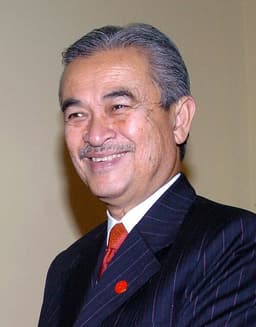
Abdullah Ahmad Badawi
Politician · Modern
50.0Total
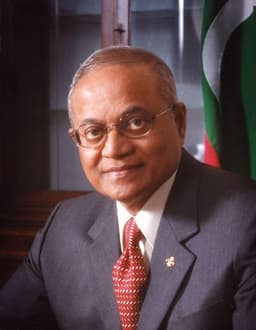
Maumoon Abdul Gayoom
Politician · Modern
55.6Total
Basic Information
Born
1939
1937
Died
—
—
Era
Modern
Modern
Nationality
Malaysia
Maldives
Occupation
Politician
Politician
Civilization
Eastern
Indian
Score Comparison
Military (10%)
11.3
40.3
Political (20%)
68.0
68.0
Influence (20%)
54.1
53.3
Legacy (20%)
43.3
45.0
Leadership (15%)
72.0
72.0
Strategy (15%)
35.4
60.0
TOTAL
50.0
55.6
Abdullah Ahmad Badawi — Complete Timeline
2004 AD
Introduction of Islam Hadhari (2004)Cultural◆ Major
As Prime Minister, Abdullah Ahmad Badawi introduced the concept of Islam Hadhari (Civilizational Islam), promoting a progressive and moderate interpretation of Islam. The policy aimed to balance Islamic values with modernization and economic development.
Islamic PolicyModerationIslam Hadhari
Impact: nationalconstructive
Electoral Landslide Victory (2004)Political Action◆ Major
Abdullah Ahmad Badawi led the Barisan Nasional to a landslide victory in the 2004 general election, winning 90% of parliamentary seats. This mandate reflected public support for his reform agenda and anti-corruption stance after the Mahathir era.
ElectionLandslide VictoryMandate
Impact: nationalconstructive
2006 AD
Implementation of the Ninth Malaysia Plan (2006)Reform◆ Major
Abdullah Ahmad Badawi launched the Ninth Malaysia Plan (2006-2010), focusing on raising the income and quality of life for low-income groups. The plan emphasized agriculture, services, and human capital development to achieve developed nation status.
Development PlanEconomic PolicyPoverty Reduction
Impact: nationalconstructive
2009 AD
Resignation as Prime Minister (2009)Political Action◆ Major
Under pressure from within UMNO and following poor electoral performance in 2008, Abdullah Ahmad Badawi resigned as Prime Minister. He was succeeded by Najib Razak. His resignation marked the end of a reformist but ultimately weakened tenure.
ResignationPolitical PressureTransition
Impact: nationaltragic
Maumoon Abdul Gayoom — Complete Timeline
1978 AD
Became President of the MaldivesPolitical Action◆ Major
Maumoon Abdul Gayoom was elected President of the Maldives, succeeding Ibrahim Nasir. He would go on to rule for 30 years, the longest tenure in the country's history, initially with popular support but later facing increasing authoritarianism.
PresidencyLongest-servingMaldives
Impact: national
1979 AD
Introduced the tourism-based economic modelReform◆ Major
Gayoom's government expanded the Maldives' tourism industry, opening numerous resorts and promoting the country as a luxury destination. This policy transformed the economy, making tourism the dominant sector and driving significant economic growth, but also creating environmental pressures.
TourismEconomic developmentMaldives
Impact: nationalconstructive
1988 AD
Survived a coup attemptPolitical Action◆ Major
A coup attempt by Sri Lankan Tamil mercenaries and Maldivian dissidents was thwarted with military assistance from India. The failed coup led to increased security measures and closer ties between the Maldives and India, while Gayoom's grip on power tightened.
Coup attemptIndia-Maldives relationsSecurity
Impact: national
2004 AD
Declared a state of emergencyPolitical Action◆ Major
Following the 2004 Indian Ocean tsunami, Gayoom declared a state of emergency. The disaster devastated the Maldives, killing over 100 people and causing massive economic damage. The government's response was criticized for being slow and inadequate.
TsunamiDisaster responseEmergency
Impact: nationaltragic
2008 AD
Lost the first multi-party presidential electionPolitical Action
After 30 years in power, Gayoom was defeated in the Maldives' first multi-party presidential election by Mohamed Nasheed. The peaceful transfer of power was a landmark for Maldivian democracy, ending Gayoom's authoritarian rule.
ElectionDemocracyTransition
Impact: national
Expert Analysis
Origins
**Abdullah Ahmad Badawi** was born on 26 November 1939 in Kepala Batas, Penang, into a family of religious scholars. His father, Ahmad Badawi, was a prominent Islamic scholar and former member of the Malaysian Islamic Party (PAS). Abdullah studied Islamic studies at the University of Malaya, graduating in 1964 with a Bachelor of Arts in Islamic Studies. He later joined the civil service before entering politics.
**Maumoon Abdul Gayoom** was born on 29 December 1937 in Malé, Maldives, into a politically active family. His father, Abdul Gayoom, was a lawyer and former attorney general. Gayoom studied at Al-Azhar University in Cairo, earning a degree in Islamic law. He also studied at the University of Cambridge, obtaining a diploma in education. He returned to the Maldives and worked as a teacher before entering politics.
Rise to Power
Abdullah Badawi's rise began in 1978 when he was elected to Parliament. He held various ministerial posts, including Defence Minister and Foreign Minister. In 1999, he was appointed Deputy Prime Minister under Mahathir Mohamad. In 2003, Mahathir stepped down, and Badawi became Prime Minister. His first major test was the 2004 election, where he led Barisan Nasional to a landslide victory, winning 90% of parliamentary seats (scoring 68.0 in political acumen).
Maumoon Gayoom became President in 1978, succeeding Ibrahim Nasir. He was initially appointed by the Majlis (parliament) and then confirmed by referendum. He consolidated power by centralizing authority and eliminating rivals. He survived a coup attempt in 1988, when Sri Lankan Tamil mercenaries and Maldivian dissidents tried to overthrow him. With military assistance from India, the coup was crushed, and Gayoom's grip on power tightened.
Leadership & Governance
Badawi's leadership style was conciliatory, focusing on consensus and reform. He introduced the concept of **Islam Hadhari** (Civilizational Islam) in 2004, aiming to promote a progressive, moderate interpretation of Islam compatible with development. He launched the **Ninth Malaysia Plan** in 2006, targeting income inequality and rural development. However, his governance was criticized for being slow and indecisive, especially in handling corruption allegations.
Gayoom was an autocratic leader who maintained power through a centralized system. He expanded the Maldives' tourism industry, transforming it from a fishing economy into a luxury destination. He also pursued infrastructure development, including the construction of the international airport and hospitals. However, his rule was marked by suppression of dissent, with limited political freedoms and no opposition parties until 2005.
Triumph & Tragedy
Badawi's triumph was his landslide 2004 electoral victory and the introduction of Islam Hadhari, which initially boosted Malaysia's image as a moderate Muslim nation. However, his tragedy came in 2008 when his coalition lost its two-thirds majority in Parliament due to public discontent over rising prices and corruption. He was forced to resign in 2009, stepping down under pressure from within UMNO. His legacy score is 43.3.
Gayoom's triumph was his successful tourism-based economic model, which transformed the Maldives from a poor island nation into a middle-income country with a high GDP per capita. He also oversaw the peaceful transition of power after his defeat in the 2008 election. His tragedy was the 2004 tsunami, which killed over 100 people and caused widespread damage, and his long autocratic rule that stifled democratic development. His legacy score is 45.0.
Character & Destiny
Badawi was known as a gentle, religiously devout leader, often called "Pak Lah" (Uncle). His cautious nature led to indecision, which undermined his reform agenda. He was unable to control factionalism within UMNO, leading to his downfall. His strategy score of 35.4 reflects his lack of political maneuvering.
Gayoom was a shrewd, resilient leader who skillfully maintained power for 30 years. He was pragmatic, using Islam and nationalism to legitimize his rule. However, his authoritarian tendencies ultimately limited his legacy, as he is remembered as a dictator who denied basic freedoms. His strategy score of 60.0 is higher than Badawi's.
Legacy
Badawi's legacy is mixed. Islam Hadhari faded after his departure, and his reforms were mostly abandoned. He is credited with promoting moderate Islam but criticized for failing to tackle corruption. The Ninth Malaysia Plan had limited impact due to poor implementation. His political influence score is 54.1.
Gayoom's legacy is more tangible. The tourism industry he built remains the backbone of the Maldives' economy. He also laid the groundwork for democratic transition, though his rule was autocratic. He is remembered as the "father of tourism" but also as a long-serving autocrat. His influence score is 53.3.
Conclusion
While both leaders scored similarly overall (Badawi 50.0, Gayoom 55.6), Gayoom had a more lasting impact. His tourism model transformed the Maldives' economy, and his 30-year rule shaped the nation's political landscape. Badawi's reforms were short-lived and failed to survive his tenure. Therefore, Maumoon Abdul Gayoom is the more impactful figure, despite his authoritarian methods.
Rankings
🥇
Maumoon Abdul GayoomLeader
Mil: 40.3Pol: 68.0Inf: 53.3
55.6
🥈
Abdullah Ahmad Badawi
Mil: 11.3Pol: 68.0Inf: 54.1
50.0
+5.6 behind
How This Comparison Works
Algorithm
Each figure is scored on 6 dimensions (0—100 scale) based on structured historical data: Military (10%), Political (20%), Influence (20%), Legacy (20%), Leadership (15%), Strategy (15%). The weighted total produces the final ranking.
Data Sources
Scores are computed from structured sub-indicators in the database. Scale factors adjust for era (Ancient ×0.85, Modern ×1.0) and civilization size (Eastern ×1.05, Other ×0.80) to account for differences in population and military scale.
Maximum 3 Figures
Comparisons are limited to 2—3 figures to ensure readability and statistical meaningfulness.
Error Margins
±5 points per dimension — Sub-scores are derived from historical records with inherent uncertainty. Two figures within 5 points on a dimension should be considered roughly equivalent in that area.
Total Score Accuracy
±3 points overall — The weighted combination of 6 dimensions produces a total score with approximately ±3 points of uncertainty. Differences of less than 3 points are not statistically significant— the figures are effectively tied.
Known Limitations
- Historical records are incomplete and uneven across civilizations
- Figures from oral-tradition societies may be underrepresented
- Occupation labels can misclassify multi-role figures
- Scores measure capability and impact, not moral character
- Quantitative scoring is a comparison tool, not absolute truth
Capability Radar
Military (10%) — Battles & Warfare
Battles
16
42
Win Rate
17
46
Expansion
23
52
Political (20%) — Governance & Reform
Reform
45
60
Diplomacy
50
55
Economy
50
50
Influence (20%) — Cultural & Global Reach
Cultural
30
30
Global
25
30
Legacy (20%) — Historical Impact
Historical
30
40
Longevity
20
30
Leadership (15%) — Power & Stability
Tenure
55
85
Stability
55
40
Strategy (15%) — Tactics & Innovation
Strategy
23
54
Tactics
25
54
Reform
30
60
Similar Comparisons
Comments & Discussion
No comments yet. Be the first to share your thoughts!