Loading...
Maumoon Abdul Gayoom vs Napoleon Bonaparte
Napoleon Bonaparte leads by 15.3 pts · 2 figures compared
…
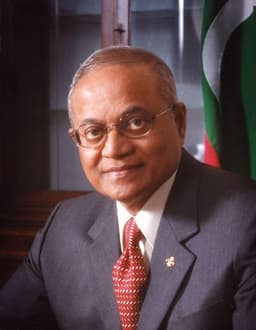
Maumoon Abdul Gayoom
Politician · Modern
55.6Total

Napoleon Bonaparte
General · Modern
70.9Total
Basic Information
Born
1937
1769
Died
—
1821
Era
Modern
Modern
Nationality
Maldives
France
Occupation
Politician
General
Civilization
Indian
Western
Score Comparison
Military (10%)
40.3
94.0
Political (20%)
68.0
72.0
Influence (20%)
53.3
40.0
Legacy (20%)
45.0
80.0
Leadership (15%)
72.0
78.0
Strategy (15%)
60.0
90.0
TOTAL
55.6
70.9
Maumoon Abdul Gayoom — Complete Timeline
1978 AD
Became President of the MaldivesPolitical Action◆ Major
Maumoon Abdul Gayoom was elected President of the Maldives, succeeding Ibrahim Nasir. He would go on to rule for 30 years, the longest tenure in the country's history, initially with popular support but later facing increasing authoritarianism.
PresidencyLongest-servingMaldives
Impact: national
1979 AD
Introduced the tourism-based economic modelReform◆ Major
Gayoom's government expanded the Maldives' tourism industry, opening numerous resorts and promoting the country as a luxury destination. This policy transformed the economy, making tourism the dominant sector and driving significant economic growth, but also creating environmental pressures.
TourismEconomic developmentMaldives
Impact: nationalconstructive
1988 AD
Survived a coup attemptPolitical Action◆ Major
A coup attempt by Sri Lankan Tamil mercenaries and Maldivian dissidents was thwarted with military assistance from India. The failed coup led to increased security measures and closer ties between the Maldives and India, while Gayoom's grip on power tightened.
Coup attemptIndia-Maldives relationsSecurity
Impact: national
2004 AD
Declared a state of emergencyPolitical Action◆ Major
Following the 2004 Indian Ocean tsunami, Gayoom declared a state of emergency. The disaster devastated the Maldives, killing over 100 people and causing massive economic damage. The government's response was criticized for being slow and inadequate.
TsunamiDisaster responseEmergency
Impact: nationaltragic
2008 AD
Lost the first multi-party presidential electionPolitical Action
After 30 years in power, Gayoom was defeated in the Maldives' first multi-party presidential election by Mohamed Nasheed. The peaceful transfer of power was a landmark for Maldivian democracy, ending Gayoom's authoritarian rule.
ElectionDemocracyTransition
Impact: national
Napoleon Bonaparte — Complete Timeline
1799 AD
Coup of 18 BrumaireOther◆ Major
Napoleon Bonaparte, with support from his brother Lucien and key political figures, overthrew the Directory in a bloodless coup. He established the Consulate with himself as First Consul, effectively becoming the ruler of France. This event ended the French Revolution's most unstable period.
French RevolutionCoupRise to Power
Impact: regional
1804 AD
Promulgation of the Napoleonic CodeOther◆ Major
Napoleon enacted the Civil Code of the French, known as the Napoleonic Code, a comprehensive set of laws that replaced the fragmented feudal legal systems. The code established legal equality, protected property rights, and secularized law. It became the basis for legal systems in many European and world countries.
Legal ReformNapoleonic CodeCivil Law
Impact: globalconstructive
1805 AD
Battle of AusterlitzWar◆ Major
Napoleon's Grande Arm
Napoleonic WarsBattleDecisive Victory
Impact: global
1812 AD
Invasion of RussiaWar◆ Major
Napoleon led the Grande Arm
Napoleonic WarsInvasionDisaster
Impact: globaldestructive
1815 AD
Battle of WaterlooWar◆ Major
Napoleon's French army was defeated by the combined forces of the Duke of Wellington's Anglo-Allied army and Gebhard Leberecht von Bl
Napoleonic WarsBattleFinal Defeat
Impact: globaldestructive
Expert Analysis
maumoon-abdul-gayoom-vs-napoleon-bonaparte
# The Island and the Eagle
In the winter of 1815, as Napoleon Bonaparte paced the deck of a British warship bound for Saint Helena, he could still see the smoke from Waterloo rising in his memory. Half a world away and nearly two centuries later, Maumoon Abdul Gayoom stood on the shore of Malé, watching waves that had just swallowed a thousand of his people, wondering if his thirty-year grip on power could survive the tide. One man conquered continents; the other ruled an archipelago of coral and sand. What force of history, what twist of character, could produce two such different fates from the same human ambition?
Origins
Napoleon was born in 1769 on Corsica, an island of fierce independence that had only recently become French. His family was minor nobility, poor enough to feel the sting of social inferiority but connected enough to send him to military school. There, the awkward boy with the Italian accent was mocked by his aristocratic classmates—a wound that never fully healed. He devoured history and strategy, dreaming not of France but of glory. The French Revolution, erupting when he was twenty, shattered the old order and opened a path for men of talent, not birth.
Maumoon Abdul Gayoom was born in 1937 in Malé, then a sleepy capital of thatched roofs and fishing boats. The Maldives was a British protectorate, poor and isolated, its people scattered across nearly two thousand islands. Gayoom’s family was scholarly; his father was a judge. He studied at Al-Azhar University in Cairo, the ancient seat of Islamic learning, and later taught in Nigeria and at Malé’s only high school. Where Napoleon learned to command armies, Gayoom learned to navigate bureaucracy and religious authority. His era was one of decolonization, not revolution—a quieter, slower transformation.
Rise to Power
Napoleon rose through cannon fire. At twenty-four, he directed the artillery that crushed a royalist uprising in Paris; at twenty-six, he led a ragged army into Italy and delivered victory after victory, each triumph a stepping stone. By 1799, with France exhausted and its government corrupt, he staged a coup and made himself First Consul. His rise was meteoric, violent, and entirely his own making.
Gayoom’s ascent was more deliberate. He served as a diplomat, then as Minister of Transport, and in 1978, with the backing of the existing elite, he was elected president in a single-candidate referendum. The Maldives had no political parties, no free press, no organized opposition. He did not seize power; he inherited it, and then he held it.
Leadership & Governance
Napoleon governed like he fought: with speed, audacity, and a genius for organization. He reformed French law into the Napoleonic Code, a rational system that swept away feudal privileges and became a model for much of Europe. He centralized education, built roads, stabilized the currency, and made peace with the Catholic Church. But his greatest reform was also his greatest flaw: he believed that one man, armed with will and intelligence, could impose order on chaos. He could not govern without war, and war eventually consumed him.
Gayoom’s rule was quieter but no less absolute. He introduced a tourism-based economic model in 1979, transforming the Maldives from a subsistence fishing economy into a luxury destination. Resorts bloomed on empty islands; foreign currency flowed in; life expectancy and literacy rose. But political freedom did not rise with them. He banned opposition parties, jailed dissidents, and rigged referendums. In 1988, when Sri Lankan Tamil mercenaries attempted a coup, Indian troops restored him—a reminder that his power depended on foreign goodwill as much as domestic control.
Triumph & Tragedy
Napoleon’s greatest moment was Austerlitz in 1805, where he destroyed a combined Russian and Austrian army with a trap so elegant it is still studied in military academies. His worst was the invasion of Russia in 1812, a catastrophe of overreach that cost half a million men and shattered his aura of invincibility. He was exiled to Elba, escaped, and raised another army—only to be crushed at Waterloo in 1815 by a coalition he had provoked but could no longer defeat.
Gayoom’s triumph was survival itself: thirty years in power, through coups, economic booms, and the 2004 Indian Ocean tsunami that killed over a hundred people and devastated his country. He declared a state of emergency and oversaw reconstruction, but the disaster also exposed his regime’s fragility. His tragedy came in 2008, when he lost the Maldives’ first multi-party presidential election to Mohamed Nasheed. After three decades, he was swept aside not by armies, but by ballots.
Character & Destiny
Napoleon was driven by an insatiable hunger for recognition. He once said, “Glory is fleeting, but obscurity is forever.” His ambition was boundless, his energy immense, his confidence almost delusional. He believed he could remake the world in his image. That belief made him a conqueror and a reformer, but also a tyrant who could not stop. His downfall came not from a single mistake, but from a personality that equated power with existence.
Gayoom was more cautious, more calculating. He governed not through charisma or grand visions, but through patience and control. He was a survivor, not a conqueror. His ambition was to stay, not to expand. Where Napoleon saw the world as a battlefield, Gayoom saw it as a chessboard. He played the long game, but in the end, even patience cannot hold back a tide.
Legacy
Napoleon left behind a transformed Europe: the Napoleonic Code, the metric system, the idea of meritocracy, and the myth of the self-made man. He is remembered as both a genius and a monster, a liberator and a despot. His name still evokes awe, debate, and endless study.
Gayoom left behind a transformed Maldives: a prosperous tourist paradise, but also a political culture of repression. He is remembered as the man who built modern Maldives—and the man who kept it in chains. His legacy is mixed, contested, and still unfolding.
Conclusion
Standing at opposite ends of power, Napoleon and Gayoom remind us that ambition takes many forms. One sought to conquer the world; the other sought to hold an island. One fell in battle; the other fell at the ballot box. Yet both were shaped by the same human drives: the hunger for control, the fear of obscurity, the belief that history bends to the will of the determined. In the end, they teach us that power is not measured by the size of your empire, but by the depth of the mark you leave—and the cost of leaving it.
Rankings
🥇
Napoleon BonaparteLeader
Mil: 94.0Pol: 72.0Inf: 40.0
70.9
🥈
Maumoon Abdul Gayoom
Mil: 40.3Pol: 68.0Inf: 53.3
55.6
+15.3 behind
How This Comparison Works
Algorithm
Each figure is scored on 6 dimensions (0—100 scale) based on structured historical data: Military (10%), Political (20%), Influence (20%), Legacy (20%), Leadership (15%), Strategy (15%). The weighted total produces the final ranking.
Data Sources
Scores are computed from structured sub-indicators in the database. Scale factors adjust for era (Ancient ×0.85, Modern ×1.0) and civilization size (Eastern ×1.05, Other ×0.80) to account for differences in population and military scale.
Maximum 3 Figures
Comparisons are limited to 2—3 figures to ensure readability and statistical meaningfulness.
Error Margins
±5 points per dimension — Sub-scores are derived from historical records with inherent uncertainty. Two figures within 5 points on a dimension should be considered roughly equivalent in that area.
Total Score Accuracy
±3 points overall — The weighted combination of 6 dimensions produces a total score with approximately ±3 points of uncertainty. Differences of less than 3 points are not statistically significant— the figures are effectively tied.
Known Limitations
- Historical records are incomplete and uneven across civilizations
- Figures from oral-tradition societies may be underrepresented
- Occupation labels can misclassify multi-role figures
- Scores measure capability and impact, not moral character
- Quantitative scoring is a comparison tool, not absolute truth
Capability Radar
Military (10%) — Battles & Warfare
Battles
42
95
Win Rate
46
90
Expansion
52
95
Political (20%) — Governance & Reform
Reform
60
95
Diplomacy
55
80
Economy
50
85
Influence (20%) — Cultural & Global Reach
Cultural
30
85
Global
30
90
Legacy (20%) — Historical Impact
Historical
40
95
Longevity
30
90
Leadership (15%) — Power & Stability
Tenure
85
85
Stability
40
70
Strategy (15%) — Tactics & Innovation
Strategy
54
95
Tactics
54
98
Reform
60
92
Similar Comparisons
Comments & Discussion
CorsicaKicker6/17/2026
Calling this a "comparison" is like comparing a hurricane to a leaky faucet. Gayoom ran a nation of 300,000 people scattered across 1,200 islands—a logistical nightmare that no general ever faced. Napoleon turned Europe into a battlefield, sure, but his empire collapsed in a decade. Gayoom held power for thirty years through the 1988 coup attempt where Tamil mercenaries invaded. He personally negotiated with hostage-takers while Napoleon was busy losing at Waterloo. Different leagues entirely.
数据铁锤6/17/2026
拿破仑在1796年意大利战役中伤亡6000人,但说真的,这比得上Gayoom在2004年海啸后重建一个国家的挑战吗?印度洋海啸杀死了马累1,500人,整个国家GDP暴跌。拿破仑输掉了滑铁卢战役,损失25,000人。一个失去了野心,一个失去了整个经济基础。军事数据不会说谎:生存比征服更艰难。
RevisionistScale6/17/2026
The "great man" theory fetishizes Napoleon while ignoring that Gayoom literally kept a nation of 26 atolls from fragmenting into chaos. Napoleon's Code remains influential, but Gayoom navigated the Maldives through British decolonization, the Cold War, and the rise of Islamist extremism without a single coup until 2008. His 1998 constitutional reforms actually devolved power—Napoleon crowned himself emperor in 1804. Who's the real autocrat?
历史碎片收集者6/17/2026
我们总是在比较「领土」和「权力」,却忽略了时间线:拿破仑在1815年流放圣赫勒拿岛时只有46岁,而Gayoom在2008年下台时已经71岁。拿破仑用20年征服了半个欧洲,然后用6年等待死亡;Gayoom用30年统治一个国家,然后选择和平离职。你说谁更懂得权力的代价?1883年史学界还在争论拿破仑的遗产,而Gayoom的遗产已经在马尔代夫旅游收入里了。
MemelordHistorian6/17/2026
Is this a joke? One guy fought 70 battles, marched on Moscow, and created the Napoleonic Code—the foundation of modern European law. The other guy... ran a tourism-based micro-state where the biggest crisis was a tsunami. Gayoom's claim to fame is the "50th independence anniversary" and some resort islands. Napoleon's claim to fame is literally reshaping the map of Europe. Stop trying to make "fetch" happen. This isn't a comparison, it's a category error.