Loading...
Abdullah al-Sallal vs Shang Kexi
Shang Kexi leads by 9.6 pts · 2 figures compared
…

Abdullah al-Sallal
General · Modern
45.1Total
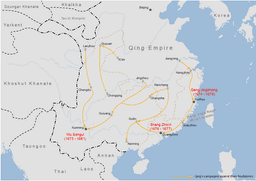
Shang Kexi
General · Modern
54.7Total
Basic Information
Born
1917
1604
Died
1994
1676
Era
Modern
Modern
Nationality
Yemen
China
Occupation
General
General
Civilization
Middle Eastern
Eastern
Score Comparison
Military (10%)
46.7
47.5
Political (20%)
39.4
68.0
Influence (20%)
49.4
56.4
Legacy (20%)
41.7
49.2
Leadership (15%)
50.7
48.8
Strategy (15%)
41.7
60.0
TOTAL
45.1
54.7
Abdullah al-Sallal — Complete Timeline
1962 AD
Led the 1962 Revolution in YemenPolitical Action
Abdullah al-Sallal led a military coup that overthrew the imamate of Muhammad al-Badr, son of Ahmad bin Yahya. He proclaimed the Yemen Arab Republic and became its first president, sparking the North Yemen Civil War.
YemenRevolutionRepublic
Impact: regionalconstructive
Became President of the Yemen Arab RepublicPolitical Action◆ Major
After the coup, al-Sallal assumed the presidency of the newly declared Yemen Arab Republic. He faced a civil war against royalist forces backed by Saudi Arabia, lasting until 1970.
YemenPresidentCivil War
Impact: national
1967 AD
Deposed and ExiledPolitical Action◆ Major
Abdullah al-Sallal was deposed by a military coup while abroad in Iraq. He went into exile in Cairo, ending his rule. His removal led to a shift in republican leadership and eventual peace negotiations.
YemenCoupExile
Impact: nationaltragic
Shang Kexi — Complete Timeline
1634 AD
Defection to the Qing DynastyPolitical Action◆ Major
Shang Kexi, a Ming general stationed in Liaodong, surrendered to the Qing dynasty after a series of defeats. His defection provided the Qing with experienced Han Chinese troops and knowledge of Ming defenses.
DefectionMing-Qing WarQing Dynasty
Impact: nationaldestructive
1644 AD
Service in the Qing Conquest of ChinaWar◆ Major
Shang Kexi led his Han Chinese forces in the Qing invasion of China proper, participating in the capture of Beijing and subsequent campaigns against Ming loyalists in the south. His troops were instrumental in the Qing victory.
Military CampaignQing ConquestHan Chinese Forces
Impact: nationaldestructive
1649 AD
Enfeoffment as Prince of PingnanPolitical Action◆ Major
The Qing court enfeoffed Shang Kexi as the Prince of Pingnan (Pacifier of the South), granting him hereditary rule over Guangdong province. This made him one of the Three Feudatories, semi-autonomous vassals in southern China.
Three FeudatoriesQing DynastyFeudal Title
Impact: regionalconstructive
1673 AD
Rebellion of the Three FeudatoriesWar◆ Major
Shang Kexi initially remained loyal to the Qing when Wu Sangui launched the Rebellion of the Three Feudatories. However, his son Shang Zhixin joined the rebels, and Shang Kexi was caught in the conflict, dying before its resolution.
RebellionThree FeudatoriesQing Dynasty
Impact: nationaldestructive
1676 AD
Death and Succession CrisisOther◆ Major
Shang Kexi died during the Rebellion of the Three Feudatories, with his son Shang Zhixin having defected to the rebels. His death marked the end of his personal rule, and the Qing later suppressed the rebellion, abolishing the feudatory system.
DeathRebellionThree Feudatories
Impact: regionaltragic
Expert Analysis
Origins
Abdullah al-Sallal was born in 1917 in Sana'a, Yemen, into a modest family. He received military training in Iraq and served in the Yemeni army under the imamate. His exposure to Arab nationalist ideas during his training shaped his revolutionary outlook. Shang Kexi was born in 1604 in Liaodong, Ming China, into a military family. He rose through the ranks of the Ming army, defending the northern border against the Qing. His early career was marked by loyalty to the Ming until his defection in 1633.
Rise to Power
Al-Sallal's rise came on September 26, 1962, when he led a coup against Imam Muhammad al-Badr, establishing the Yemen Arab Republic. The coup was supported by Egyptian President Gamal Abdel Nasser and military officers. Al-Sallal became president and faced an immediate civil war with royalist forces backed by Saudi Arabia. Shang Kexi's rise followed his defection to the Qing in 1633 after a series of defeats. He was given command of Han Chinese troops and played a key role in the Qing conquest of China, including the capture of Beijing in 1644. In 1649, he was enfeoffed as Prince of Pingnan, ruling Guangdong province.
Leadership & Governance
Al-Sallal's leadership was marked by centralization and reliance on Egyptian support. He implemented socialist reforms, nationalized industries, and sought to modernize Yemen. However, his rule was autocratic, and he faced constant rebellion. His governance score stands at 39.4, reflecting instability. Shang Kexi governed Guangdong as a semi-autonomous prince, maintaining order and collecting taxes for the Qing. He allowed local customs and promoted trade, but his rule was feudal, with hereditary succession. His political score of 68.0 indicates effective administration within the Qing system.
Triumph & Tragedy
Al-Sallal's greatest triumph was overthrowing the imamate and establishing a republic, ending centuries of religious rule. His tragedy was the prolonged civil war that devastated Yemen, and his eventual deposition in 1967 while abroad, leading to exile in Cairo. Shang Kexi's triumphs include successful military campaigns for the Qing and stable governance in Guangdong. His tragedy came during the Rebellion of the Three Feudatories (1673-1681): his son Shang Zhixin joined the rebels, and Shang Kexi died in 1676 before the rebellion was crushed, his legacy tarnished by familial betrayal.
Character & Destiny
Al-Sallal was a determined revolutionary, but his reliance on foreign support and lack of broad coalition weakened his position. His character score of 50.7 reflects moderate leadership. Shang Kexi was pragmatic and loyal to the Qing until his death, but his son's rebellion marred his legacy. His strategic score of 60.0 shows careful decision-making, yet he failed to secure his dynasty's future.
Legacy
Al-Sallal's legacy is mixed: he is remembered as the father of the Yemeni republic, but his rule saw instability. His total score of 45.1 reflects limited lasting impact. Shang Kexi's legacy as a Ming defector and Qing prince is complex; he contributed to Qing consolidation but is often overshadowed by Wu Sangui. His total score of 54.7 indicates greater overall impact due to his role in the Qing conquest and governance.
Conclusion
While al-Sallal's revolution was a pivotal moment for Yemen, his rule was short-lived and chaotic. Shang Kexi, despite being a defector, had a more enduring impact through his military contributions and governance. With a total score of 54.7 against 45.1, Shang Kexi had greater historical impact due to his role in the Qing dynasty's rise and his effective administration of Guangdong.
Rankings
🥇
Shang KexiLeader
Mil: 47.5Pol: 68.0Inf: 56.4
54.7
🥈
Abdullah al-Sallal
Mil: 46.7Pol: 39.4Inf: 49.4
45.1
+9.6 behind
How This Comparison Works
Algorithm
Each figure is scored on 6 dimensions (0—100 scale) based on structured historical data: Military (10%), Political (20%), Influence (20%), Legacy (20%), Leadership (15%), Strategy (15%). The weighted total produces the final ranking.
Data Sources
Scores are computed from structured sub-indicators in the database. Scale factors adjust for era (Ancient ×0.85, Modern ×1.0) and civilization size (Eastern ×1.05, Other ×0.80) to account for differences in population and military scale.
Maximum 3 Figures
Comparisons are limited to 2—3 figures to ensure readability and statistical meaningfulness.
Error Margins
±5 points per dimension — Sub-scores are derived from historical records with inherent uncertainty. Two figures within 5 points on a dimension should be considered roughly equivalent in that area.
Total Score Accuracy
±3 points overall — The weighted combination of 6 dimensions produces a total score with approximately ±3 points of uncertainty. Differences of less than 3 points are not statistically significant— the figures are effectively tied.
Known Limitations
- Historical records are incomplete and uneven across civilizations
- Figures from oral-tradition societies may be underrepresented
- Occupation labels can misclassify multi-role figures
- Scores measure capability and impact, not moral character
- Quantitative scoring is a comparison tool, not absolute truth
Capability Radar
Military (10%) — Battles & Warfare
Battles
30
55
Win Rate
40
50
Expansion
15
40
Political (20%) — Governance & Reform
Reform
30
35
Diplomacy
25
55
Economy
20
40
Influence (20%) — Cultural & Global Reach
Cultural
15
30
Global
10
30
Legacy (20%) — Historical Impact
Historical
30
45
Longevity
10
40
Leadership (15%) — Power & Stability
Tenure
35
60
Stability
15
45
Strategy (15%) — Tactics & Innovation
Strategy
30
50
Tactics
25
45
Reform
20
30
Similar Comparisons
Comments & Discussion
No comments yet. Be the first to share your thoughts!