Loading...
Jassa Singh Ramgarhia vs Shang Kexi
Jassa Singh Ramgarhia leads by 1.4 pts · 2 figures compared
…

Jassa Singh Ramgarhia
General · Modern
56.1Total
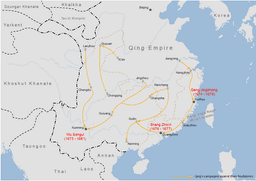
Shang Kexi
General · Modern
54.7Total
Basic Information
Born
1723
1604
Died
1803
1676
Era
Modern
Modern
Nationality
India
China
Occupation
General
General
Civilization
Indian
Eastern
Score Comparison
Military (10%)
70.0
47.5
Political (20%)
48.0
68.0
Influence (20%)
56.4
56.4
Legacy (20%)
49.2
49.2
Leadership (15%)
65.0
48.8
Strategy (15%)
57.5
60.0
TOTAL
56.1
54.7
Jassa Singh Ramgarhia — Complete Timeline
1754 AD
Construction of Ramgarh FortPolitical Action◆ Major
Jassa Singh Ramgarhia built the Ramgarh Fort near Amritsar, which became the stronghold of his misl. The fort's construction solidified his control over the region and gave his misl its name, establishing him as a major Sikh leader.
Sikh MislFortificationPunjab
Impact: regionalconstructive
1764 AD
Capture of SirhindWar◆ Major
Jassa Singh Ramgarhia participated in the Sikh capture of Sirhind from the Afghan Durrani Empire. The victory avenged the 1762 Vadda Ghalughara massacre and established Sikh control over the strategic city, boosting his misl's power.
Sikh-Afghan WarsBattlePunjab
Impact: regional
1770 AD
Conflict with Jassa Singh AhluwaliaWar
Jassa Singh Ramgarhia fought against the Dal Khalsa led by Jassa Singh Ahluwalia over leadership disputes. He was defeated and forced to flee to the desert, losing his territories temporarily, which weakened his misl's influence.
Sikh Civil WarPower StrugglePunjab
Impact: regionaldestructive
1803 AD
Alliance with the BritishPolitical Action
Jassa Singh Ramgarhia allied with the British East India Company against the Marathas. This alliance secured his territories under British protection, but also marked the beginning of British influence over Sikh misls.
British AllianceSikh MislPunjab
Impact: regional
Shang Kexi — Complete Timeline
1634 AD
Defection to the Qing DynastyPolitical Action◆ Major
Shang Kexi, a Ming general stationed in Liaodong, surrendered to the Qing dynasty after a series of defeats. His defection provided the Qing with experienced Han Chinese troops and knowledge of Ming defenses.
DefectionMing-Qing WarQing Dynasty
Impact: nationaldestructive
1644 AD
Service in the Qing Conquest of ChinaWar◆ Major
Shang Kexi led his Han Chinese forces in the Qing invasion of China proper, participating in the capture of Beijing and subsequent campaigns against Ming loyalists in the south. His troops were instrumental in the Qing victory.
Military CampaignQing ConquestHan Chinese Forces
Impact: nationaldestructive
1649 AD
Enfeoffment as Prince of PingnanPolitical Action◆ Major
The Qing court enfeoffed Shang Kexi as the Prince of Pingnan (Pacifier of the South), granting him hereditary rule over Guangdong province. This made him one of the Three Feudatories, semi-autonomous vassals in southern China.
Three FeudatoriesQing DynastyFeudal Title
Impact: regionalconstructive
1673 AD
Rebellion of the Three FeudatoriesWar◆ Major
Shang Kexi initially remained loyal to the Qing when Wu Sangui launched the Rebellion of the Three Feudatories. However, his son Shang Zhixin joined the rebels, and Shang Kexi was caught in the conflict, dying before its resolution.
RebellionThree FeudatoriesQing Dynasty
Impact: nationaldestructive
1676 AD
Death and Succession CrisisOther◆ Major
Shang Kexi died during the Rebellion of the Three Feudatories, with his son Shang Zhixin having defected to the rebels. His death marked the end of his personal rule, and the Qing later suppressed the rebellion, abolishing the feudatory system.
DeathRebellionThree Feudatories
Impact: regionaltragic
Expert Analysis
Origins
Jassa Singh Ramgarhia was born in 1723 into a Sikh family in the village of Ichogil near Amritsar. His father, Bhagwan Singh, was a peasant farmer. Little is known of his early education, but he was trained in martial arts and horsemanship. He joined the Sikh misl system, a confederation of warrior bands that emerged in the 18th century to resist Mughal and Afghan rule. His rise began when he built the Ramgarh Fort (Ramgarh means 'fort of God') near Amritsar in 1748, which became the base of his misl, the Ramgarhia.
Shang Kexi was born in 1604 in Liaodong, a frontier region of the Ming dynasty. His father, Shang Xueyan, served as a Ming military officer. Shang Kexi followed his father into the military, becoming a general in the Ming army. He was stationed in Liaodong to defend against the rising Qing (Manchu) threat. In 1633, after a series of defeats, he surrendered to the Qing, a decision that would define his career.
Rise to Power
Jassa Singh Ramgarhia's power grew as he fortified his stronghold and expanded his territory through raids and battles. In 1761, after the Third Battle of Panipat, the Afghan Durrani Empire weakened, allowing Sikh misls to gain ground. In 1764, Jassa Singh Ramgarhia participated in the capture of Sirhind, a key city, avenging the 1762 Vadda Ghalughara massacre where Afghans killed thousands of Sikhs. This victory increased his prestige. However, internal conflicts with other misl leaders, notably Jassa Singh Ahluwalia, led to his defeat in 1770 and forced him to flee to the desert region of Bikaner. He later returned and allied with the British East India Company in 1803, securing his territories under British protection.
Shang Kexi rose to prominence after defecting to the Qing. His experience and Han Chinese troops were valuable to the Qing in their conquest of China. He participated in the capture of Beijing in 1644 and subsequent campaigns against Ming loyalists and rebels. In 1648, the Qing enfeoffed him as the Prince of Pingnan (Pacifier of the South), granting him hereditary rule over Guangdong province. This made him one of the Three Feudatories, semi-autonomous rulers who controlled large parts of southern China.
Leadership & Governance
Jassa Singh Ramgarhia led the Ramgarhia misl, which operated as a decentralized military band. His leadership was based on personal loyalty and the ability to provide protection and plunder. He maintained control through fortifications like Ramgarh Fort. His governance was typical of Sikh misls: collect revenue from lands under control, administer justice through local councils, and maintain a cavalry force. However, his political score of 48.0 reflects limited state-building; he never established a lasting administrative structure.
Shang Kexi, as a Qing feudatory, governed Guangdong with significant autonomy. He maintained his own army, collected taxes, and appointed officials. His political score of 68.0 indicates higher effectiveness in governance. He integrated Han Chinese and Manchu practices, but his rule was ultimately subordinate to the Qing emperor. His leadership style was autocratic, and he suppressed dissent forcefully. However, his reliance on hereditary succession led to instability; his son Shang Zhixin rebelled against the Qing during the Rebellion of the Three Feudatories.
Triumph & Tragedy
Jassa Singh Ramgarhia's greatest success was building the Ramgarh Fort and establishing the Ramgarhia misl as a significant force. He scored 70.0 in military, reflecting his battlefield successes, such as the capture of Sirhind. His alliance with the British preserved his territories until his death in 1803. However, his greatest failure was his inability to unite with other Sikh misls; his conflict with Jassa Singh Ahluwalia weakened the Sikh confederation and led to his temporary exile. His legacy score of 49.2 indicates limited long-term impact; the Ramgarhia misl was eventually absorbed into the Sikh Empire under Ranjit Singh.
Shang Kexi's triumph was his rise from Ming general to Qing prince, controlling a wealthy province. He contributed to the Qing conquest of China and maintained stability in Guangdong for decades. However, his tragedy was the rebellion of his son Shang Zhixin, which tarnished his legacy. He died in 1676 during the rebellion, with his son having defected to Wu Sangui. The Qing court later executed his family and abolished the Pingnan feudatory. His political score of 68.0 is offset by a military score of 47.5, reflecting his role more as a defector than a battlefield commander.
Character & Destiny
Jassa Singh Ramgarhia was known for his tenacity and skill in fortification. He was a capable military leader but lacked the political acumen to navigate Sikh inter-misl rivalries. His character—stubborn and independent—led him to conflict with other leaders, shaping his destiny of temporary exile. He scored 65.0 in leadership, indicating strong command of his forces, but his strategy score of 57.5 shows limitations in long-term planning.
Shang Kexi was pragmatic and opportunistic. His decision to defect to the Qing was a calculated move for survival and advancement. He was loyal to the Qing until his death, but his inability to control his son's rebellion highlighted weaknesses in his family governance. His strategy score of 60.0 reflects his ability to navigate the treacherous politics of the Qing court. Historians have viewed him as a competent administrator but a tragic figure whose legacy was overshadowed by the rebellion.
Legacy
Jassa Singh Ramgarhia is remembered as a symbol of Sikh resistance and fortification. The Ramgarhia misl gave rise to the Ramgarhia community, a prominent Sikh clan. However, his legacy is localized; his impact on broader Indian history is limited. He scored 49.2 in legacy, reflecting this. In contrast, Shang Kexi's legacy is tied to the Three Feudatories system, which shaped Qing governance in southern China. His defection contributed to the Qing consolidation, but the rebellion of his son led to the end of feudal privileges. He scored 49.2 in legacy as well, but his political influence (68.0) had a more enduring impact on Chinese history.
Conclusion
While Jassa Singh Ramgarhia excelled in military leadership (70.0 vs 47.5) and had a higher total score (56.1 vs 54.7), Shang Kexi's political influence was greater. Shang Kexi's role in the Qing conquest and his governance of Guangdong had a more significant impact on the course of Chinese history than Jassa Singh's localized exploits. The Ramgarhia misl, despite its military prowess, was eventually absorbed into larger entities. Therefore, Shang Kexi had a greater overall impact, despite his lower total score, due to his integration into a major dynasty and his influence on Qing policy. However, Jassa Singh's influence score (56.4) matches Shang Kexi's, indicating comparable reach within their respective contexts.
Rankings
🥇
Jassa Singh RamgarhiaLeader
Mil: 70.0Pol: 48.0Inf: 56.4
56.1
🥈
Shang Kexi
Mil: 47.5Pol: 68.0Inf: 56.4
54.7
+1.4 behind
How This Comparison Works
Algorithm
Each figure is scored on 6 dimensions (0—100 scale) based on structured historical data: Military (10%), Political (20%), Influence (20%), Legacy (20%), Leadership (15%), Strategy (15%). The weighted total produces the final ranking.
Data Sources
Scores are computed from structured sub-indicators in the database. Scale factors adjust for era (Ancient ×0.85, Modern ×1.0) and civilization size (Eastern ×1.05, Other ×0.80) to account for differences in population and military scale.
Maximum 3 Figures
Comparisons are limited to 2—3 figures to ensure readability and statistical meaningfulness.
Error Margins
±5 points per dimension — Sub-scores are derived from historical records with inherent uncertainty. Two figures within 5 points on a dimension should be considered roughly equivalent in that area.
Total Score Accuracy
±3 points overall — The weighted combination of 6 dimensions produces a total score with approximately ±3 points of uncertainty. Differences of less than 3 points are not statistically significant— the figures are effectively tied.
Known Limitations
- Historical records are incomplete and uneven across civilizations
- Figures from oral-tradition societies may be underrepresented
- Occupation labels can misclassify multi-role figures
- Scores measure capability and impact, not moral character
- Quantitative scoring is a comparison tool, not absolute truth
Capability Radar
Military (10%) — Battles & Warfare
Battles
55
55
Win Rate
60
50
Expansion
50
40
Political (20%) — Governance & Reform
Reform
35
35
Diplomacy
40
55
Economy
30
40
Influence (20%) — Cultural & Global Reach
Cultural
40
30
Global
30
30
Legacy (20%) — Historical Impact
Historical
45
45
Longevity
40
40
Leadership (15%) — Power & Stability
Tenure
45
60
Stability
35
45
Strategy (15%) — Tactics & Innovation
Strategy
55
50
Tactics
50
45
Reform
40
30
Similar Comparisons
Comments & Discussion
No comments yet. Be the first to share your thoughts!