Loading...
Hugh Dowding vs Shang Kexi
Hugh Dowding leads by 17.9 pts · 2 figures compared
…

Hugh Dowding
General · Modern
72.6Total
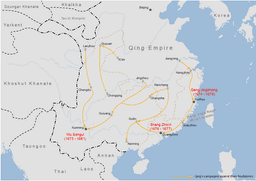
Shang Kexi
General · Modern
54.7Total
Basic Information
Born
1882
1604
Died
1970
1676
Era
Modern
Modern
Nationality
United Kingdom
China
Occupation
General
General
Civilization
Western
Eastern
Score Comparison
Military (10%)
72.5
47.5
Political (20%)
68.0
68.0
Influence (20%)
88.0
56.4
Legacy (20%)
65.0
49.2
Leadership (15%)
62.0
48.8
Strategy (15%)
76.0
60.0
TOTAL
72.6
54.7
Hugh Dowding — Complete Timeline
1936 AD
Introduced Dowding SystemInvention◆ Major
As Air Member for Research and Development, Dowding oversaw the creation of the integrated air defense system known as the Dowding System. It combined radar, observer corps, fighter control rooms, and radio communication, enabling effective command and control during the Battle of Britain.
TechnologyAir DefenseRadar
Impact: globalconstructive
1940 AD
Battle of BritainWar
Dowding, as Commander-in-Chief of Fighter Command, directed the air defense of Britain against the German Luftwaffe. His strategy of conserving fighter strength and using radar-based command and control led to a British victory, preventing a German invasion.
World War IIAir BattleDefense
Impact: globalconstructive
Relieved of CommandPolitical Action◆ Major
Dowding was removed as Commander-in-Chief of Fighter Command shortly after the Battle of Britain, partly due to disagreements with the Air Ministry over offensive operations and his perceived lack of aggression. He was replaced by Sholto Douglas and given a lesser role in the Ministry of Aircraft Production.
World War IICommand ChangeRoyal Air Force
Impact: nationaltragic
Shang Kexi — Complete Timeline
1634 AD
Defection to the Qing DynastyPolitical Action◆ Major
Shang Kexi, a Ming general stationed in Liaodong, surrendered to the Qing dynasty after a series of defeats. His defection provided the Qing with experienced Han Chinese troops and knowledge of Ming defenses.
DefectionMing-Qing WarQing Dynasty
Impact: nationaldestructive
1644 AD
Service in the Qing Conquest of ChinaWar◆ Major
Shang Kexi led his Han Chinese forces in the Qing invasion of China proper, participating in the capture of Beijing and subsequent campaigns against Ming loyalists in the south. His troops were instrumental in the Qing victory.
Military CampaignQing ConquestHan Chinese Forces
Impact: nationaldestructive
1649 AD
Enfeoffment as Prince of PingnanPolitical Action◆ Major
The Qing court enfeoffed Shang Kexi as the Prince of Pingnan (Pacifier of the South), granting him hereditary rule over Guangdong province. This made him one of the Three Feudatories, semi-autonomous vassals in southern China.
Three FeudatoriesQing DynastyFeudal Title
Impact: regionalconstructive
1673 AD
Rebellion of the Three FeudatoriesWar◆ Major
Shang Kexi initially remained loyal to the Qing when Wu Sangui launched the Rebellion of the Three Feudatories. However, his son Shang Zhixin joined the rebels, and Shang Kexi was caught in the conflict, dying before its resolution.
RebellionThree FeudatoriesQing Dynasty
Impact: nationaldestructive
1676 AD
Death and Succession CrisisOther◆ Major
Shang Kexi died during the Rebellion of the Three Feudatories, with his son Shang Zhixin having defected to the rebels. His death marked the end of his personal rule, and the Qing later suppressed the rebellion, abolishing the feudatory system.
DeathRebellionThree Feudatories
Impact: regionaltragic
Expert Analysis
Origins
Hugh Dowding (1882-1970) was born in Moffat, Scotland, into a military family. He attended the Royal Military Academy at Woolwich and was commissioned into the Royal Artillery. His early career included service in India and with the Royal Flying Corps during World War I, where he developed an interest in aviation. Shang Kexi (1604-1676) was born in Liaodong, China, into a Ming military family. He served as a Ming general in the late Ming period, defending the northern frontier against the Qing. His early experiences were shaped by the chaos of the Ming collapse.
Rise to Power
Dowding rose through the ranks of the Royal Air Force, becoming Air Member for Research and Development in the 1930s. He championed the development of radar and the integrated air defense system that became the Dowding System. In 1936, he became Commander-in-Chief of Fighter Command. His foresight in preparing for air defense was crucial during the Battle of Britain in 1940. Shang Kexi rose by defecting to the Qing in 1633 after several defeats. He led Han Chinese forces in the Qing conquest, participating in the capture of Beijing in 1644. For his service, he was enfeoffed as Prince of Pingnan in 1649, ruling Guangdong.
Leadership & Governance
Dowding's leadership was characterized by meticulous planning and scientific integration. He established a centralized command using radar, observer corps, and fighter control. He conserved fighter strength, refusing to commit forces to the Battle of France. His style was reserved but effective. Shang Kexi governed Guangdong as a semi-autonomous prince, maintaining Han Chinese institutions under Qing suzerainty. He was a competent administrator but his rule was part of the feudal system that later rebelled. His leadership score of 48.8 reflects his limited independent impact.
Triumph & Tragedy
Dowding's greatest triumph was winning the Battle of Britain, defeating the Luftwaffe in 1940. His Dowding System scored 88.0 in influence. However, his tragedy was being relieved of command in 1940 due to political conflicts, despite his success. He was sidelined for the rest of the war. Shang Kexi's triumph was securing Guangdong for the Qing and establishing a dynasty that lasted until 1676. His tragedy was his son's rebellion, which led to the end of his family's power. He died during the Rebellion of the Three Feudatories, with his legacy tarnished. His military score of 47.5 reflects his limited strategic impact.
Character & Destiny
Dowding was known as "Stuffy" for his formal demeanor. He was stubborn in his convictions, which both saved Britain and cost him his job. His character shaped his destiny: his insistence on radar saved the nation, but his refusal to compromise led to his dismissal. Shang Kexi was a pragmatic defector, prioritizing survival. His character led him to serve the Qing, but his son's rebellion destroyed his legacy. His political score of 68.0 is similar to Dowding's, but his overall impact was lower.
Legacy
Dowding's legacy is immense: the Dowding System became the foundation of modern air defense, influencing NATO and other countries. He is remembered as the architect of victory in the Battle of Britain. Shang Kexi is remembered as a Ming defector who became a Qing prince, but his legacy is overshadowed by the Rebellion of the Three Feudatories. His influence score of 56.4 reflects his limited long-term impact.
Conclusion
Hugh Dowding had a greater impact with a total score of 72.6 compared to Shang Kexi's 54.7. Dowding's innovations in air defense saved Britain and shaped modern warfare, while Shang Kexi's role was limited to a transitional period in Chinese history. Dowding's influence endures, while Shang Kexi's is largely forgotten. The score gap of 17.9 points is justified.
Rankings
🥇
Hugh DowdingLeader
Mil: 72.5Pol: 68.0Inf: 88.0
72.6
🥈
Shang Kexi
Mil: 47.5Pol: 68.0Inf: 56.4
54.7
+17.9 behind
How This Comparison Works
Algorithm
Each figure is scored on 6 dimensions (0—100 scale) based on structured historical data: Military (10%), Political (20%), Influence (20%), Legacy (20%), Leadership (15%), Strategy (15%). The weighted total produces the final ranking.
Data Sources
Scores are computed from structured sub-indicators in the database. Scale factors adjust for era (Ancient ×0.85, Modern ×1.0) and civilization size (Eastern ×1.05, Other ×0.80) to account for differences in population and military scale.
Maximum 3 Figures
Comparisons are limited to 2—3 figures to ensure readability and statistical meaningfulness.
Error Margins
±5 points per dimension — Sub-scores are derived from historical records with inherent uncertainty. Two figures within 5 points on a dimension should be considered roughly equivalent in that area.
Total Score Accuracy
±3 points overall — The weighted combination of 6 dimensions produces a total score with approximately ±3 points of uncertainty. Differences of less than 3 points are not statistically significant— the figures are effectively tied.
Known Limitations
- Historical records are incomplete and uneven across civilizations
- Figures from oral-tradition societies may be underrepresented
- Occupation labels can misclassify multi-role figures
- Scores measure capability and impact, not moral character
- Quantitative scoring is a comparison tool, not absolute truth
Capability Radar
Military (10%) — Battles & Warfare
Battles
75
55
Win Rate
85
50
Expansion
10
40
Political (20%) — Governance & Reform
Reform
60
35
Diplomacy
50
55
Economy
30
40
Influence (20%) — Cultural & Global Reach
Cultural
60
30
Global
75
30
Legacy (20%) — Historical Impact
Historical
85
45
Longevity
70
40
Leadership (15%) — Power & Stability
Tenure
40
60
Stability
70
45
Strategy (15%) — Tactics & Innovation
Strategy
95
50
Tactics
90
45
Reform
80
30
Similar Comparisons
Comments & Discussion
No comments yet. Be the first to share your thoughts!