Loading...
Abu Ubayda ibn al-Jarrah vs Zhang He
Abu Ubayda ibn al-Jarrah leads by 6.5 pts · 2 figures compared
…

Abu Ubayda ibn al-Jarrah
General · Ancient
55.9Total
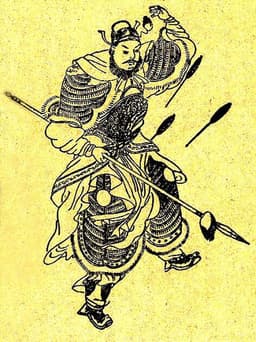
Zhang He
General · Ancient
49.4Total
Basic Information
Born
-583
167
Died
—
231
Era
Ancient
Ancient
Nationality
Rashidun Caliphate
China
Occupation
General
General
Civilization
Middle Eastern
Eastern
Score Comparison
Military (10%)
65.0
67.3
Political (20%)
36.5
27.9
Influence (20%)
60.0
50.2
Legacy (20%)
54.0
45.8
Leadership (15%)
62.0
57.6
Strategy (15%)
61.3
58.0
TOTAL
55.9
49.4
Abu Ubayda ibn al-Jarrah — Complete Timeline
634 AD
Appointed commander of the Syrian campaignWar◆ Major
Caliph Abu Bakr appointed Abu Ubayda ibn al-Jarrah as the supreme commander of the Muslim armies in Syria. He led the conquest of key cities including Damascus and Emesa, and was known for his piety and administrative skills.
Military CommandConquestIslamic Expansion
Impact: regional
636 AD
Battle of YarmoukWar
Abu Ubayda, as commander-in-chief, led the Muslim forces to a decisive victory over the Byzantine Empire at the Battle of Yarmouk. This battle secured Muslim control over Syria and Palestine, and marked a turning point in the Islamic conquests.
BattleByzantine EmpireConquest
Impact: global
639 AD
Death from plague in AmwasOther◆ Major
Abu Ubayda died during the Plague of Amwas (Emmaus) in Palestine, which killed thousands of Muslims. His death was a significant loss to the early Islamic community, and he was buried in the Jordan Valley.
DeathPlagueLoss
Impact: regionaltragic
Zhang He — Complete Timeline
200 AD
Battle of GuanduWar◆ Major
Zhang He served under Yuan Shao at Guandu. After Yuan Shao's defeat, he defected to Cao Cao, bringing valuable intelligence.
Three KingdomsBattleDefection
Impact: national
211 AD
Campaign against Ma ChaoWar◆ Major
Zhang He fought in the campaign against Ma Chao in the northwest. He helped secure Wei control over the region.
Three KingdomsCampaignMa Chao
Impact: regionalconstructive
228 AD
Battle of JietingWar
Zhang He led the Wei army against Shu at Jieting. He defeated Ma Su's forces, forcing Zhuge Liang's First Northern Campaign to retreat.
Three KingdomsBattleMa Su
Impact: nationalconstructive
231 AD
Battle of MumenWar◆ Major
Zhang He pursued Zhuge Liang's retreating army at Mumen. He was ambushed by Shu crossbowmen and killed, a major loss for Wei.
Three KingdomsDeathAmbush
Impact: nationaltragic
Expert Analysis
Origins
Abu Ubayda ibn al-Jarrah was born around 583 CE in Mecca, a member of the Banu al-Harith clan of the Quraysh tribe. He was among the earliest converts to Islam, accepting the faith in the first decade of Muhammad's prophethood. His family background was modest, but his character earned him the title "Amin al-Umma" (Trustee of the Nation). He migrated to Medina in 622 CE and participated in all major early Muslim battles, including Badr and Uhud.
Zhang He was born circa 167 CE in Hejian Commandery, central China, during the waning years of the Han dynasty. He began his career as a minor official under the Han, but the chaos of the Yellow Turban Rebellion and the subsequent warlord conflicts shaped his path. He initially served under Han Fu, then Yuan Shao, and eventually Cao Cao. His early life was marked by the brutal competition of the Three Kingdoms period.
Rise to Power
Abu Ubayda's rise came through his unwavering loyalty to the early Islamic state. After the death of Muhammad in 632 CE, he was a key figure in securing the succession of Abu Bakr, thwarting a rebellion by the Ansar. Caliph Abu Bakr appointed him as supreme commander of the Syrian campaign in 634 CE, replacing Khalid ibn al-Walid but keeping him as a subordinate. This decision was based on Abu Ubayda's administrative skills and piety.
Zhang He rose to prominence through his military service under Yuan Shao. At the Battle of Guandu in 200 CE, Yuan Shao's defeat led Zhang He to defect to Cao Cao, bringing valuable intelligence about Yuan's forces. Cao Cao recognized his talent and made him a general. Zhang He's turning point came in 228 CE at the Battle of Jieting, where he defeated Ma Su and forced Zhuge Liang's First Northern Campaign to retreat, establishing him as a top Wei commander.
Leadership & Governance
Abu Ubayda led with a consultative style, often seeking advice from subordinates like Khalid ibn al-Walid. He was lenient in governance, imposing light taxes on conquered peoples and respecting local customs. During the conquest of Syria, he negotiated surrenders that preserved churches and synagogues. His leadership was moral: he distributed spoils fairly and lived modestly, even as governor.
Zhang He was a strict disciplinarian who emphasized training and logistics. He was known for his caution on the battlefield, preferring to avoid risky maneuvers. In governance, he served as a regional commander under Wei, focusing on defense and suppression of rebellions. He did not engage in civil administration, remaining purely a military figure. His leadership score of 57.6 reflects a capable but uninspiring command style, compared to Abu Ubayda's 62.0.
Triumph & Tragedy
Abu Ubayda's greatest triumph was the Battle of Yarmouk in 636 CE, where he assumed overall command after Khalid's dismissal and led 40,000 Muslims against 100,000 Byzantines. The victory secured Syria and Palestine for Islam. However, his greatest failure was his death from plague at Amwas in 639 CE. He had ignored warnings to flee the epidemic, choosing to stay with his soldiers. This loss deprived the Caliphate of a trusted leader during a critical period.
Zhang He's triumph was at Jieting in 228 CE, where his tactical acumen defeated Ma Su's poorly positioned army. This victory saved Wei from a Shu invasion and cemented his reputation. His tragedy came at the Battle of Mumen in 231 CE. Pursuing Zhuge Liang's retreating forces, he was ambushed and killed by crossbowmen. His caution abandoned him in a fatal moment of overconfidence. Wei lost a veteran general, and Zhuge Liang achieved a symbolic victory.
Character & Destiny
Abu Ubayda was self-effacing and pious, often deferring to others. His humility earned him respect but also led him to accept the plague as divine will. His character score of 62.0 leadership reflects a man who led by example. Destiny favored him with early success but cut his life short at age 57.
Zhang He was calculating and reserved, but also proud. His caution served him well for decades, but his desire to capture Zhuge Liang led to his demise. His political score of 27.9 indicates poor navigation of court intrigues. He died at about 64, a victim of his own ambition.
Legacy
Abu Ubayda's legacy is as the "Trustee of the Nation" and a model of Islamic leadership. His conquests laid the foundation for the Umayyad Caliphate's expansion. He is remembered in Islamic history as a paragon of virtue. His legacy score of 54.0 reflects his impact on early Islam.
Zhang He is remembered as a capable Wei general in the Three Kingdoms romance. His tactical victory at Jieting is studied in military history. However, his legacy is overshadowed by greater figures like Cao Cao and Zhuge Liang. His legacy score of 45.8 is lower due to his limited influence beyond the battlefield.
Conclusion
Abu Ubayda ibn al-Jarrah had a greater historical impact than Zhang He. While Zhang He scored higher in military (67.3 vs 65.0), Abu Ubayda's total score of 55.9 exceeds Zhang He's 49.4. More importantly, Abu Ubayda's conquests permanently changed the religious and political map of the Middle East, bringing Syria under Islamic rule for centuries. Zhang He, despite his tactical brilliance, only contributed to the stability of a single Chinese kingdom during a period of disunity. Abu Ubayda's leadership and legacy shaped world history, while Zhang He remains a footnote in a regional conflict.
Rankings
🥇
Abu Ubayda ibn al-JarrahLeader
Mil: 65.0Pol: 36.5Inf: 60.0
55.9
🥈
Zhang He
Mil: 67.3Pol: 27.9Inf: 50.2
49.4
+6.5 behind
How This Comparison Works
Algorithm
Each figure is scored on 6 dimensions (0—100 scale) based on structured historical data: Military (10%), Political (20%), Influence (20%), Legacy (20%), Leadership (15%), Strategy (15%). The weighted total produces the final ranking.
Data Sources
Scores are computed from structured sub-indicators in the database. Scale factors adjust for era (Ancient ×0.85, Modern ×1.0) and civilization size (Eastern ×1.05, Other ×0.80) to account for differences in population and military scale.
Maximum 3 Figures
Comparisons are limited to 2—3 figures to ensure readability and statistical meaningfulness.
Error Margins
±5 points per dimension — Sub-scores are derived from historical records with inherent uncertainty. Two figures within 5 points on a dimension should be considered roughly equivalent in that area.
Total Score Accuracy
±3 points overall — The weighted combination of 6 dimensions produces a total score with approximately ±3 points of uncertainty. Differences of less than 3 points are not statistically significant— the figures are effectively tied.
Known Limitations
- Historical records are incomplete and uneven across civilizations
- Figures from oral-tradition societies may be underrepresented
- Occupation labels can misclassify multi-role figures
- Scores measure capability and impact, not moral character
- Quantitative scoring is a comparison tool, not absolute truth
Capability Radar
Military (10%) — Battles & Warfare
Battles
65
65
Win Rate
80
60
Expansion
75
40
Political (20%) — Governance & Reform
Reform
30
20
Diplomacy
70
40
Economy
40
30
Influence (20%) — Cultural & Global Reach
Cultural
55
30
Global
55
20
Legacy (20%) — Historical Impact
Historical
65
45
Longevity
60
40
Leadership (15%) — Power & Stability
Tenure
60
55
Stability
65
45
Strategy (15%) — Tactics & Innovation
Strategy
75
65
Tactics
70
70
Reform
30
30
Similar Comparisons
Comments & Discussion
No comments yet. Be the first to share your thoughts!