Loading...
Agilulf vs Julius Caesar
Julius Caesar leads by 37.1 pts · 2 figures compared
…
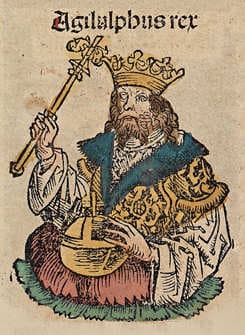
Agilulf
Emperor · Medieval
45.7Total

Julius Caesar
General · Ancient
82.8Total
Basic Information
Born
555
-100
Died
616
-44
Era
Medieval
Ancient
Nationality
Lombards
Roman Republic
Occupation
Emperor
General
Civilization
Western
Western
Score Comparison
Military (10%)
50.0
88.0
Political (20%)
36.5
78.0
Influence (20%)
49.4
85.0
Legacy (20%)
40.8
82.0
Leadership (15%)
58.8
80.0
Strategy (15%)
38.6
85.0
TOTAL
45.7
82.8
Agilulf — Complete Timeline
590 AD
Conversion from Arianism to CatholicismCultural◆ Major
Agilulf converted from Arian Christianity to Catholicism, aligning the Lombard kingdom with the Papacy and the majority of the Italian population. This shift reduced religious tensions and facilitated integration with the Romanized populace.
Religious ConversionLombard KingdomCatholic Church
Impact: regionalconstructive
593 AD
Siege of RomeWar
Agilulf besieged Rome, threatening the city and Pope Gregory I. The siege was lifted after negotiations, with the Lombards withdrawing in exchange for tribute. This event highlighted the Lombard military threat to the Papacy.
SiegeLombard-Papal ConflictMilitary Campaign
Impact: regionaldestructive
598 AD
Peace Treaty with the Byzantine EmpirePolitical Action◆ Major
Agilulf negotiated a peace treaty with the Byzantine Exarch of Ravenna, ending decades of intermittent warfare. The treaty secured Lombard control over much of northern Italy and established a period of stability.
DiplomacyByzantine-Lombard RelationsPeace
Impact: regionalconstructive
Julius Caesar — Complete Timeline
58 BC
Gallic WarsWar◆ Major
Caesar, as proconsul of Gaul, launched a series of campaigns that conquered all of Gaul (modern France, Belgium, and parts of Switzerland). He fought numerous battles, including against the Helvetii, the Belgae, and the Gallic chieftain Vercingetorix. The wars brought immense wealth and a loyal army to Caesar.
Gallic WarsConquestRoman Expansion
Impact: regional
49 BC
Crossing the RubiconPolitical Action◆ Major
Caesar led Legio XIII across the Rubicon River into Italy, defying the Roman Senate's order to disband his army. This act triggered a civil war against Pompey and the Optimates, ultimately leading to Caesar's dictatorship and the end of the Roman Republic.
Roman Civil WarEnd of RepublicPower Struggle
Impact: global
48 BC
Battle of PharsalusWar◆ Major
Caesar's outnumbered army defeated the larger forces of Pompey the Great at Pharsalus in Greece. Caesar's tactical use of a reserve line to counter Pompey's cavalry charge proved decisive. Pompey fled to Egypt, where he was assassinated, leaving Caesar as the undisputed master of the Roman world.
Roman Civil WarBattleDecisive Victory
Impact: regional
44 BC
Appointment as Dictator for LifePolitical Action◆ Major
The Roman Senate appointed Caesar dictator perpetuo (dictator for life), granting him unprecedented personal power. This move concentrated military, legislative, and judicial authority in one person, effectively ending the Roman Republic's traditional system of checks and balances and alarming many senators.
DictatorshipEnd of RepublicPower Consolidation
Impact: regionaldestructive
Assassination on the Ides of MarchPolitical Action◆ Major
A group of Roman senators, led by Marcus Junius Brutus and Gaius Cassius Longinus, stabbed Caesar to death at a meeting of the Senate in the Theatre of Pompey. The assassination was intended to restore the Republic, but instead triggered another civil war that led to the rise of the Roman Empire.
AssassinationRoman PoliticsEnd of Republic
Impact: globaldestructive
Expert Analysis
agilulf-vs-julius-caesar
# The Shadow and the Sun
In the year 593, the Lombard king Agilulf stood before the walls of Rome, his army poised to sack the ancient capital of the Western world. Pope Gregory I, a man of immense spiritual authority but no military might, negotiated with the barbarian king. The siege was lifted. A treaty was signed. The moment passed. Almost exactly six centuries later, another general—Julius Caesar—crossed a small river in northern Italy and changed the course of history forever. Why did one man stop at the gates, while the other marched through them? The answer lies not merely in ambition, but in the very fabric of their worlds.
Origins
Julius Caesar was born into a patrician family in 100 BCE, at the twilight of the Roman Republic. His world was one of relentless competition—for military glory, political office, and the favor of the mob. The Republic was a cauldron of ambition, where a man could rise from nothing to command legions, but where success invited envy and assassination. Caesar’s early life was marked by exile, debt, and a desperate need to prove himself. He was a gambler by nature, a man who borrowed fortunes to stage games for the masses, knowing that glory was the only currency that mattered.
Agilulf, by contrast, emerged from a very different world. Born around 555, he was a Lombard chieftain in a fractured Italy. The Lombards had invaded the peninsula after the collapse of Roman authority, but they were outsiders in a land still dominated by Byzantine power and the growing influence of the Papacy. Agilulf’s challenge was not to conquer a Republic but to hold together a kingdom of warriors who had little loyalty beyond their own clans. His world was one of survival, not glory—a world where conversion to Catholicism in 590 was less an act of faith than a strategic necessity to win the support of the Pope and the Italian populace.
Rise to Power
Caesar’s path to power was a masterpiece of calculated risk. He served as a military tribune, then as quaestor in Spain, where he saw the statue of Alexander the Great and wept at his own lack of achievement. He forged the First Triumvirate with Pompey and Crassus, a political alliance that gave him command of Gaul. In eight years of brutal warfare, he conquered a territory larger than Italy itself, amassing a fortune and an army loyal to him alone. The Rubicon was the final threshold: crossing it meant civil war, but not crossing it meant oblivion.
Agilulf’s rise was quieter but no less significant. He became king of the Lombards in 590, a time when his people were besieged by both the Byzantine Empire and internal divisions. His first major act was the siege of Rome in 593—a demonstration of force that ended not in conquest but in negotiation. This was not cowardice; it was realism. Agilulf understood that his kingdom could not survive a war on two fronts. He made peace with the Byzantines in 598, securing a fragile stability that allowed his people to consolidate their hold on northern Italy.
Leadership & Governance
Caesar governed as he conquered: with audacity and speed. As dictator, he reformed the calendar, granted citizenship to provincials, and launched massive building projects. He centralized power in his own hands, undermining the Senate and the old aristocratic order. His military genius lay in improvisation—at Alesia, he built fortifications around a besieged city while simultaneously defending against a relief army. His political wisdom, however, was flawed. He pardoned his enemies, but never won their loyalty. He believed that power, once seized, could be held by sheer force of will.
Agilulf’s rule was more modest but more sustainable. He converted to Catholicism, aligning his kingdom with the Pope and the majority of his subjects. He negotiated peace with the Byzantines, not because he could not fight, but because he knew that war would bleed his people dry. He strengthened Lombard control through diplomacy and marriage, rather than conquest. His strategy was one of consolidation, not expansion. Where Caesar built an empire, Agilulf built a kingdom.
Triumph & Tragedy
Caesar’s greatest triumph was his conquest of Gaul, which made him the richest and most powerful man in the Roman world. His greatest tragedy was his assassination on the Ides of March, 44 BCE, at the hands of senators he had pardoned. He died believing he could control the forces he had unleashed, but the Republic he sought to reform was already dead. His murder plunged Rome into another civil war, and the Empire that followed was his creation, but not his vision.
Agilulf’s triumph was the peace treaty of 598, which gave his kingdom two decades of stability. His tragedy was that this peace was fragile. After his death in 616, the Lombard kingdom would face renewed Byzantine pressure and internal strife. He had built a house of cards, but it was the best house possible in a world of chaos.
Character & Destiny
Caesar was a man of boundless ambition and cold calculation. He wrote his own commentaries, shaped his own legend, and believed that fate favored the bold. His personality drove him to take risks that others would not—and ultimately, to die because he could not stop taking them. He was a genius of action, but a failure of reflection.
Agilulf was a pragmatist. He was not a conqueror but a survivor. He understood that in the long twilight of the ancient world, the only victory was to endure. His conversion, his treaties, his restraint—all were choices made not for glory, but for the survival of his people. He was a man who knew his limits, and that knowledge was his strength.
Legacy
Caesar’s legacy is immense. His name became synonymous with imperial power: *Kaiser* in German, *Tsar* in Russian. His reforms shaped the Roman Empire, and through it, all of Western civilization. He is remembered as a military genius, a political visionary, and a cautionary tale about the dangers of unchecked ambition.
Agilulf’s legacy is quieter. He is remembered, if at all, as a king who brought stability to a turbulent age. His conversion helped Christianize the Lombards, and his peace treaties allowed Italy to recover from centuries of war. He is not a figure of legend, but a figure of history—a man who did what he could with what he had.
Conclusion
Standing on the banks of the Rubicon, Caesar saw a future of infinite possibility. Standing before the walls of Rome, Agilulf saw a future of necessary compromise. Both men were leaders of their age, but their ages were different. Caesar lived in a world of ambition, where one man could reshape history. Agilulf lived in a world of survival, where the best one could hope for was to hold the line. In the end, Caesar’s story is one of triumph and tragedy; Agilulf’s is one of persistence and peace. Both are essential to understanding the long, strange arc of Western history—a tale of glory and grit, of suns that burn bright and shadows that endure.
Rankings
🥇
Julius CaesarLeader
Mil: 88.0Pol: 78.0Inf: 85.0
82.8
🥈
Agilulf
Mil: 50.0Pol: 36.5Inf: 49.4
45.7
+37.1 behind
How This Comparison Works
Algorithm
Each figure is scored on 6 dimensions (0—100 scale) based on structured historical data: Military (10%), Political (20%), Influence (20%), Legacy (20%), Leadership (15%), Strategy (15%). The weighted total produces the final ranking.
Data Sources
Scores are computed from structured sub-indicators in the database. Scale factors adjust for era (Ancient ×0.85, Modern ×1.0) and civilization size (Eastern ×1.05, Other ×0.80) to account for differences in population and military scale.
Maximum 3 Figures
Comparisons are limited to 2—3 figures to ensure readability and statistical meaningfulness.
Error Margins
±5 points per dimension — Sub-scores are derived from historical records with inherent uncertainty. Two figures within 5 points on a dimension should be considered roughly equivalent in that area.
Total Score Accuracy
±3 points overall — The weighted combination of 6 dimensions produces a total score with approximately ±3 points of uncertainty. Differences of less than 3 points are not statistically significant— the figures are effectively tied.
Known Limitations
- Historical records are incomplete and uneven across civilizations
- Figures from oral-tradition societies may be underrepresented
- Occupation labels can misclassify multi-role figures
- Scores measure capability and impact, not moral character
- Quantitative scoring is a comparison tool, not absolute truth
Capability Radar
Military (10%) — Battles & Warfare
Battles
20
95
Win Rate
25
92
Expansion
20
97
Political (20%) — Governance & Reform
Reform
30
90
Diplomacy
35
85
Economy
30
82
Influence (20%) — Cultural & Global Reach
Cultural
20
88
Global
15
94
Legacy (20%) — Historical Impact
Historical
25
95
Longevity
20
96
Leadership (15%) — Power & Stability
Tenure
40
75
Stability
35
60
Strategy (15%) — Tactics & Innovation
Strategy
25
94
Tactics
20
96
Reform
15
88
Similar Comparisons
Comments & Discussion
ShadowLegion6/17/2026
Caesar didn't just cross the Rubicon—he shattered the Republic's spine. Agilulf faced Pope Gregory I, a man who reframed surrender as diplomacy, while Caesar dealt with a Senate that had already devoured itself with civil wars. The key difference? Lombard kings lacked the institutional tools to rule Rome, let alone sack it sustainably. Caesar had a decade of Gallic conquests funding his ambition. Agilulf had loot and no administrative network. That's why one carved history; the other just indent
ThesisThrasher6/17/2026
说Agilulf“止步于罗马城下”就是历史教科书式的洗白。593年他的军队染病,补给线被拜占庭海军切断,根本打不了持久战——教皇谈判不过是给了个体面台阶。反观Caesar,前49年他带着第13军团闪电般南下,沿途城镇望风而降,是因为他早就在高卢战争中学会了后勤与心理战的双重艺术。拿一个军阀跟帝国缔造者比?把Agilulf扔到元老院辩论,他连发言机会都没有。
NumismaticNerd6/17/2026
Coinage doesn't lie: Caesar minted his own silver denarii bearing his likeness while still alive—an unheard-of provocation. Agilulf never struck a single coin with his portrait anywhere in Lombard Italy. That's the difference between a man building a personal cult and one just trying to hold a throne. When Caesar crossed the Rubicon, he carried the economic infrastructure of Rome in his pay chests. Agilulf lifted the siege because his treasury was empty. Money talks louder than swords.
ByzantineBias6/17/2026
你们都在吹Caesar的野心,但别忘了593年东罗马帝国皇帝莫里斯还活着。Agilulf撤兵不是出于对教皇的敬畏,而是怕查士丁尼二世派兵从拉文纳抄他后路。Caesar跨卢比孔河时面对的只是一个瘫痪的元老院和庞培的犹豫——权力真空让他敢赌。把这俩位置互换:如果Caesar遇上东罗马的牵制体系,他也会当“和平使者”。军事史不是个人英雄传,是系统的博弈。
DeadLanguagesDr6/17/2026
Let’s not ignore the literary framing: Caesar wrote his own epic; Agilulf got chronicled by Paul the Deacon centuries later. One controlled his narrative down to the comma; the other is a footnote in someone else’s story. When Caesar called his invasion a *justum bellum* against senatorial tyranny, he gave future historians a ready-made justification. Agilulf’s treaty with Gregory? It survives only as church propaganda about papal miracles. History belongs to those who write it, not those who en