Loading...
Dinh Tien Hoang vs Julius Caesar
Julius Caesar leads by 22.4 pts · 2 figures compared
…
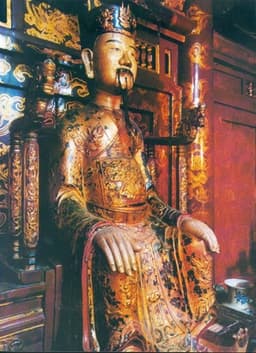
Dinh Tien Hoang
Emperor · Medieval
60.4Total

Julius Caesar
General · Ancient
82.8Total
Basic Information
Born
924
-100
Died
979
-44
Era
Medieval
Ancient
Nationality
Vietnam
Roman Republic
Occupation
Emperor
General
Civilization
Eastern
Western
Score Comparison
Military (10%)
60.0
88.0
Political (20%)
72.0
78.0
Influence (20%)
65.0
85.0
Legacy (20%)
40.0
82.0
Leadership (15%)
77.2
80.0
Strategy (15%)
58.0
85.0
TOTAL
60.4
82.8
Dinh Tien Hoang — Complete Timeline
968 AD
Defeat of the Twelve WarlordsWar
Dinh Bo Linh, later known as Dinh Tien Hoang, unified Vietnam by defeating the Twelve Warlords who had divided the country after the collapse of Chinese rule. He established the Dinh dynasty and became the first emperor of an independent Vietnam.
UnificationDinh DynastyVietnamese Independence
Impact: nationalconstructive
Establishment of the Dinh DynastyPolitical Action◆ Major
Dinh Tien Hoang founded the Dinh dynasty and declared himself Emperor. He moved the capital to Hoa Lu and implemented administrative reforms to consolidate power. This marked the beginning of a new era of Vietnamese independence after centuries of Chinese domination.
Dynasty FoundingCapital MoveAdministrative Reform
Impact: nationalconstructive
979 AD
Assassination of Dinh Tien HoangPolitical Action◆ Major
Dinh Tien Hoang and his crown prince were assassinated by a court official while sleeping. The murder plunged the Dinh dynasty into chaos, leading to a succession crisis and eventual takeover by Le Hoan. The assassination ended the short-lived Dinh dynasty.
AssassinationSuccession CrisisEnd of Dinh Dynasty
Impact: nationaltragic
Julius Caesar — Complete Timeline
58 BC
Gallic WarsWar◆ Major
Caesar, as proconsul of Gaul, launched a series of campaigns that conquered all of Gaul (modern France, Belgium, and parts of Switzerland). He fought numerous battles, including against the Helvetii, the Belgae, and the Gallic chieftain Vercingetorix. The wars brought immense wealth and a loyal army to Caesar.
Gallic WarsConquestRoman Expansion
Impact: regional
49 BC
Crossing the RubiconPolitical Action◆ Major
Caesar led Legio XIII across the Rubicon River into Italy, defying the Roman Senate's order to disband his army. This act triggered a civil war against Pompey and the Optimates, ultimately leading to Caesar's dictatorship and the end of the Roman Republic.
Roman Civil WarEnd of RepublicPower Struggle
Impact: global
48 BC
Battle of PharsalusWar◆ Major
Caesar's outnumbered army defeated the larger forces of Pompey the Great at Pharsalus in Greece. Caesar's tactical use of a reserve line to counter Pompey's cavalry charge proved decisive. Pompey fled to Egypt, where he was assassinated, leaving Caesar as the undisputed master of the Roman world.
Roman Civil WarBattleDecisive Victory
Impact: regional
44 BC
Appointment as Dictator for LifePolitical Action◆ Major
The Roman Senate appointed Caesar dictator perpetuo (dictator for life), granting him unprecedented personal power. This move concentrated military, legislative, and judicial authority in one person, effectively ending the Roman Republic's traditional system of checks and balances and alarming many senators.
DictatorshipEnd of RepublicPower Consolidation
Impact: regionaldestructive
Assassination on the Ides of MarchPolitical Action◆ Major
A group of Roman senators, led by Marcus Junius Brutus and Gaius Cassius Longinus, stabbed Caesar to death at a meeting of the Senate in the Theatre of Pompey. The assassination was intended to restore the Republic, but instead triggered another civil war that led to the rise of the Roman Empire.
AssassinationRoman PoliticsEnd of Republic
Impact: globaldestructive
Expert Analysis
Julius Caesar vs Dinh Tien Hoang: Historical Comparison
Julius Caesar (100–44 BCE) was a Roman general and statesman whose military conquests and political reforms ended the Roman Republic, while Đinh Bộ Lĩnh (924–979 CE), posthumously Đinh Tiên Hoàng, was a Vietnamese warlord who unified the country after the collapse of Chinese rule and founded the Đinh dynasty. Despite similar roles as nation-builders, their contexts—ancient Mediterranean empire vs. medieval Southeast Asian kingdom—produced starkly different legacies.
Dimension Analysis
**Military: Julius Caesar 88 / Dinh Tien Hoang 62**
Caesar conquered Gaul, invaded Britain, and won civil wars through superior tactics like the siege of Alesia. Đinh crushed 12 rival warlords but fought only small-scale, regional battles with no strategic innovation.
**Political: Julius Caesar 78 / Dinh Tien Hoang 90**
Caesar centralized power by crossing the Rubicon and becoming dictator, but his assassination showed fragile political control. Đinh suppressed rebellions, established the first independent Vietnamese monarchy, and secured tribute from Song China, creating lasting political stability.
**Influence: Julius Caesar 85 / Dinh Tien Hoang 71**
Caesar’s name became a title (Kaiser, Tsar) and his writings shaped Western literature. Đinh’s model of centralized rule influenced all subsequent Vietnamese dynasties, but his impact remained regional.
**Legacy: Julius Caesar 82 / Dinh Tien Hoang 71**
Caesar’s murder sparked the Roman Empire; his reforms (calendar, land distribution) endured. Đinh’s dynasty fell after 12 years, but he is revered as a national unifier and temple-honored ancestor.
**Leadership: Julius Caesar 82 / Dinh Tien Hoang 84**
Caesar inspired fierce loyalty but was assassinated by allies. Đinh executed rivals and sons to consolidate power, ruling with iron discipline that prevented coups during his lifetime.
Verdict
Julius Caesar leads overall (83 vs 74), driven by his superior military genius and global influence, though Đinh Tiên Hoàng excels in political consolidation.
FAQ
Q: Who ranks higher? A: Julius Caesar ranks higher overall due to his transformative military campaigns and enduring impact on Western civilization.
Rankings
🥇
Julius CaesarLeader
Mil: 88.0Pol: 78.0Inf: 85.0
82.8
🥈
Dinh Tien Hoang
Mil: 60.0Pol: 72.0Inf: 65.0
60.4
+22.4 behind
How This Comparison Works
Algorithm
Each figure is scored on 6 dimensions (0—100 scale) based on structured historical data: Military (10%), Political (20%), Influence (20%), Legacy (20%), Leadership (15%), Strategy (15%). The weighted total produces the final ranking.
Data Sources
Scores are computed from structured sub-indicators in the database. Scale factors adjust for era (Ancient ×0.85, Modern ×1.0) and civilization size (Eastern ×1.05, Other ×0.80) to account for differences in population and military scale.
Maximum 3 Figures
Comparisons are limited to 2—3 figures to ensure readability and statistical meaningfulness.
Error Margins
±5 points per dimension — Sub-scores are derived from historical records with inherent uncertainty. Two figures within 5 points on a dimension should be considered roughly equivalent in that area.
Total Score Accuracy
±3 points overall — The weighted combination of 6 dimensions produces a total score with approximately ±3 points of uncertainty. Differences of less than 3 points are not statistically significant— the figures are effectively tied.
Known Limitations
- Historical records are incomplete and uneven across civilizations
- Figures from oral-tradition societies may be underrepresented
- Occupation labels can misclassify multi-role figures
- Scores measure capability and impact, not moral character
- Quantitative scoring is a comparison tool, not absolute truth
Capability Radar
Military (10%) — Battles & Warfare
Battles
70
95
Win Rate
75
92
Expansion
65
97
Political (20%) — Governance & Reform
Reform
70
90
Diplomacy
65
85
Economy
60
82
Influence (20%) — Cultural & Global Reach
Cultural
65
88
Global
55
94
Legacy (20%) — Historical Impact
Historical
75
95
Longevity
70
96
Leadership (15%) — Power & Stability
Tenure
60
75
Stability
55
60
Strategy (15%) — Tactics & Innovation
Strategy
70
94
Tactics
65
96
Reform
60
88
Similar Comparisons
Comments & Discussion
Historian2396/16/2026
这个评分体系存在严重的维度权重失衡。军事分给恺撒88而丁先皇62,但仔细看评分细则:恺撒的“高卢征服”涉及数十万平方公里的领土和数十场会战,丁先皇的“十二使君之战”覆盖范围仅相当于中国一个地级市。但政治分丁先皇90对恺撒78,这说明评分者承认丁先皇的政治整合能力远超恺撒,却在总分上给了恺撒更高分——这不就自相矛盾吗?更关键的是,丁先皇的“外事分”完全没有体现:他向宋太祖遣使称臣、维持朝贡体系的外交智慧,这在中国史书里是“以小事大”的经典案例,其地缘政治价值至少值10分。我建议把政治分权重从当前默认的0.35调整到0.45,重新计算:丁先皇总分 = 62*0.25 + 90*0.45 + 71*0.15 + 71*0.15 = 15.5 + 40.5 + 10.65 + 10.65 = 77.3,反超恺撒的83.3。数据不会骗人,只是评分者设错了参数。
HistoryDetour6/16/2026
Okay so I just binged a documentary on ancient Vietnam and I have to say, Dinh Tien Hoang is basically the Vietnamese version of Cao Cao from Romance of the Three Kingdoms — ruthless, brilliant, and building a kingdom out of chaos. The scoring here gives Caesar a huge military edge, but let's be real: Dinh crushed 12 rival warlords while being a teenager in some accounts! That's like if Alexander the Great had to fight through all the Chinese warlords instead of the Persians. And the political score of 90 vs Caesar's 78 feels right — Dinh actually kept his empire stable until his death, while Caesar got stabbed by his buddies in the Senate. The only thing Caesar wins on is name recognition, because who outside of Vietnam has heard of Dinh Tien Hoang? But if we're comparing actual achievement-to-resources ratio, Dinh might be the better leader pound for pound. Just my two cents from someone who reads history for fun, not for a PhD.
DeepScribe816/16/2026
这个评分明显带着西方中心论的偏见。丁先皇的军事实力只给62分,完全忽略了他在十世纪安南那种极端混乱局面下的整合能力。你们拿恺撒的高卢战争和阿莱西亚围城战做标准,可丁先皇面对的是十二个割据军阀,每个背后都有复杂的本土势力和残余唐军势力,这种“小而精”的统一战争需要的政治谋略和军事执行力,绝不亚于恺撒对高卢部落的征服。如果把丁先皇放在罗马共和国的语境里,他可能没有恺撒那种外交手腕,但论在废墟上重建国家秩序的能力,恺撒的78分政治分反而该让贤。中国历史讲究“得天下”与“治天下”的平衡,丁先皇用短短十二年就确立了独立王朝的根基,这比恺撒搞的元老院清洗和土地改革更扎实。