Loading...
Ahmad Shah I Wali vs Julius Caesar
Julius Caesar leads by 31.1 pts · 2 figures compared
…
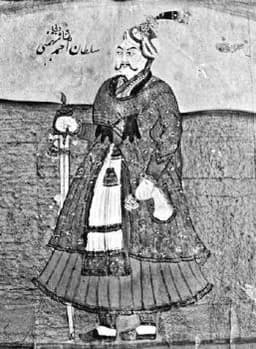
Ahmad Shah I Wali
Emperor · Medieval
51.7Total

Julius Caesar
General · Ancient
82.8Total
Basic Information
Born
1422
-100
Died
1436
-44
Era
Medieval
Ancient
Nationality
India
Roman Republic
Occupation
Emperor
General
Civilization
Indian
Western
Score Comparison
Military (10%)
40.0
88.0
Political (20%)
48.0
78.0
Influence (20%)
51.0
85.0
Legacy (20%)
42.5
82.0
Leadership (15%)
74.0
80.0
Strategy (15%)
60.0
85.0
TOTAL
51.7
82.8
Ahmad Shah I Wali — Complete Timeline
1424 AD
Relocation of the Bahmani capital to BidarPolitical Action
Ahmad Shah I Wali moved the Bahmani capital from Gulbarga to Bidar, a more defensible location. He constructed a new fort and palace complex in Bidar, which became the political center of the sultanate.
Capital MoveUrban Development
Impact: regionalconstructive
1425 AD
War against the Vijayanagara EmpireWar◆ Major
Ahmad Shah I Wali launched a successful campaign against the Vijayanagara Empire, capturing the fort of Mudgal. The victory expanded Bahmani territory in the Raichur Doab.
WarVijayanagaraTerritorial Expansion
Impact: regional
1428 AD
Construction of the Bidar FortCultural◆ Major
Ahmad Shah I Wali oversaw the construction of the Bidar Fort, a massive defensive structure with seven gates and extensive ramparts. The fort became the seat of Bahmani power for over a century.
ArchitectureFortification
Impact: regionalconstructive
1430 AD
Suppression of the rebellion of the Bahmani noblesPolitical Action
Ahmad Shah I Wali crushed a rebellion by powerful Bahmani nobles who opposed his centralization of authority. The rebels were defeated, and their leaders were executed or exiled.
RebellionInternal Conflict
Impact: nationaldestructive
Julius Caesar — Complete Timeline
58 BC
Gallic WarsWar◆ Major
Caesar, as proconsul of Gaul, launched a series of campaigns that conquered all of Gaul (modern France, Belgium, and parts of Switzerland). He fought numerous battles, including against the Helvetii, the Belgae, and the Gallic chieftain Vercingetorix. The wars brought immense wealth and a loyal army to Caesar.
Gallic WarsConquestRoman Expansion
Impact: regional
49 BC
Crossing the RubiconPolitical Action◆ Major
Caesar led Legio XIII across the Rubicon River into Italy, defying the Roman Senate's order to disband his army. This act triggered a civil war against Pompey and the Optimates, ultimately leading to Caesar's dictatorship and the end of the Roman Republic.
Roman Civil WarEnd of RepublicPower Struggle
Impact: global
48 BC
Battle of PharsalusWar◆ Major
Caesar's outnumbered army defeated the larger forces of Pompey the Great at Pharsalus in Greece. Caesar's tactical use of a reserve line to counter Pompey's cavalry charge proved decisive. Pompey fled to Egypt, where he was assassinated, leaving Caesar as the undisputed master of the Roman world.
Roman Civil WarBattleDecisive Victory
Impact: regional
44 BC
Appointment as Dictator for LifePolitical Action◆ Major
The Roman Senate appointed Caesar dictator perpetuo (dictator for life), granting him unprecedented personal power. This move concentrated military, legislative, and judicial authority in one person, effectively ending the Roman Republic's traditional system of checks and balances and alarming many senators.
DictatorshipEnd of RepublicPower Consolidation
Impact: regionaldestructive
Assassination on the Ides of MarchPolitical Action◆ Major
A group of Roman senators, led by Marcus Junius Brutus and Gaius Cassius Longinus, stabbed Caesar to death at a meeting of the Senate in the Theatre of Pompey. The assassination was intended to restore the Republic, but instead triggered another civil war that led to the rise of the Roman Empire.
AssassinationRoman PoliticsEnd of Republic
Impact: globaldestructive
Expert Analysis
ahmad-shah-i-wali-vs-julius-caesar
# The Crossing and the Citadel
On a cold January morning in 49 BCE, Julius Caesar stood at the banks of the Rubicon River, a small stream that marked the boundary of his lawful command. To cross was treason; to stay was irrelevance. He made his choice, and the Roman Republic never recovered. Across the world and fourteen centuries later, Ahmad Shah I Wali faced a different kind of crossing. He looked out from Gulbarga, the old Bahmani capital, and decided to move his entire court to Bidar, a barren plateau that would become the symbol of his reign. One man crossed a river to shatter a republic; the other crossed a landscape to build a fortress. Their paths diverged in every way, yet both understood that history belongs to those who dare to move.
Origins
Julius Caesar was born into the chaos of the late Roman Republic, a world of civil wars, debt, and aristocratic competition. His family, the Julii, claimed descent from the goddess Venus, but they were politically marginal. Caesar grew up watching Sulla and Marius tear Rome apart, learning early that power came not from law but from armies. He was a gambler by nature, a man who borrowed fortunes he could not repay and seduced enemies' wives as a political tactic. His Rome was a city of marble and blood, where ambition was the only virtue that mattered.
Ahmad Shah I Wali emerged in a very different world. The Bahmani Sultanate was a medieval Islamic kingdom in the Deccan, a patchwork of Persian nobles, Hindu warriors, and Turkic slaves. He was the son of Sultan Taj ud-Din Firuz Shah, a ruler who had spent decades fighting the Vijayanagara Empire to the south. Ahmad inherited a kingdom exhausted by war, plagued by rebellious nobles who saw the sultan as first among equals rather than an absolute ruler. His India was a land of monsoon rains, spice routes, and constant tension between faith and power.
Rise to Power
Caesar’s path to power was a masterclass in strategic patience. He climbed the Roman political ladder—quaestor, aedile, praetor, consul—while building a network of debts and alliances. His appointment as governor of Gaul in 58 BCE gave him an army, and he spent eight years conquering a territory that made him rich, famous, and feared. When the Senate ordered him to disband his legions, he refused. The Rubicon was not a moment of impulse; it was the culmination of a lifetime of calculated risk.
Ahmad Shah I Wali inherited power rather than seized it. He became sultan in 1422 after his father’s death, but the throne was unstable. The Bahmani nobles, many of whom commanded their own armies, saw the new sultan as weak. Ahmad’s first challenge was to prove he could rule. He did not have Caesar’s luxury of foreign conquest; he had to consolidate what he already held. His rise was less a dramatic crossing than a slow tightening of the fist.
Leadership & Governance
Caesar governed through personal magnetism and military genius. He led his legions from the front, sharing their rations and sleeping in their tents. His reforms in Gaul—building roads, granting citizenship to allies, imposing Roman law—were designed to create loyalty that transcended the old Republic. As dictator, he reformed the calendar, redistributed land to veterans, and centralized power in his own hands. He was ruthless but pragmatic, pardoning enemies who submitted and destroying those who resisted. His strategy was always to divide and conquer, whether in Gaul or in the Senate.
Ahmad Shah I Wali governed through architecture and consolidation. In 1424, he moved the Bahmani capital from Gulbarga to Bidar, a decision that reshaped his kingdom. Bidar was defensible, perched on a basalt plateau, and Ahmad transformed it into a fortress city with seven gates and extensive walls. In 1428, he completed the Bidar Fort, a masterpiece of medieval military engineering. He also promoted Islamic culture, building mosques and madrasas that turned Bidar into a center of learning. But his political style was cautious. In 1430, when Bahmani nobles rebelled against his centralization of authority, he crushed them decisively but did not exterminate them. He understood that in the Deccan, a sultan needed allies, not corpses.
Triumph & Tragedy
Caesar’s greatest triumph was the conquest of Gaul, a feat that added a vast territory to the Roman world and made him the richest man in history. His victory at the Battle of Alesia in 52 BCE, where he besieged a Gallic army larger than his own, remains a textbook example of military genius. His tragedy was the Ides of March, 44 BCE, when his own senators stabbed him to death. He had centralized power so completely that his survival became impossible. The Republic he had conquered died with him.
Ahmad Shah I Wali’s greatest triumph came in 1425, when he launched a successful campaign against the Vijayanagara Empire, capturing the fort of Mudgal. It was a rare victory against a larger, wealthier enemy, and it secured his southern border for a generation. His tragedy was quieter: he spent his reign fighting not foreign enemies but his own nobility. The rebellion of 1430 revealed a kingdom held together by personal loyalty rather than institutions. When Ahmad died in 1436, the Bahmani Sultanate began a slow decline that would end in fragmentation.
Character & Destiny
Caesar was a man of boundless ambition and cold calculation. He wrote his own propaganda, forgave his enemies until they became liabilities, and understood that in politics, perception is reality. His destiny was to destroy the Republic he claimed to love, not because he hated it, but because he could not imagine himself as anything less than its master. His character made the crossing of the Rubicon inevitable.
Ahmad Shah I Wali was a builder, not a destroyer. He moved a capital, raised a fortress, and suppressed a rebellion, but he never dreamed of empire. His destiny was to preserve what he had inherited, not to expand it. The Deccan was a world of shifting alliances and fragile kingdoms, and Ahmad’s caution was a survival strategy. He died in his bed, which was more than Caesar managed.
Legacy
Caesar’s legacy is the Roman Empire. His heir, Octavian, learned from his mistakes and built a system that lasted five centuries. Caesar’s name became a title—Kaiser, Tsar—and his writings remain classics of military literature. He is remembered as the man who crossed the Rubicon, a phrase that still means a point of no return.
Ahmad Shah I Wali’s legacy is Bidar. The fort he built still stands, a UNESCO World Heritage site that draws visitors from around the world. He is remembered as a patron of Islamic culture and a consolidator of the Bahmani Sultanate, but his name is unknown outside South Asia. He did not change the world; he built a citadel and held it.
Conclusion
Caesar and Ahmad Shah I Wali never met, never knew of each other’s existence. One lived in a world of legions and senators, the other in a world of sultans and rajas. Yet both faced the same question: what do you do with power when you have it? Caesar answered by reaching for more, and his ambition destroyed him. Ahmad answered by holding fast, and his caution preserved his kingdom for a time. History remembers the man who crossed the river, but it was the man who built the fortress who died in peace. Perhaps the lesson is not that one was right and the other wrong, but that every leader must choose between the river and the wall—and live with the consequences.
Rankings
🥇
Julius CaesarLeader
Mil: 88.0Pol: 78.0Inf: 85.0
82.8
🥈
Ahmad Shah I Wali
Mil: 40.0Pol: 48.0Inf: 51.0
51.7
+31.1 behind
How This Comparison Works
Algorithm
Each figure is scored on 6 dimensions (0—100 scale) based on structured historical data: Military (10%), Political (20%), Influence (20%), Legacy (20%), Leadership (15%), Strategy (15%). The weighted total produces the final ranking.
Data Sources
Scores are computed from structured sub-indicators in the database. Scale factors adjust for era (Ancient ×0.85, Modern ×1.0) and civilization size (Eastern ×1.05, Other ×0.80) to account for differences in population and military scale.
Maximum 3 Figures
Comparisons are limited to 2—3 figures to ensure readability and statistical meaningfulness.
Error Margins
±5 points per dimension — Sub-scores are derived from historical records with inherent uncertainty. Two figures within 5 points on a dimension should be considered roughly equivalent in that area.
Total Score Accuracy
±3 points overall — The weighted combination of 6 dimensions produces a total score with approximately ±3 points of uncertainty. Differences of less than 3 points are not statistically significant— the figures are effectively tied.
Known Limitations
- Historical records are incomplete and uneven across civilizations
- Figures from oral-tradition societies may be underrepresented
- Occupation labels can misclassify multi-role figures
- Scores measure capability and impact, not moral character
- Quantitative scoring is a comparison tool, not absolute truth
Capability Radar
Military (10%) — Battles & Warfare
Battles
45
95
Win Rate
50
92
Expansion
40
97
Political (20%) — Governance & Reform
Reform
50
90
Diplomacy
45
85
Economy
40
82
Influence (20%) — Cultural & Global Reach
Cultural
30
88
Global
15
94
Legacy (20%) — Historical Impact
Historical
35
95
Longevity
20
96
Leadership (15%) — Power & Stability
Tenure
55
75
Stability
50
60
Strategy (15%) — Tactics & Innovation
Strategy
45
94
Tactics
40
96
Reform
35
88
Similar Comparisons
Comments & Discussion
CrixusThrowback6/17/2026
Military historians love to hype Caesar’s Rubicon as some ultimate gamble. But honestly? Crossing the Rubicon was a calculated power play with loyal legions at his back, against an unprepared Senate. Ahmad Shah I Wali’s move to Bidar was the real bold play—relocating an entire court to a waterless plateau? That’s logistical suicide unless you’ve got vision. Caesar gambled with soldiers, Ahmad gambled with civilization itself. One risked mutiny, the other risked thirst for thousands.
数据侦探6/17/2026
表面上可比性很弱,但仔细看数据——凯撒跨河时带着第13军团约5000人,而艾哈迈德沙阿移动整个宫廷、军队和工匠,估计超过两万人,跨越近150公里荒漠。谁是更大规模的人口迁徙?答案很明显。罗马史料把凯撒神化,但忽略了他的后勤基本依靠掠夺。艾哈迈德在比达尔建造的引水系统和储水池,保证了长期生存。这就是硬核工程 vs 个人野心的区别。
LivyLeftMe6/17/2026
Let’s cut the dramatic framing. Caesar crossing the Rubicon is a tired classroom trope, not history’s most daring pivot. Ahmad Shah I Wali moving his capital to Bidar was a strategic masterstroke—he turned an arid backwater into a fortified powerhouse that lasted generations. Caesar burned bridges for personal power; Ahmad built foundations for a dynasty. The Roman’s move was a short-term coup; the Deccan sultan’s was a civilizational footprint. There’s no contest here if you value sustainabilit
波斯双头鹰6/17/2026
艾哈迈德沙阿不是“另一种凯撒”,他是凯撒的反面。凯撒追求个人荣耀,直到把自己变成独裁官;艾哈迈德却建立了一个多元宫廷——波斯学者、印度教将领、德干工匠共同协作。他迁都比达尔,本质上是为了远离德里文化霸权,打造真正的德干认同。凯撒跨过一条河毁掉共和国,艾哈迈德跨过一片荒原创造了一个文明混合体。一个是毁灭者,一个是建造者。历史不该把他们硬扭在一起比较。