Loading...
This comparison has not been analyzed yet.
One-time AI generation (~1 minute). Scores and timeline are already available below.
Ahmed Muhtar Pasha vs Nikolai Vatutin
Ahmed Muhtar Pasha leads by 1.5 pts · 2 figures compared
…

Ahmed Muhtar Pasha
General · Modern
58.5Total
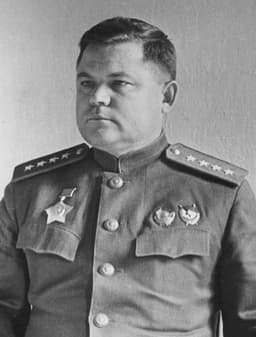
Nikolai Vatutin
General · Modern
57.0Total
Basic Information
Born
1839
1901
Died
1919
1944
Era
Modern
Modern
Nationality
Ottoman Empire
USSR
Occupation
General
General
Civilization
Middle Eastern
Western
Score Comparison
Military (10%)
55.0
72.0
Political (20%)
68.0
42.2
Influence (20%)
57.2
57.2
Legacy (20%)
46.7
50.0
Leadership (15%)
72.0
61.1
Strategy (15%)
60.7
75.0
TOTAL
58.5
57.0
Ahmed Muhtar Pasha — Complete Timeline
1877 AD
Command in the Russo-Turkish WarWar◆ Major
Ahmed Muhtar Pasha commanded Ottoman forces in the Caucasus campaign against Russia during the 1877-1878 Russo-Turkish War. He achieved initial victories at the Battle of Kizil-Tepe but was ultimately forced to retreat after the fall of Erzurum.
Russo-Turkish WarCaucasus CampaignOttoman Command
Impact: regional
1912 AD
Appointment as Grand VizierPolitical Action◆ Major
Ahmed Muhtar Pasha was appointed Grand Vizier of the Ottoman Empire in July 1912, leading the 'Great Cabinet' government. His administration lasted only four months, falling in October 1912 due to the outbreak of the First Balkan War.
Ottoman GovernmentGrand VizierBalkan War
Impact: national
Resignation as Grand VizierPolitical Action◆ Major
Ahmed Muhtar Pasha resigned as Grand Vizier on October 29, 1912, following the Ottoman Empire's military defeats in the First Balkan War. His resignation marked the end of the 'Great Cabinet' and the return of the Committee of Union and Progress to power.
Ottoman GovernmentResignationBalkan War Defeat
Impact: nationaldestructive
Nikolai Vatutin — Complete Timeline
1943 AD
Battle of KurskWar◆ Major
Vatutin commanded the Voronezh Front during the Battle of Kursk. His forces defended the southern sector against the German offensive, then participated in the counteroffensive that recaptured Kharkov and pushed German forces back.
World War IIEastern FrontBattle of Kursk
Impact: regional
Battle of the DnieperWar◆ Major
Vatutin led the 1st Ukrainian Front in crossing the Dnieper River and liberating Kiev on November 6, 1943. This operation broke the German defensive line and established a strategic bridgehead for further advances into Ukraine.
World War IIEastern FrontLiberation of Kiev
Impact: regional
1944 AD
Mortally wounded by Ukrainian insurgentsOther◆ Major
On February 29, 1944, Vatutin was ambushed and shot by Ukrainian Insurgent Army (UPA) partisans near Rovno. He died of his wounds on April 15, 1944, becoming the highest-ranking Soviet general killed in action during World War II.
DeathWorld War IIUkrainian Insurgency
Impact: nationaltragic
This comparison has not been analyzed yet.
One-time AI generation (~1 minute). Scores and timeline are already available below.
Rankings
🥇
Ahmed Muhtar PashaLeader
Mil: 55.0Pol: 68.0Inf: 57.2
58.5
🥈
Nikolai Vatutin
Mil: 72.0Pol: 42.2Inf: 57.2
57.0
+1.5 behind
How This Comparison Works
Algorithm
Each figure is scored on 6 dimensions (0—100 scale) based on structured historical data: Military (10%), Political (20%), Influence (20%), Legacy (20%), Leadership (15%), Strategy (15%). The weighted total produces the final ranking.
Data Sources
Scores are computed from structured sub-indicators in the database. Scale factors adjust for era (Ancient ×0.85, Modern ×1.0) and civilization size (Eastern ×1.05, Other ×0.80) to account for differences in population and military scale.
Maximum 3 Figures
Comparisons are limited to 2—3 figures to ensure readability and statistical meaningfulness.
Error Margins
±5 points per dimension — Sub-scores are derived from historical records with inherent uncertainty. Two figures within 5 points on a dimension should be considered roughly equivalent in that area.
Total Score Accuracy
±3 points overall — The weighted combination of 6 dimensions produces a total score with approximately ±3 points of uncertainty. Differences of less than 3 points are not statistically significant— the figures are effectively tied.
Known Limitations
- Historical records are incomplete and uneven across civilizations
- Figures from oral-tradition societies may be underrepresented
- Occupation labels can misclassify multi-role figures
- Scores measure capability and impact, not moral character
- Quantitative scoring is a comparison tool, not absolute truth
Capability Radar
Military (10%) — Battles & Warfare
Battles
55
85
Win Rate
50
80
Expansion
30
75
Political (20%) — Governance & Reform
Reform
55
30
Diplomacy
50
35
Economy
45
20
Influence (20%) — Cultural & Global Reach
Cultural
30
30
Global
25
35
Legacy (20%) — Historical Impact
Historical
40
55
Longevity
30
40
Leadership (15%) — Power & Stability
Tenure
60
40
Stability
40
25
Strategy (15%) — Tactics & Innovation
Strategy
55
85
Tactics
60
88
Reform
65
70
Similar Comparisons
Comments & Discussion
No comments yet. Be the first to share your thoughts!