Loading...
Ajaka vs Julius Caesar
Julius Caesar leads by 38.0 pts · 2 figures compared
…
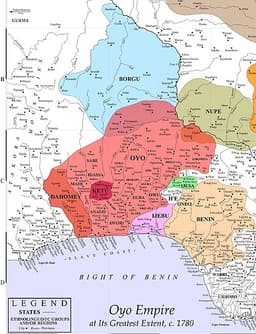
Ajaka
Emperor · Medieval
44.8Total

Julius Caesar
General · Ancient
82.8Total
Basic Information
Born
1220
-100
Died
1270
-44
Era
Medieval
Ancient
Nationality
Oyo Empire
Roman Republic
Occupation
Emperor
General
Civilization
Other
Western
Score Comparison
Military (10%)
20.0
88.0
Political (20%)
40.8
78.0
Influence (20%)
49.4
85.0
Legacy (20%)
39.2
82.0
Leadership (15%)
67.0
80.0
Strategy (15%)
45.0
85.0
TOTAL
44.8
82.8
Ajaka — Complete Timeline
1230 AD
First reign and exilePolitical Action
Ajaka's first reign as Alaafin was marked by his peaceful nature, which was seen as weakness by his military commanders. He was deposed and exiled by his brother, Sango, who then took the throne. This event highlights the tension between peaceful and militaristic leadership in Oyo.
DepositionExileBrotherly Conflict
Impact: national
1245 AD
Restoration to the throne of OyoPolitical Action◆ Major
After the death of Sango, the Oyo chiefs recalled Ajaka from exile and restored him as Alaafin. His peaceful and diplomatic rule was seen as a contrast to Sango's violent reign. He was able to reunite the kingdom and re-establish stability.
RestorationPeaceful RuleOyo
Impact: nationalconstructive
Julius Caesar — Complete Timeline
58 BC
Gallic WarsWar◆ Major
Caesar, as proconsul of Gaul, launched a series of campaigns that conquered all of Gaul (modern France, Belgium, and parts of Switzerland). He fought numerous battles, including against the Helvetii, the Belgae, and the Gallic chieftain Vercingetorix. The wars brought immense wealth and a loyal army to Caesar.
Gallic WarsConquestRoman Expansion
Impact: regional
49 BC
Crossing the RubiconPolitical Action◆ Major
Caesar led Legio XIII across the Rubicon River into Italy, defying the Roman Senate's order to disband his army. This act triggered a civil war against Pompey and the Optimates, ultimately leading to Caesar's dictatorship and the end of the Roman Republic.
Roman Civil WarEnd of RepublicPower Struggle
Impact: global
48 BC
Battle of PharsalusWar◆ Major
Caesar's outnumbered army defeated the larger forces of Pompey the Great at Pharsalus in Greece. Caesar's tactical use of a reserve line to counter Pompey's cavalry charge proved decisive. Pompey fled to Egypt, where he was assassinated, leaving Caesar as the undisputed master of the Roman world.
Roman Civil WarBattleDecisive Victory
Impact: regional
44 BC
Appointment as Dictator for LifePolitical Action◆ Major
The Roman Senate appointed Caesar dictator perpetuo (dictator for life), granting him unprecedented personal power. This move concentrated military, legislative, and judicial authority in one person, effectively ending the Roman Republic's traditional system of checks and balances and alarming many senators.
DictatorshipEnd of RepublicPower Consolidation
Impact: regionaldestructive
Assassination on the Ides of MarchPolitical Action◆ Major
A group of Roman senators, led by Marcus Junius Brutus and Gaius Cassius Longinus, stabbed Caesar to death at a meeting of the Senate in the Theatre of Pompey. The assassination was intended to restore the Republic, but instead triggered another civil war that led to the rise of the Roman Empire.
AssassinationRoman PoliticsEnd of Republic
Impact: globaldestructive
Expert Analysis
ajaka-vs-julius-caesar
# The Peaceful King and the Conquering General
On a spring morning in 44 BCE, a Roman dictator fell bleeding at the feet of his assassins, his body pierced by twenty-three dagger wounds. Half a world away and more than a millennium later, another ruler—deposed, exiled, and then recalled—returned to his throne not with an army but with the quiet consent of his people. Julius Caesar and Ajaka of Oyo could hardly have been more different, yet both faced the same fundamental question of power: how does a leader hold authority in a world that worships strength?
Origins
Caesar was born into the chaos of the late Roman Republic, a world of civil wars, crumbling traditions, and ambitious men who saw the state as a ladder. His family, the Julii, claimed descent from the goddess Venus, but they were patricians in name only—politically marginal, financially strained. From childhood, Caesar understood that in Rome, reputation was currency and audacity was capital.
Ajaka, by contrast, was born into the structured hierarchy of the Oyo Empire in what is now southwestern Nigeria. The Alaafin—the emperor—was not merely a political figure but a sacred king, bound by ritual and expected to embody the balance between earthly power and divine mandate. Ajaka’s father, Oranyan, had founded the empire, and his brother Sango would later become deified as the god of thunder and lightning. The expectations placed on Ajaka were immense, but they were expectations of harmony, not conquest.
Rise to Power
Caesar’s ascent was a masterclass in calculated risk. He borrowed fortunes to fund spectacles, seduced allies and enemies alike, and climbed the political ladder through a combination of military command and popular reform. His conquest of Gaul (58–50 BCE) was not just a war—it was a personal empire-building project that gave him wealth, loyal legions, and a reputation that eclipsed all rivals. When the Senate ordered him to disband his army, he crossed the Rubicon River in 49 BCE, a decision that meant civil war or death. He chose war.
Ajaka’s rise was quieter. He became Alaafin around 1230, inheriting a young empire still consolidating its power. His reign was marked not by expansion but by administration. He sought to govern through diplomacy, arbitration, and the careful management of Oyo’s complex network of subordinate chiefs and tributaries. Where Caesar saw every political problem as a military one, Ajaka saw every military option as a political failure.
Leadership & Governance
Caesar governed as he fought: decisively, ruthlessly, and with an eye on the future. As dictator, he reformed the calendar, granted citizenship to provincial elites, initiated public works, and centralized authority in ways that would outlast him. His military genius was undeniable—the siege of Alesia (52 BCE), the lightning campaign at Pharsalus (48 BCE)—but his political wisdom was equally sharp. He knew that power required spectacle, and he provided it: triumphs, games, and the image of a leader who was both of the people and above them.
Ajaka’s governance was the opposite. He ruled not by force but by persuasion, relying on the traditional checks and balances of Oyo’s council of chiefs. His peaceful nature, however, was interpreted by his military commanders as weakness. In 1230, they deposed him, replacing him with his more aggressive brother Sango. Where Caesar would have crushed such insubordination with legions, Ajaka accepted exile. He waited.
Sango’s reign was brief and violent. He expanded Oyo’s territory but alienated his allies, and after his death—according to tradition, he committed suicide—the chiefs turned back to Ajaka. In 1245, they restored him to the throne. He returned not as a conqueror but as a diplomat, ruling without military aggression for the remainder of his life.
Triumph & Tragedy
Caesar’s greatest triumph was also his greatest tragedy: he became so powerful that he made the Republic’s survival impossible. His reforms were visionary, but his accumulation of titles—dictator for life, consul for ten years, perpetual tribune—convinced a faction of senators that only his death could save the Republic. On the Ides of March, 44 BCE, they proved tragically wrong. The Republic died with him, and the Empire was born from his blood.
Ajaka’s tragedy was subtler. He was a good king in a world that did not always reward goodness. His first reign ended in humiliation, and even his restoration was conditional—the chiefs brought him back because Sango’s aggression had failed, not because they valued peace. Ajaka ruled until his death around 1270, but his legacy was overshadowed by the thunder of his brother’s legend.
Character & Destiny
Caesar’s personality was a weapon. He was ambitious, calculating, and impossibly confident—a man who could dictate letters while riding, who forgave his enemies but never forgot them. His famous line, “Veni, vidi, vici” (“I came, I saw, I conquered”), captured his essence: speed, clarity, and an almost inhuman efficiency. He believed that destiny was something to be seized, not awaited.
Ajaka’s character was shaped by restraint. He valued stability over glory, consensus over command. His patience in exile, his willingness to forgive those who deposed him, and his refusal to seek revenge all suggest a leader who measured success not by territory but by peace. Yet this very virtue was his vulnerability. In a world where strength was often synonymous with violence, his gentleness was mistaken for weakness.
Legacy
Caesar’s legacy is monumental. His name became a title—Kaiser, Tsar—and his reforms laid the foundation for the Roman Empire that would dominate the Mediterranean for centuries. He is remembered as a military genius, a political visionary, and a warning about the dangers of unchecked power. Historians score him at 83.3 overall, with military and strategy ratings of 88.0 each—numbers that reflect his enduring image as the archetypal conqueror.
Ajaka’s legacy is quieter but no less significant. In Yoruba tradition, he is remembered as a king who ruled with wisdom, not war. His scores—56.5 overall, with a leadership rating of 72.6—suggest a leader who was effective but not transformative. Yet his story offers a different model of leadership: one where power is not seized but entrusted, where a ruler’s greatest strength is the willingness to step aside and return when needed.
Conclusion
Caesar and Ajaka represent two poles of leadership: the conqueror who shapes the world through force, and the peacemaker who preserves it through patience. One died in a senate chamber, betrayed by those he trusted; the other died in his bed, having been twice given the throne by those who had once rejected him. Their stories remind us that greatness takes many forms, and that the quietest ruler may sometimes be the wisest. In a world that still celebrates the Caesars, perhaps there is something to learn from the Ajaka.
Rankings
🥇
Julius CaesarLeader
Mil: 88.0Pol: 78.0Inf: 85.0
82.8
🥈
Ajaka
Mil: 20.0Pol: 40.8Inf: 49.4
44.8
+38.0 behind
How This Comparison Works
Algorithm
Each figure is scored on 6 dimensions (0—100 scale) based on structured historical data: Military (10%), Political (20%), Influence (20%), Legacy (20%), Leadership (15%), Strategy (15%). The weighted total produces the final ranking.
Data Sources
Scores are computed from structured sub-indicators in the database. Scale factors adjust for era (Ancient ×0.85, Modern ×1.0) and civilization size (Eastern ×1.05, Other ×0.80) to account for differences in population and military scale.
Maximum 3 Figures
Comparisons are limited to 2—3 figures to ensure readability and statistical meaningfulness.
Error Margins
±5 points per dimension — Sub-scores are derived from historical records with inherent uncertainty. Two figures within 5 points on a dimension should be considered roughly equivalent in that area.
Total Score Accuracy
±3 points overall — The weighted combination of 6 dimensions produces a total score with approximately ±3 points of uncertainty. Differences of less than 3 points are not statistically significant— the figures are effectively tied.
Known Limitations
- Historical records are incomplete and uneven across civilizations
- Figures from oral-tradition societies may be underrepresented
- Occupation labels can misclassify multi-role figures
- Scores measure capability and impact, not moral character
- Quantitative scoring is a comparison tool, not absolute truth
Capability Radar
Military (10%) — Battles & Warfare
Battles
5
95
Win Rate
5
92
Expansion
5
97
Political (20%) — Governance & Reform
Reform
35
90
Diplomacy
45
85
Economy
30
82
Influence (20%) — Cultural & Global Reach
Cultural
25
88
Global
10
94
Legacy (20%) — Historical Impact
Historical
20
95
Longevity
15
96
Leadership (15%) — Power & Stability
Tenure
40
75
Stability
50
60
Strategy (15%) — Tactics & Innovation
Strategy
5
94
Tactics
5
96
Reform
5
88
Similar Comparisons
Comments & Discussion
No comments yet. Be the first to share your thoughts!