Loading...
Ajatashatru vs Modu Chanyu
Modu Chanyu leads by 2.5 pts · 2 figures compared
…

Ajatashatru
Emperor · Ancient
58.6Total
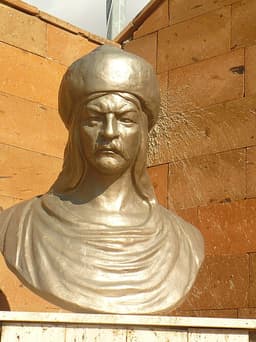
Modu Chanyu
Emperor · Ancient
61.1Total
Basic Information
Born
-530
-234
Died
-460
-174
Era
Ancient
Ancient
Nationality
India
Xiongnu
Occupation
Emperor
Emperor
Civilization
Indian
Eastern
Score Comparison
Military (10%)
63.3
77.5
Political (20%)
68.0
62.7
Influence (20%)
55.0
56.7
Legacy (20%)
58.0
40.0
Leadership (15%)
53.2
78.0
Strategy (15%)
58.0
80.3
TOTAL
58.6
61.1
Ajatashatru — Complete Timeline
491 BC
Imprisoned His Father BimbisaraPolitical Action◆ Major
Ajatashatru overthrew his father Bimbisara, imprisoning him to seize the throne of Magadha. This act of patricide was condemned in Buddhist texts, but it secured Ajatashatru's rule and allowed him to pursue an expansionist policy.
Succession CrisisPatricide
Impact: nationaldestructive
485 BC
Fortified RajagrihaOther
Ajatashatru fortified the city of Rajagriha (modern Rajgir) with massive stone walls to protect Magadha's capital from attack. The fortifications included a new outer wall and strengthened defenses, making Rajagriha one of the strongest fortified cities in ancient India.
FortificationDefense
483 BC
Convened the First Buddhist CouncilCultural
Ajatashatru sponsored the First Buddhist Council at Rajagriha, held shortly after the Buddha's death. Under the monk Mahakashyapa's leadership, 500 arhats recited and codified the Buddha's teachings (Sutras) and monastic rules (Vinaya), preserving them orally.
BuddhismCouncilScripture
Impact: globalconstructive
480 BC
War with the Licchavis of VaishaliWar◆ Major
Ajatashatru waged a prolonged war against the Licchavi republic of Vaishali, eventually conquering it. He used new military technology including catapults and a siege engine. This victory expanded Magadha's territory and eliminated a rival power.
ConquestMagadha Expansion
Impact: regional
Modu Chanyu — Complete Timeline
209 BC
Unification of the Xiongnu TribesPolitical Action
Modu Chanyu unified the nomadic tribes of the Mongolian steppe into the Xiongnu Empire after killing his father, Touman. He established a centralized military and political structure, creating a powerful confederation that rivaled Han China.
UnificationXiongnu EmpireNomadic Confederation
Impact: regional
200 BC
Battle of BaidengWar
Modu Chanyu besieged Emperor Gaozu of Han at Baideng (modern Datong, Shanxi) for seven days. The Han emperor was forced to negotiate a peace treaty, agreeing to pay tribute and send a princess for marriage, establishing Xiongnu dominance over northern China.
BattleHan DynastyTribute System
Impact: regional
198 BC
Treaty of HeqinPolitical Action◆ Major
Modu Chanyu formalized the Heqin treaty with the Han Dynasty, which included annual tribute payments, marriage alliances, and the recognition of the Xiongnu as equals. This treaty maintained peace for decades and set a precedent for Han-Xiongnu relations.
TreatyHeqinDiplomacy
Impact: regional
176 BC
Expansion into Central AsiaWar◆ Major
Modu Chanyu expanded Xiongnu control westward, defeating the Yuezhi and other nomadic groups. He extended Xiongnu influence over the Tarim Basin and parts of Central Asia, controlling key trade routes and establishing a vast steppe empire.
ExpansionCentral AsiaYuezhi
Impact: regional
Expert Analysis
Origins
Ajatashatru (c. 492–460 BCE) was a king of the Magadha dynasty in ancient India, son of King Bimbisara and Queen Chellana. He was born into the ruling Haryanka dynasty, which had expanded Magadha through conquest and marriage alliances. His early life was marked by ambition and impatience for power. Educated in statecraft and warfare, he was influenced by both Jainism and Buddhism, though his actions often contradicted their principles.
Modu Chanyu (c. 234–174 BCE) was the son of Touman, a chieftain of the Xiongnu confederation on the Mongolian steppe. As a young prince, he was sent as a hostage to the Yuezhi, a rival nomadic group. After escaping and returning, he trained his troops with disciplined loyalty, famously shooting his own horse, wife, and father to test obedience. This harsh upbringing forged a ruthless leader who would unite the Xiongnu tribes.
Rise to Power
Ajatashatru's ascent was violent: he overthrew his father Bimbisara by imprisoning him, seizing the throne of Magadha around 492 BCE. This patricide was condemned in Buddhist texts, but it secured his rule. He then waged a prolonged war against the Licchavi republic of Vaishali, using new military technology such as catapults and a war chariot with a rotating blade. The conquest of Vaishali expanded Magadha's territory and wealth. He also fortified Rajagriha with massive stone walls, securing his capital.
Modu Chanyu rose by killing his father, Touman, around 209 BCE after training his warriors to follow his every command. He then unified the Xiongnu tribes by defeating rival chieftains and centralizing power. His key turning point was the Battle of Baideng in 200 BCE, where he besieged Emperor Gaozu of Han for seven days, forcing the Han to negotiate. This victory established the Xiongnu as a major power. He later expanded westward, defeating the Yuezhi and dominating the Tarim Basin.
Leadership & Governance
Ajatashatru ruled Magadha as an absolute monarch, focusing on territorial expansion and administrative consolidation. He patronized Buddhism, convening the First Buddhist Council at Rajagriha shortly after the Buddha's death. This council, led by the monk Mahakashyapa, compiled the Buddha's teachings into the Tripitaka. However, his governance was marked by cruelty: he imprisoned his father and committed patricide. His military innovations, like catapults, gave him tactical advantages, but his reign was unstable due to his violent rise.
Modu Chanyu built a centralized nomadic empire with a hierarchical structure. He divided the Xiongnu into left and right wings, each led by loyal commanders, and established a system of tribute from conquered peoples. His Heqin treaty with the Han Dynasty (198 BCE) secured annual payments, silk, and a marriage alliance, which stabilized the border. He was a strategic innovator, using cavalry tactics and psychological warfare. His leadership scored 78.0, reflecting his ability to command loyalty and expand the empire.
Triumph & Tragedy
Ajatashatru's greatest success was the conquest of Vaishali and the consolidation of Magadha as a dominant power in northern India. His sponsorship of the First Buddhist Council ensured the preservation of Buddhist scriptures, a legacy that outlasted his kingdom. His greatest failure was his patricide and the moral condemnation it brought. The Buddhist text Mahavamsa describes his eventual remorse and conversion to Buddhism, but his reign ended in parricide by his own son Udayabhadra, repeating the cycle of violence.
Modu Chanyu's triumph was the unification of the Xiongnu and the humiliation of the Han at Baideng, which forced China into a tributary relationship. His expansion into Central Asia secured trade routes and resources. His tragedy was the ephemeral nature of his empire: after his death, the Xiongnu fragmented due to internal divisions and later Han counterattacks. The Heqin treaty eventually failed, leading to renewed conflict. His military score of 77.5 reflects his tactical brilliance, but his legacy score of 40.0 shows the empire's decline.
Character & Destiny
Ajatashatru was ambitious and ruthless, willing to kill his own father for power. His character combined cunning with a capacity for remorse, as he later embraced Buddhism. Yet his parricide created a precedent for dynastic instability: his own son killed him. His decisions were driven by a desire for territorial control and religious patronage, but his violent methods undermined long-term stability. He scored 53.2 in leadership, reflecting his flawed governance.
Modu Chanyu was a master of psychological manipulation and discipline. He trained his warriors to obey without question, even to the point of killing their own kin. His character was cold and calculating; he killed his father and rival brothers without hesitation. This ruthlessness enabled him to unite the steppe, but it also meant his empire depended on his personal authority. After his death, no successor could hold the confederation together. His leadership score of 78.0 indicates his effectiveness, but his legacy score of 40.0 shows the empire's fragility.
Legacy
Ajatashatru's legacy is tied to Buddhism: the First Buddhist Council preserved the core teachings, influencing millions over millennia. Magadha under his rule became a springboard for the Maurya Empire, which later unified India. However, his violent reign and parricide are also remembered. His overall score of 58.6 reflects a mixed impact: religious influence balanced against political instability.
Modu Chanyu's legacy is foundational for steppe empires. He established the model of a nomadic confederation that would be emulated by the Mongols and others. The Heqin treaty set a precedent for Chinese tributary relations with northern neighbors. Yet his empire collapsed within decades. His total score of 61.1 is slightly higher, but his impact was more immediate and less enduring than Ajatashatru's religious contributions.
Conclusion
While Modu Chanyu scores higher overall (61.1 vs 58.6), Ajatashatru's impact through the Buddhist Council has a longer-lasting and broader influence. Modu's military and strategic achievements are impressive, but his empire faded. Ajatashatru, despite his moral failings, facilitated the preservation of a world religion that continues to shape Asia. Therefore, Ajatashatru had greater historical impact, even if his personal scores are lower.
Rankings
🥇
Modu ChanyuLeader
Mil: 77.5Pol: 62.7Inf: 56.7
61.1
🥈
Ajatashatru
Mil: 63.3Pol: 68.0Inf: 55.0
58.6
+2.5 behind
How This Comparison Works
Algorithm
Each figure is scored on 6 dimensions (0—100 scale) based on structured historical data: Military (10%), Political (20%), Influence (20%), Legacy (20%), Leadership (15%), Strategy (15%). The weighted total produces the final ranking.
Data Sources
Scores are computed from structured sub-indicators in the database. Scale factors adjust for era (Ancient ×0.85, Modern ×1.0) and civilization size (Eastern ×1.05, Other ×0.80) to account for differences in population and military scale.
Maximum 3 Figures
Comparisons are limited to 2—3 figures to ensure readability and statistical meaningfulness.
Error Margins
±5 points per dimension — Sub-scores are derived from historical records with inherent uncertainty. Two figures within 5 points on a dimension should be considered roughly equivalent in that area.
Total Score Accuracy
±3 points overall — The weighted combination of 6 dimensions produces a total score with approximately ±3 points of uncertainty. Differences of less than 3 points are not statistically significant— the figures are effectively tied.
Known Limitations
- Historical records are incomplete and uneven across civilizations
- Figures from oral-tradition societies may be underrepresented
- Occupation labels can misclassify multi-role figures
- Scores measure capability and impact, not moral character
- Quantitative scoring is a comparison tool, not absolute truth
Capability Radar
Military (10%) — Battles & Warfare
Battles
55
85
Win Rate
60
90
Expansion
75
95
Political (20%) — Governance & Reform
Reform
65
90
Diplomacy
60
85
Economy
55
75
Influence (20%) — Cultural & Global Reach
Cultural
70
70
Global
65
75
Legacy (20%) — Historical Impact
Historical
75
85
Longevity
70
80
Leadership (15%) — Power & Stability
Tenure
70
80
Stability
50
80
Strategy (15%) — Tactics & Innovation
Strategy
70
92
Tactics
65
88
Reform
60
95
Similar Comparisons
Comments & Discussion
No comments yet. Be the first to share your thoughts!