Loading...
Al-Mustain vs Charles VIII of France
Charles VIII of France leads by 5.9 pts · 2 figures compared
…

Al-Mustain
Emperor · Medieval
40.0Total
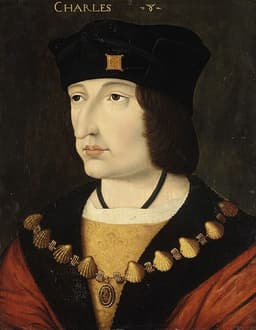
Charles VIII of France
Emperor · Medieval
45.9Total
Basic Information
Born
836
1470
Died
866
1498
Era
Medieval
Medieval
Nationality
Abbasid Caliphate
France
Occupation
Emperor
Emperor
Civilization
Middle Eastern
Western
Score Comparison
Military (10%)
20.0
40.0
Political (20%)
35.0
30.8
Influence (20%)
47.1
54.9
Legacy (20%)
35.8
49.2
Leadership (15%)
49.9
45.0
Strategy (15%)
45.0
45.0
TOTAL
40.0
45.9
Al-Mustain — Complete Timeline
862 AD
Accession as Puppet CaliphPolitical Action◆ Major
Al-Mustain was installed as caliph by the Turkish guard after the death of al-Muntasir. He was a puppet ruler, with real power held by the Turkish military commanders, marking the height of Turkish domination.
Puppet RulerTurkish Domination
Impact: national
865 AD
Civil War with Al-MutazzWar◆ Major
Al-Mustain faced a rebellion from his cousin al-Mutazz, who was supported by Turkish factions. The civil war led to the siege of Baghdad and ended with al-Mustain's abdication in 866.
Civil WarSiege of Baghdad
Impact: regionaldestructive
866 AD
Abdication and ExecutionPolitical Action◆ Major
Al-Mustain abdicated the caliphate in favor of al-Mutazz after being defeated. Despite promises of safety, he was executed shortly after, demonstrating the brutality of the Turkish-dominated politics.
AbdicationExecution
Impact: nationaltragic
Charles VIII of France — Complete Timeline
1494 AD
Invasion of ItalyWar
Charles VIII led a French army into Italy to claim the Kingdom of Naples, beginning the Italian Wars. He marched through Italy unopposed, entered Florence and Rome, and conquered Naples in 1495, but was forced to retreat by the League of Venice.
Italian WarsInvasionCapetian
Impact: global
1495 AD
Battle of FornovoWar◆ Major
Charles VIII's French army fought the League of Venice at Fornovo. Though technically a French victory as they broke through the enemy lines, Charles VIII lost his baggage train and was forced to withdraw from Italy, ending his Neapolitan adventure.
Italian WarsBattleCapetian
Impact: regional
1498 AD
Death by AccidentOther◆ Major
Charles VIII died after striking his head on a low door lintel while walking to watch a tennis match at the Ch
Accidental DeathSuccessionCapetian
Impact: nationaltragic
Expert Analysis
Origins
Al-Mustain, born in 836 CE, was the son of Abbasid Caliph al-Mutawakkil. His early life was shaped by the court intrigues of Samarra, where Turkish military commanders held increasing power. After his father's assassination and his brother al-Muntasir's brief reign, Al-Mustain was installed as caliph in 862 CE at age 26, but he was never more than a figurehead. The Turkish guard, led by commanders like Wasif and Bugha, controlled the state, reducing the caliph to a ceremonial role.
Charles VIII of France, born in 1470, was the only son of King Louis XI. His childhood was isolated; his father kept him away from court out of fear of assassination. Charles was raised in the Château d'Amboise with a focus on piety and chivalric ideals. He became king at age 13 in 1483, with his sister Anne de Beaujeu acting as regent until he came of age. Unlike Al-Mustain, Charles inherited a strong, centralized kingdom, thanks to his father's consolidation of power.
Rise to Power
Al-Mustain ascended to the caliphate in 862 after the death of al-Muntasir, who was likely poisoned by Turkish generals. The Turkish guard, seeking a compliant ruler, chose Al-Mustain. However, his cousin al-Mutazz, also a son of al-Mutawakkil, was supported by rival Turkish factions. This led to a civil war in 865-866. Al-Mustain's forces were besieged in Baghdad, and he was forced to abdicate in January 866 after promises of safety. The Turks had effectively turned the caliphate into a puppet state, with Al-Mustain as their pawn.
Charles VIII's rise was smoother. He inherited the throne in 1483, but his minority was managed by his sister Anne. In 1491, he married Anne of Brittany, securing that duchy for France. Charles was ambitious to reclaim the Kingdom of Naples, which he claimed through his father's Angevin heritage. In 1494, he launched an invasion of Italy, beginning the Italian Wars. His army, equipped with advanced artillery, swept through Italy virtually unopposed, entering Florence and Rome. He was crowned King of Naples in 1495.
Leadership & Governance
Al-Mustain had no real governance role. His political score of 35.0 reflects his inability to exercise authority. He was a puppet, with Turkish commanders making all decisions. His leadership score of 49.9 is generous, as he mostly followed orders. The Abbasid bureaucracy continued to function, but the caliph was a mere symbol.
Charles VIII, with a leadership score of 45.0, was more active but impulsive. He centralized French administration, continuing his father's policies. However, his governance was overshadowed by his Italian ambitions. He left France for Italy in 1494, entrusting the kingdom to regents. His invasion was initially successful, but he failed to secure his conquests. The League of Venice formed against him, and at the Battle of Fornovo (1495), his army narrowly escaped. Charles's military score of 40.0 reflects his reliance on mercenaries and luck.
Triumph & Tragedy
Al-Mustain's greatest triumph was surviving as caliph for four years under Turkish domination, a feat given the violent turnover of his predecessors. However, his tragedy was his execution in 866, despite a promise of safety. He was killed on the orders of al-Mutazz, who feared he might be a rallying point for opposition. Al-Mustain's reign was a low point of the Abbasid caliphate, with the institution's power permanently diminished.
Charles VIII's triumph was the quick conquest of Naples in 1495, demonstrating French military power. He also expanded French influence in Italy. His tragedy was his sudden death in 1498 at age 27, after hitting his head on a door lintel. He left no surviving male heir, leading to the accession of Louis XII and the continuation of the Italian Wars. Charles's legacy score of 49.2 is higher than Al-Mustain's 35.8, as his actions had long-term consequences for Europe.
Character & Destiny
Al-Mustain was a passive figure, shaped by the Turkish military's dominance. His character score is not directly measured, but his low political acumen (35.0) and military score (20.0) suggest he lacked the skills to resist. His destiny was to be a pawn, and his death showed the ruthless nature of Abbasid politics.
Charles VIII was energetic but naive. His desire for glory led him to Italy, but he lacked strategic depth (strategy score 45.0). His death by accident was ironic for a king who had dreamed of crusade. Historians often view him as a transitional figure, whose actions set the stage for the Habsburg-Valois conflict.
Legacy
Al-Mustain's legacy is as a symbol of the Abbasid caliphate's decline. His reign marked the point when Turkish generals openly controlled the caliphate, leading to the eventual rise of the Buyids and Seljuks. His legacy score of 35.8 reflects his limited impact. He is mostly forgotten, except by specialists.
Charles VIII's legacy is more significant. He initiated the Italian Wars (1494-1559), which involved major European powers and transformed warfare. His invasion spread Renaissance ideas to France and exposed French nobles to Italian culture. His death led to the end of the Valois line and the eventual rise of the Bourbons. Charles's influence score of 54.9 is higher than Al-Mustain's 47.1, reflecting his role in shaping early modern Europe.
Conclusion
Charles VIII had greater impact than Al-Mustain, with a total score of 45.9 versus 40.0. While both were limited rulers, Charles's invasion of Italy set off a chain of events that reshaped European politics. Al-Mustain, by contrast, was a passive victim of forces he could not control. Charles's legacy, though mixed, is more enduring. The score gap of 5.9 points reflects this difference. Charles VIII is clearly the more significant historical figure.
Rankings
🥇
Charles VIII of FranceLeader
Mil: 40.0Pol: 30.8Inf: 54.9
45.9
🥈
Al-Mustain
Mil: 20.0Pol: 35.0Inf: 47.1
40.0
+5.9 behind
How This Comparison Works
Algorithm
Each figure is scored on 6 dimensions (0—100 scale) based on structured historical data: Military (10%), Political (20%), Influence (20%), Legacy (20%), Leadership (15%), Strategy (15%). The weighted total produces the final ranking.
Data Sources
Scores are computed from structured sub-indicators in the database. Scale factors adjust for era (Ancient ×0.85, Modern ×1.0) and civilization size (Eastern ×1.05, Other ×0.80) to account for differences in population and military scale.
Maximum 3 Figures
Comparisons are limited to 2—3 figures to ensure readability and statistical meaningfulness.
Error Margins
±5 points per dimension — Sub-scores are derived from historical records with inherent uncertainty. Two figures within 5 points on a dimension should be considered roughly equivalent in that area.
Total Score Accuracy
±3 points overall — The weighted combination of 6 dimensions produces a total score with approximately ±3 points of uncertainty. Differences of less than 3 points are not statistically significant— the figures are effectively tied.
Known Limitations
- Historical records are incomplete and uneven across civilizations
- Figures from oral-tradition societies may be underrepresented
- Occupation labels can misclassify multi-role figures
- Scores measure capability and impact, not moral character
- Quantitative scoring is a comparison tool, not absolute truth
Capability Radar
Military (10%) — Battles & Warfare
Battles
5
45
Win Rate
5
40
Expansion
5
50
Political (20%) — Governance & Reform
Reform
5
25
Diplomacy
10
30
Economy
5
20
Influence (20%) — Cultural & Global Reach
Cultural
5
25
Global
5
35
Legacy (20%) — Historical Impact
Historical
10
55
Longevity
5
30
Leadership (15%) — Power & Stability
Tenure
10
40
Stability
5
15
Strategy (15%) — Tactics & Innovation
Strategy
5
30
Tactics
5
35
Reform
5
20
Similar Comparisons
Comments & Discussion
No comments yet. Be the first to share your thoughts!