Loading...
Charles VIII of France vs Napoleon Bonaparte
Napoleon Bonaparte leads by 25.0 pts · 2 figures compared
…
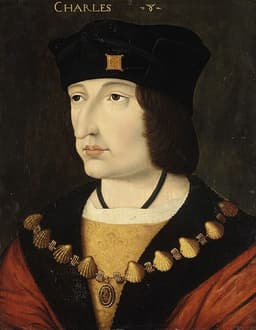
Charles VIII of France
Emperor · Medieval
45.9Total

Napoleon Bonaparte
General · Modern
70.9Total
Basic Information
Born
1470
1769
Died
1498
1821
Era
Medieval
Modern
Nationality
France
France
Occupation
Emperor
General
Civilization
Western
Western
Score Comparison
Military (10%)
40.0
94.0
Political (20%)
30.8
72.0
Influence (20%)
54.9
40.0
Legacy (20%)
49.2
80.0
Leadership (15%)
45.0
78.0
Strategy (15%)
45.0
90.0
TOTAL
45.9
70.9
Charles VIII of France — Complete Timeline
1494 AD
Invasion of ItalyWar
Charles VIII led a French army into Italy to claim the Kingdom of Naples, beginning the Italian Wars. He marched through Italy unopposed, entered Florence and Rome, and conquered Naples in 1495, but was forced to retreat by the League of Venice.
Italian WarsInvasionCapetian
Impact: global
1495 AD
Battle of FornovoWar◆ Major
Charles VIII's French army fought the League of Venice at Fornovo. Though technically a French victory as they broke through the enemy lines, Charles VIII lost his baggage train and was forced to withdraw from Italy, ending his Neapolitan adventure.
Italian WarsBattleCapetian
Impact: regional
1498 AD
Death by AccidentOther◆ Major
Charles VIII died after striking his head on a low door lintel while walking to watch a tennis match at the Ch
Accidental DeathSuccessionCapetian
Impact: nationaltragic
Napoleon Bonaparte — Complete Timeline
1799 AD
Coup of 18 BrumaireOther◆ Major
Napoleon Bonaparte, with support from his brother Lucien and key political figures, overthrew the Directory in a bloodless coup. He established the Consulate with himself as First Consul, effectively becoming the ruler of France. This event ended the French Revolution's most unstable period.
French RevolutionCoupRise to Power
Impact: regional
1804 AD
Promulgation of the Napoleonic CodeOther◆ Major
Napoleon enacted the Civil Code of the French, known as the Napoleonic Code, a comprehensive set of laws that replaced the fragmented feudal legal systems. The code established legal equality, protected property rights, and secularized law. It became the basis for legal systems in many European and world countries.
Legal ReformNapoleonic CodeCivil Law
Impact: globalconstructive
1805 AD
Battle of AusterlitzWar◆ Major
Napoleon's Grande Arm
Napoleonic WarsBattleDecisive Victory
Impact: global
1812 AD
Invasion of RussiaWar◆ Major
Napoleon led the Grande Arm
Napoleonic WarsInvasionDisaster
Impact: globaldestructive
1815 AD
Battle of WaterlooWar◆ Major
Napoleon's French army was defeated by the combined forces of the Duke of Wellington's Anglo-Allied army and Gebhard Leberecht von Bl
Napoleonic WarsBattleFinal Defeat
Impact: globaldestructive
Expert Analysis
charles-viii-of-france-vs-napoleon-bonaparte
The Door and the Throne
History has a peculiar sense of humor. It gave Charles VIII of France a kingdom, an army, and a dream of Italian glory—then killed him with a door. It gave Napoleon Bonaparte the same kingdom, a greater army, and a continent to conquer—then buried him on a remote Atlantic island. One died in a freak accident at twenty-seven, his ambitions scattered like dust. The other died in exile at fifty-one, his name still echoing across Europe. What separates a footnote from a legend? The answer lies not in luck, but in character, timing, and the terrifying weight of ambition.
Origins
Napoleon Bonaparte was born in 1769 on Corsica, an island that had just become French. His family was minor nobility, but his world was one of restless ambition. He was short, intense, and hungry—not for food, but for recognition. The French Revolution, which erupted when he was twenty, shattered the old order and opened doors that had been locked for centuries. A man of talent, even a Corsican outsider, could rise. Napoleon devoured military history, studied artillery, and learned to think in terms of strategy, not just tactics.
Charles VIII, born in 1470, inherited a very different France. The medieval world was crumbling, but its hierarchies remained. He was the son of King Louis XI, the "Spider King," who had spent his life weaving webs of intrigue. Charles was raised in a court that valued lineage over merit. He was frail, sickly, and awkward—a boy king who grew into a man of fleeting passions. His education was mediocre, his health poor, and his judgment worse. Where Napoleon saw opportunity in chaos, Charles saw only the glitter of distant crowns.
Rise to Power
Napoleon’s ascent was a masterclass in seizing the moment. In 1796, at just twenty-six, he was given command of the French army in Italy. He turned a ragged, starving force into a conquering machine. Victory at the Battle of Lodi, then at Arcola, then at Rivoli—each triumph amplified his legend. By 1799, he had overthrown the Directory and made himself First Consul. In 1804, he crowned himself Emperor. Every step was calculated, every risk weighed. He was not merely lucky; he was relentless.
Charles VIII’s rise was simpler: he was born king. At thirteen, he took the throne after his father’s death. For years, his sister Anne acted as regent, while Charles sulked and dreamed. When he finally seized power in 1492, he was twenty-two—young, impulsive, and desperate to prove himself. His eye fell on Italy, specifically the Kingdom of Naples, which he claimed through a distant Angevin inheritance. It was a gambler’s move, not a strategist’s. He assembled an army, crossed the Alps in 1494, and marched through Italy unopposed—at first.
Leadership & Governance
Napoleon was a ruler of staggering competence. His Napoleonic Code, enacted in 1804, reformed French law and influenced legal systems across Europe. He centralized administration, stabilized the currency, and established the Bank of France. As a general, he was a genius: he understood terrain, logistics, and the psychology of his men. He could inspire soldiers to die for him, and they often did. His political wisdom, however, was flawed. He could not stop conquering. Peace bored him. His score of 75.0 in political leadership reflects a man who ruled brilliantly but governed arrogantly.
Charles VIII was a disaster in both war and peace. His military score of 34.6 speaks for itself. In 1495, at the Battle of Fornovo, his army technically broke through the League of Venice’s lines, but the French lost their baggage train and much of their plunder. Charles himself fought bravely, but bravery without strategy is just noise. He made no lasting reforms, built no institutions, left no code. His political score of 43.0 is generous. He was a king who ruled by accident, not design.
Triumph & Tragedy
Napoleon’s greatest moment was Austerlitz in 1805, where he crushed the combined armies of Russia and Austria. It was a masterpiece of deception, timing, and courage. His worst was the invasion of Russia in 1812, where hubris and logistics destroyed his Grand Army. Then came Leipzig in 1813, exile to Elba, a brief return, and finally Waterloo in 1815. His tragedy was not defeat—it was that he could never stop fighting long enough to keep what he had won.
Charles VIII’s triumph was his entry into Naples in 1495, where he was crowned king without a fight. It was a hollow victory, built on fear and promises he could not keep. His tragedy came three years later, in 1498. He was walking to watch a tennis match at the Château d’Amboise when he struck his head on a low door lintel. He died hours later. No battle, no conspiracy—just a door. His Italian conquests evaporated. The wars he started continued for decades, but he was forgotten.
Character & Destiny
Napoleon’s personality was a storm: restless, brilliant, arrogant, and magnetic. He believed in destiny, but he also believed in hard work. He once said, “Impossible is a word to be found only in the dictionary of fools.” He drove himself and others mercilessly. His downfall came from that same drive—he could not stop, could not compromise, could not see that even genius has limits.
Charles VIII was a different creature: dreamy, impulsive, and fragile. He wanted glory without understanding its cost. He invaded Italy not out of necessity, but out of vanity. He had no plan for governance, no vision for his kingdom, no sense of consequence. His death was absurd, but fitting. A man who lived by whim died by accident.
Legacy
Napoleon’s legacy is immense. His legal code, his military innovations, his reshaping of Europe—all endure. He is studied in every military academy, debated in every history seminar. His scores of 82.0 for influence and 78.0 for legacy reflect a man who changed the world, even if he could not keep it.
Charles VIII’s legacy is a footnote. He started the Italian Wars, which ravaged the peninsula for decades, but he himself is remembered mostly for his absurd death. His influence score of 73.1 is inflated by the wars he triggered, not by anything he did. He is a cautionary tale: a king who wanted to be great but lacked the mind, the will, and the luck to become so.
Conclusion
Napoleon and Charles VIII both reached for Italy. One built an empire; the other hit a door. Their difference is not just talent—it is the willingness to learn, to plan, to endure. Napoleon’s tragedy was that he could not stop. Charles’s tragedy was that he never really started. In the end, history remembers not just what you attempt, but what you achieve—and how you fail. One man’s fall was epic, the other’s was absurd. And that, perhaps, is the cruelest judgment of all.
Rankings
🥇
Napoleon BonaparteLeader
Mil: 94.0Pol: 72.0Inf: 40.0
70.9
🥈
Charles VIII of France
Mil: 40.0Pol: 30.8Inf: 54.9
45.9
+25.0 behind
How This Comparison Works
Algorithm
Each figure is scored on 6 dimensions (0—100 scale) based on structured historical data: Military (10%), Political (20%), Influence (20%), Legacy (20%), Leadership (15%), Strategy (15%). The weighted total produces the final ranking.
Data Sources
Scores are computed from structured sub-indicators in the database. Scale factors adjust for era (Ancient ×0.85, Modern ×1.0) and civilization size (Eastern ×1.05, Other ×0.80) to account for differences in population and military scale.
Maximum 3 Figures
Comparisons are limited to 2—3 figures to ensure readability and statistical meaningfulness.
Error Margins
±5 points per dimension — Sub-scores are derived from historical records with inherent uncertainty. Two figures within 5 points on a dimension should be considered roughly equivalent in that area.
Total Score Accuracy
±3 points overall — The weighted combination of 6 dimensions produces a total score with approximately ±3 points of uncertainty. Differences of less than 3 points are not statistically significant— the figures are effectively tied.
Known Limitations
- Historical records are incomplete and uneven across civilizations
- Figures from oral-tradition societies may be underrepresented
- Occupation labels can misclassify multi-role figures
- Scores measure capability and impact, not moral character
- Quantitative scoring is a comparison tool, not absolute truth
Capability Radar
Military (10%) — Battles & Warfare
Battles
45
95
Win Rate
40
90
Expansion
50
95
Political (20%) — Governance & Reform
Reform
25
95
Diplomacy
30
80
Economy
20
85
Influence (20%) — Cultural & Global Reach
Cultural
25
85
Global
35
90
Legacy (20%) — Historical Impact
Historical
55
95
Longevity
30
90
Leadership (15%) — Power & Stability
Tenure
40
85
Stability
15
70
Strategy (15%) — Tactics & Innovation
Strategy
30
95
Tactics
35
98
Reform
20
92
Similar Comparisons
Comments & Discussion
THE DOOR CRITIC6/17/2026
Let's be real here: Charles VIII dying by smacking his head on a low door lintel is the most perfectly medieval French ending imaginable. Napoleon got St. Helena—an epic, tragic exile worthy of a Greek play. Charles got a doorframe. Historians love romanticizing this as "fate," but I call it what it is: a man who couldn't even clear a 5-foot-8 doorway while chasing Italian dreams. That's not tragic; that's farce.
军史考据狂6/17/2026
拿破仑在1796年意大利战役中展现了革命军队的机动天才——他只用一个月就横扫皮埃蒙特,迫使撒丁王国单独媾和。而查理八世1494年的入侵完全依赖瑞士雇佣兵,后勤一团糟,拿波里贵族一个月就把他当傻瓜耍。一个是军事革命者,一个是中世纪骑士cosplay。拿破仑赢在不只是枪炮,而是让整个民族为他而战。
CLASSICS-SCHOOLED SKEPTIC6/17/2026
Napoleon's real genius wasn't military—it was institutional. He didn't just conquer; he built. The Napoleonic Code, the Bank of France, the lycées system—these outlived his empire by centuries. Charles VIII left nothing but a dent in a doorway and a brief French occupation of Naples that collapsed immediately. One created a template for modern Europe; the other provided a cautionary tale about head injuries. The comparison is laughable.
幽默历史老师6/17/2026
说个冷知识:查理八世的绰号是"礼貌的国王",因为他见了谁都鞠躬——结果他连死亡都很有礼貌,轻轻撞了一下门就走了。拿破仑的外号是"小伍长",因为他和士兵睡同一片雪地,吃同一锅汤。这俩人的人生观差了一整个宇宙:一个以为打打仗、体面死了就行,另一个要改写世界地图。哪个更值得学?你自己说。
REVISIONIST CRITIC6/17/2026
Enough of the Napoleon cult. His campaigns killed millions of Europeans for what? A few years of glory, then exile. Charles VIII invaded Italy with far less bloodshed and at least had the decency to die young enough not to become a monster. Napoleon’s real legacy is the centralised state that crushed local liberties for two centuries. Charles left feudalism wobbling, which at least allowed for diversity. I’d take a door over a dictatorship any day.