Loading...
Charles VIII of France vs Henry the Young King
Charles VIII of France leads by 5.1 pts · 2 figures compared
…
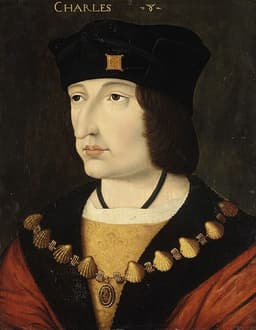
Charles VIII of France
Emperor · Medieval
45.9Total
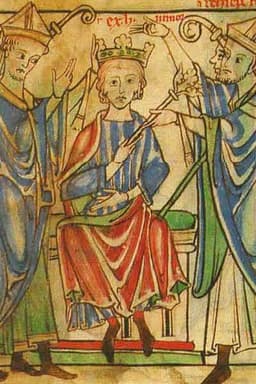
Henry the Young King
Emperor · Medieval
40.8Total
Basic Information
Born
1470
1155
Died
1498
1183
Era
Medieval
Medieval
Nationality
France
England
Occupation
Emperor
Emperor
Civilization
Western
Western
Score Comparison
Military (10%)
40.0
14.9
Political (20%)
30.8
40.8
Influence (20%)
54.9
47.1
Legacy (20%)
49.2
35.8
Leadership (15%)
45.0
49.9
Strategy (15%)
45.0
50.0
TOTAL
45.9
40.8
Charles VIII of France — Complete Timeline
1494 AD
Invasion of ItalyWar
Charles VIII led a French army into Italy to claim the Kingdom of Naples, beginning the Italian Wars. He marched through Italy unopposed, entered Florence and Rome, and conquered Naples in 1495, but was forced to retreat by the League of Venice.
Italian WarsInvasionCapetian
Impact: global
1495 AD
Battle of FornovoWar◆ Major
Charles VIII's French army fought the League of Venice at Fornovo. Though technically a French victory as they broke through the enemy lines, Charles VIII lost his baggage train and was forced to withdraw from Italy, ending his Neapolitan adventure.
Italian WarsBattleCapetian
Impact: regional
1498 AD
Death by AccidentOther◆ Major
Charles VIII died after striking his head on a low door lintel while walking to watch a tennis match at the Ch
Accidental DeathSuccessionCapetian
Impact: nationaltragic
Henry the Young King — Complete Timeline
1170 AD
Coronation as Junior KingPolitical Action◆ Major
Henry the Young King was crowned as junior king of England by his father Henry II, a practice to secure succession. This coronation gave him nominal authority but no real power, leading to future conflict.
CoronationSuccession
Impact: national
1172 AD
Second CoronationPolitical Action
To assert his status, Henry the Young King was crowned again at Winchester by the Archbishop of York, after his first coronation was performed by the Archbishop of Canterbury, causing a dispute.
CoronationChurch Dispute
Impact: national
1173 AD
Rebellion of 1173-1174War◆ Major
Henry the Young King led a major rebellion against his father Henry II, joined by his brothers Richard and Geoffrey, and supported by King Louis VII of France. The revolt failed after 18 months, and Henry was forced to submit.
RebellionCivil WarFamily Conflict
Impact: regionaldestructive
1183 AD
Death from DysenteryOther◆ Major
Henry the Young King died of dysentery at Martel in Quercy, France, at age 28. His death ended his rivalry with his father and brothers, and he was buried in Rouen Cathedral.
DeathDisease
Impact: regionaltragic
Expert Analysis
Origins
Charles VIII of France was born on June 30, 1470, at the Château d'Amboise, the only surviving son of King Louis XI and Charlotte of Savoy. His father, known as the "Spider King," raised him in isolation, fearing the machinations of the nobility. Charles received a limited education, focusing on chivalric ideals rather than statecraft. He was physically frail, with a hunched back and a large head, but possessed a strong will.
Henry the Young King was born on February 28, 1155, in London, the second son of King Henry II of England and Eleanor of Aquitaine. As the eldest surviving son after the death of his older brother William, he was groomed for kingship. He was handsome, athletic, and charismatic, but lacked real authority. His father kept him on a tight leash, granting him titles but no power.
Rise to Power
Charles VIII ascended the throne at age 13 upon his father's death in 1483. His older sister Anne de Beaujeu acted as regent, suppressing noble rebellions and consolidating royal power. Charles came of age in 1491, marrying Anne of Brittany to secure the duchy. His ambition turned to Italy, where he claimed the Kingdom of Naples through his Angevin ancestry. In 1494, he launched the Italian Wars, marching an army of 25,000 men across the Alps.
Henry the Young King was crowned junior king of England at Westminster Abbey on June 14, 1170, by the Archbishop of York, bypassing the Archbishop of Canterbury. This was part of Henry II's plan to secure succession. In 1172, he was crowned again at Winchester to assert his status. However, his father refused to grant him any real power or lands. Frustrated, Henry joined a rebellion against his father in 1173, supported by his brothers Richard and Geoffrey, and King Louis VII of France.
Leadership & Governance
Charles VIII's leadership style was impulsive and chivalric. He dreamed of crusade and glory, but lacked strategic depth. His governance was marked by the Treaty of Étaples (1492) ending conflict with England, and the Treaty of Barcelona (1493) securing his borders. However, his Italian campaign showed poor diplomacy: he alienated potential allies and provoked the League of Venice. His rule saw centralization of royal power, but his death left a regency for his successor.
Henry the Young King never actually governed. As a junior king, he had nominal authority but no real control. His leadership was defined by rebellion. In 1173-74, he led a coalition against his father, but the revolt collapsed due to lack of coordination. Henry II's military response was swift, and the young king was forced to submit. He spent the rest of his life in a cycle of reconciliation and renewed conflict, never holding any administrative role.
Triumph & Tragedy
Charles VIII's triumph was the rapid conquest of Naples in 1495. He entered the city unopposed, crowned himself king, and seemed to have achieved his goal. However, the League of Venice formed against him, and at the Battle of Fornovo (July 6, 1495), his army fought through enemy lines to retreat back to France. Technically a French victory, it was a strategic failure as he lost his gains. His tragedy was his death at age 27: on April 7, 1498, he struck his head on a low door lintel at Amboise and died hours later. He left no surviving heir, ending the direct Valois line.
Henry the Young King's triumph was his coronation as junior king, a rare honor that recognized his status. His rebellion of 1173-74, though failed, showed his ability to rally support. His tragedy was his death from dysentery on June 11, 1183, at age 28, while on campaign against his father. He died in penance, having received the Eucharist. His death ended the civil war, but he left no legacy of governance.
Character & Destiny
Charles VIII was described as naive and easily influenced, but also determined. His decision to invade Italy was driven by a romantic notion of crusade, not realpolitik. His character led to a string of miscalculations: he ignored papal warnings, underestimated Italian alliances, and failed to consolidate gains. His accidental death was symbolic of his reckless approach.
Henry the Young King was charismatic but petulant. He craved recognition and power, but lacked the patience to earn it. His rebellion against his father was a filial betrayal that defined his life. Historians assess him as a figure of unrealized potential, a king in name only. His death allowed his brother Richard to become king, altering English history.
Legacy
Charles VIII's legacy is the Italian Wars, which lasted until 1559 and involved every major European power. He introduced the Renaissance to France by bringing Italian artists and scholars north. His military campaign set a pattern for French ambitions in Italy. He scored 54.9 in influence and 49.2 in legacy, reflecting his role as a catalyst for conflict.
Henry the Young King's legacy is minimal. He is remembered primarily as a rebel son and a cautionary tale of ambition without authority. His death paved the way for Richard the Lionheart and John. He scored 47.1 in influence and 35.8 in legacy, underscoring his lack of lasting impact. His name is often omitted from lists of English kings.
Conclusion
Charles VIII of France had a greater impact than Henry the Young King. Despite his low political score (30.8) and military score (40.0), his initiation of the Italian Wars reshaped European diplomacy for generations. Henry, with a total score of 40.8 versus Charles's 45.9, never ruled independently and left no enduring mark. Charles's actions, however flawed, had continental consequences, while Henry's rebellion was a family squabble. The clear position is that Charles VIII's legacy, though based on a failed campaign, outweighs Henry's unfulfilled potential.
Rankings
🥇
Charles VIII of FranceLeader
Mil: 40.0Pol: 30.8Inf: 54.9
45.9
🥈
Henry the Young King
Mil: 14.9Pol: 40.8Inf: 47.1
40.8
+5.1 behind
How This Comparison Works
Algorithm
Each figure is scored on 6 dimensions (0—100 scale) based on structured historical data: Military (10%), Political (20%), Influence (20%), Legacy (20%), Leadership (15%), Strategy (15%). The weighted total produces the final ranking.
Data Sources
Scores are computed from structured sub-indicators in the database. Scale factors adjust for era (Ancient ×0.85, Modern ×1.0) and civilization size (Eastern ×1.05, Other ×0.80) to account for differences in population and military scale.
Maximum 3 Figures
Comparisons are limited to 2—3 figures to ensure readability and statistical meaningfulness.
Error Margins
±5 points per dimension — Sub-scores are derived from historical records with inherent uncertainty. Two figures within 5 points on a dimension should be considered roughly equivalent in that area.
Total Score Accuracy
±3 points overall — The weighted combination of 6 dimensions produces a total score with approximately ±3 points of uncertainty. Differences of less than 3 points are not statistically significant— the figures are effectively tied.
Known Limitations
- Historical records are incomplete and uneven across civilizations
- Figures from oral-tradition societies may be underrepresented
- Occupation labels can misclassify multi-role figures
- Scores measure capability and impact, not moral character
- Quantitative scoring is a comparison tool, not absolute truth
Capability Radar
Military (10%) — Battles & Warfare
Battles
45
10
Win Rate
40
5
Expansion
50
5
Political (20%) — Governance & Reform
Reform
25
0
Diplomacy
30
10
Economy
20
0
Influence (20%) — Cultural & Global Reach
Cultural
25
5
Global
35
5
Legacy (20%) — Historical Impact
Historical
55
10
Longevity
30
5
Leadership (15%) — Power & Stability
Tenure
40
10
Stability
15
5
Strategy (15%) — Tactics & Innovation
Strategy
30
10
Tactics
35
10
Reform
20
0
Similar Comparisons
Comments & Discussion
No comments yet. Be the first to share your thoughts!