Loading...
Alan Brooke vs James FitzJames Berwick
Alan Brooke leads by 1.9 pts · 2 figures compared
…
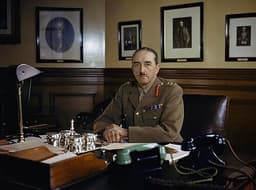
Alan Brooke
General · Modern
64.5Total

James FitzJames Berwick
General · Modern
62.6Total
Basic Information
Born
1883
1670
Died
1963
1734
Era
Modern
Modern
Nationality
United Kingdom
France
Occupation
General
General
Civilization
Western
Western
Score Comparison
Military (10%)
55.0
78.0
Political (20%)
72.0
72.0
Influence (20%)
61.0
62.0
Legacy (20%)
55.0
50.0
Leadership (15%)
80.0
62.0
Strategy (15%)
72.0
67.2
TOTAL
64.5
62.6
Alan Brooke — Complete Timeline
1941 AD
Appointed Chief of the Imperial General StaffOther◆ Major
In December 1941, Alan Brooke was appointed Chief of the Imperial General Staff (CIGS), the professional head of the British Army. He served in this role throughout World War II, overseeing military strategy and operations, and was a key member of the Chiefs of Staff Committee that advised Prime Minister Winston Churchill.
World War IIBritish ArmyMilitary Leadership
Impact: global
1943 AD
Participated in the Casablanca ConferenceOther◆ Major
In January 1943, Brooke attended the Casablanca Conference with Churchill and Roosevelt, where Allied strategy for the remainder of World War II was discussed. The conference agreed on the policy of 'unconditional surrender' for the Axis powers and the invasion of Sicily, with Brooke playing a key role in shaping military plans.
World War IIAllied StrategyCasablanca
Impact: global
Attended the Tehran ConferenceOther◆ Major
In November-December 1943, Brooke attended the Tehran Conference with Churchill, Roosevelt, and Stalin. The conference coordinated Allied military strategy against Germany, including the timing of the cross-channel invasion (Operation Overlord) and the Soviet offensive, with Brooke providing military advice on the feasibility of operations.
World War IIAllied StrategyTehran
Impact: global
1944 AD
Oversaw the D-Day PlanningOther◆ Major
As CIGS, Brooke was instrumental in planning the Normandy landings (D-Day) on June 6, 1944. He coordinated with Allied commanders to develop the invasion strategy, including the selection of landing beaches and the allocation of forces, which led to the successful liberation of Western Europe from Nazi occupation.
World War IID-DayNormandy Invasion
Impact: globalconstructive
Promoted to Field MarshalOther◆ Major
On January 1, 1944, Alan Brooke was promoted to the rank of Field Marshal, the highest rank in the British Army. This promotion recognized his exceptional service as CIGS and his contributions to Allied victory in World War II.
World War IIPromotionField Marshal
Impact: nationalconstructive
James FitzJames Berwick — Complete Timeline
1702 AD
Service in the War of the Spanish SuccessionWar◆ Major
Berwick commanded French forces in Spain, capturing Barcelona in 1705 and defeating the Allies at the Battle of Almansa in 1707. These victories secured the Spanish throne for Philip V, Louis XIV's grandson.
WarVictorySpain
Impact: regionalconstructive
1703 AD
Appointment as Marshal of FrancePolitical Action◆ Major
Berwick was appointed Marshal of France by Louis XIV, despite his illegitimate Stuart birth. This appointment recognized his military successes and loyalty to the French crown.
AppointmentPromotionHonor
Impact: nationalconstructive
1714 AD
Siege of Barcelona (1714)War◆ Major
Berwick commanded the French siege of Barcelona, which fell after 13 months. The capture ended Catalan resistance to Philip V and led to the abolition of Catalan institutions under the Nueva Planta decrees.
SiegeConquestCatalonia
Impact: regionaldestructive
1734 AD
Death at the Siege of PhilippsburgWar
Berwick was killed by a cannonball while inspecting siege works at Philippsburg during the War of the Polish Succession. His death was a significant loss for the French army.
DeathSiegeLoss
Impact: regionaltragic
Expert Analysis
Origins
Alan Brooke was born on July 23, 1883, in Bagnères-de-Bigorre, France, to an Anglo-Irish family with a military tradition. He was educated at the Royal Military Academy, Woolwich, and commissioned into the Royal Artillery in 1902. His early career included service in India and on the Western Front during World War I, where he developed a reputation for meticulous planning and staff work.
James FitzJames, 1st Duke of Berwick, was born on August 21, 1670, in Moulins, France, the illegitimate son of James II of England and Arabella Churchill. Raised in France, he was educated for a military career and served in the French army under Louis XIV. His lineage gave him connections to both English and French nobility, but his illegitimacy limited his inheritance.
Rise to Power
Brooke's rise came during World War II. In 1940, he commanded II Corps in the British Expeditionary Force, overseeing the evacuation from Dunkirk. His performance led to his appointment as Chief of the Imperial General Staff (CIGS) in December 1941. As CIGS, he became Churchill's primary military advisor and a key figure in Allied strategy, attending conferences at Casablanca (January 1943), Tehran (November 1943), and Yalta (February 1945). His influence grew as he managed the complex relationships between British, American, and Soviet commanders.
Berwick rose through the French military hierarchy. He served in the War of the Grand Alliance (1688-1697) and was appointed a lieutenant general by 1704. His breakthrough came during the War of the Spanish Succession, when he commanded French forces in Spain. In 1707, he defeated the Allied army at the Battle of Almansa, a victory that secured Philip V's throne. For this, Louis XIV appointed him Marshal of France in 1707, an exceptional honor for an illegitimate Stuart.
Leadership & Governance
Brooke's leadership style was methodical and detail-oriented. He reorganized the British Army, improving training, logistics, and coordination with allies. He often clashed with Churchill over strategic priorities, advocating for a cautious approach in the Mediterranean while Churchill favored bold offensives. Brooke's governance of the army emphasized efficiency and professionalism, scoring 80.0 in leadership. His political score of 72.0 reflects his ability to navigate the Allied command structure.
Berwick led by personal example and tactical acumen. He was known for his discipline and siegecraft, as seen in the captures of Barcelona (1714) and Philippsburg (1734). His political score of 72.0 matches Brooke's, as he served as a diplomat and governor in Spain. However, his leadership score of 62.0 is lower, partly because his command was more localized and less about institutional reform.
Triumph & Tragedy
Brooke's greatest triumph was his role in planning the Normandy landings (D-Day, June 6, 1944). He coordinated with Eisenhower, Montgomery, and other commanders to develop the invasion strategy. His greatest failure was his underestimation of the German counteroffensive in the Ardennes (Battle of the Bulge, December 1944), though he quickly adapted. His military score of 55.0 is relatively low due to his staff role rather than field command.
Berwick's triumph was the capture of Barcelona in 1714 after a 13-month siege, ending Catalan resistance. He also won the decisive Battle of Almansa (1707). His tragedy was his death at the Siege of Philippsburg (June 12, 1734), killed by a cannonball while inspecting works. His military score of 78.0 reflects his success in battles and sieges.
Character & Destiny
Brooke was reserved, analytical, and often pessimistic. His diaries reveal frustration with Churchill's impulsiveness and American strategic naivety. His character shaped his fate as a behind-the-scenes architect of victory rather than a public hero. He was promoted to Field Marshal in 1944 and later made a viscount.
Berwick was pragmatic and loyal, serving France despite his English royal blood. His illegitimate birth drove him to prove his worth through military service. His destiny was to die in action, a fitting end for a soldier of his era.
Legacy
Brooke's legacy is as the principal organizer of the British war effort. He reformed the army and established the structure for joint Allied operations. Post-war, he served as Lord High Constable of England and wrote his memoirs. His influence is seen in modern British military staff systems.
Berwick's legacy is as a marshal of France who secured Spanish succession for the Bourbons. His descendants include the Dukes of Alba and Berwick. However, his reputation is overshadowed by figures like Marlborough and Napoleon.
Conclusion
Alan Brooke had greater overall impact due to his role in winning World War II and shaping the post-war world. His total score of 64.5 exceeds Berwick's 62.6, and his political and leadership scores are higher. While Berwick's military achievements were impressive, Brooke's strategic influence was global and enduring. The score gap of 1.9 points is narrow, but Brooke's legacy in institutional reform and Allied coordination gives him the edge.
Rankings
🥇
Alan BrookeLeader
Mil: 55.0Pol: 72.0Inf: 61.0
64.5
🥈
James FitzJames Berwick
Mil: 78.0Pol: 72.0Inf: 62.0
62.6
+1.9 behind
How This Comparison Works
Algorithm
Each figure is scored on 6 dimensions (0—100 scale) based on structured historical data: Military (10%), Political (20%), Influence (20%), Legacy (20%), Leadership (15%), Strategy (15%). The weighted total produces the final ranking.
Data Sources
Scores are computed from structured sub-indicators in the database. Scale factors adjust for era (Ancient ×0.85, Modern ×1.0) and civilization size (Eastern ×1.05, Other ×0.80) to account for differences in population and military scale.
Maximum 3 Figures
Comparisons are limited to 2—3 figures to ensure readability and statistical meaningfulness.
Error Margins
±5 points per dimension — Sub-scores are derived from historical records with inherent uncertainty. Two figures within 5 points on a dimension should be considered roughly equivalent in that area.
Total Score Accuracy
±3 points overall — The weighted combination of 6 dimensions produces a total score with approximately ±3 points of uncertainty. Differences of less than 3 points are not statistically significant— the figures are effectively tied.
Known Limitations
- Historical records are incomplete and uneven across civilizations
- Figures from oral-tradition societies may be underrepresented
- Occupation labels can misclassify multi-role figures
- Scores measure capability and impact, not moral character
- Quantitative scoring is a comparison tool, not absolute truth
Capability Radar
Military (10%) — Battles & Warfare
Battles
60
75
Win Rate
55
80
Expansion
20
70
Political (20%) — Governance & Reform
Reform
60
55
Diplomacy
80
70
Economy
50
50
Influence (20%) — Cultural & Global Reach
Cultural
30
45
Global
65
35
Legacy (20%) — Historical Impact
Historical
75
55
Longevity
60
40
Leadership (15%) — Power & Stability
Tenure
70
65
Stability
85
60
Strategy (15%) — Tactics & Innovation
Strategy
90
82
Tactics
75
78
Reform
85
60
Similar Comparisons
Comments & Discussion
No comments yet. Be the first to share your thoughts!