Loading...
Albert Kesselring vs Hermann Hoth
Albert Kesselring leads by 10.0 pts · 2 figures compared
…

Albert Kesselring
General · Modern
58.4Total
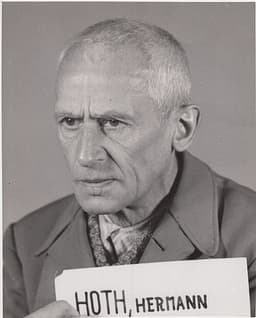
Hermann Hoth
General · Modern
48.4Total
Basic Information
Born
1885
1885
Died
1960
1971
Era
Modern
Modern
Nationality
Germany
Germany
Occupation
General
General
Civilization
Western
Western
Score Comparison
Military (10%)
72.5
67.3
Political (20%)
46.6
27.9
Influence (20%)
61.0
56.4
Legacy (20%)
50.0
48.3
Leadership (15%)
72.0
36.9
Strategy (15%)
56.2
58.0
TOTAL
58.4
48.4
Albert Kesselring — Complete Timeline
1940 AD
Command of Luftflotte 2 in the Battle of BritainWar◆ Major
Kesselring commanded Luftflotte 2 during the Battle of Britain. His air fleet conducted bombing raids against British airfields and cities. The Luftwaffe failed to achieve air superiority, leading to the cancellation of Operation Sea Lion, the planned invasion of Britain.
World War IIAir WarBattle of Britain
Impact: globaldestructive
1943 AD
Supreme Commander in ItalyWar◆ Major
Kesselring was appointed Commander-in-Chief of German forces in Italy after the Allied invasion. He organized a successful defensive campaign, delaying the Allied advance up the Italian peninsula. His strategy included the use of fortified lines and delaying actions.
World War IIItalian CampaignDefense
Impact: regional
1944 AD
Defense of the Gustav Line and Monte CassinoWar◆ Major
Kesselring commanded the defense of the Gustav Line, anchored by Monte Cassino. German forces held off repeated Allied assaults for months. The battle resulted in the destruction of the Monte Cassino abbey and heavy casualties on both sides before the line was finally breached.
World War IIItalian CampaignBattle
Impact: regionaldestructive
1945 AD
Surrender and War Crimes TrialPolitical Action◆ Major
Kesselring surrendered his forces in Italy in May 1945. He was tried by a British military court for war crimes, including the Ardeatine massacre and the shooting of partisans. He was sentenced to death, but the sentence was commuted to life imprisonment. He was released in 1952.
World War IIWar Crimes TrialPost-War
Impact: nationaltragic
Hermann Hoth — Complete Timeline
1941 AD
Command of Panzer Group 3 in Operation BarbarossaWar◆ Major
Hoth commanded Panzer Group 3 during the invasion of the Soviet Union. His forces advanced on Minsk and Vitebsk, encircling large Soviet forces in the early stages of the campaign.
World War IIEastern FrontOperation Barbarossa
Impact: regional
1943 AD
Command of 4th Panzer Army at KurskWar◆ Major
Hoth led the 4th Panzer Army in the southern sector of the Battle of Kursk. His forces achieved initial penetrations but were halted at Prokhorovka, contributing to the German failure.
World War IIEastern FrontKursk
Impact: regional
1948 AD
Imprisonment for War CrimesPolitical Action◆ Major
Hoth was tried at the Subsequent Nuremberg Trials in the High Command Trial. He was found guilty of war crimes and crimes against humanity and sentenced to 15 years imprisonment.
War Crimes TrialPost-War Justice
Impact: national
Expert Analysis
Origins
Albert Kesselring was born on November 30, 1885, in Marktsteft, Bavaria, into a middle-class family. His father was a school inspector. Kesselring joined the Bavarian Army as a cadet in 1904 and served in the artillery. He rose through the ranks during World War I, earning the Iron Cross. After the war, he remained in the Reichswehr and transitioned to the Luftwaffe in 1933, where he learned to fly at age 48.
Hermann Hoth was born on April 12, 1885, in Neuruppin, Brandenburg, into a military family. His father was an army surgeon. Hoth joined the Imperial German Army in 1903 and served as a staff officer in World War I. He remained in the Reichswehr and became a panzer commander, advocating for armored warfare. By 1938, he commanded the 15th Infantry Division.
Rise to Power
Kesselring's rise accelerated during the rearmament period. He commanded Luftflotte 1 during the invasion of Poland in 1939 and Luftflotte 2 during the Battle of France in 1940. His success in France earned him promotion to Generalfeldmarschall in July 1940. During the Battle of Britain, Kesselring's Luftflotte 2 conducted bombing raids, but the Luftwaffe failed to gain air superiority. Nonetheless, he remained in favor.
Hoth rose through the panzer corps. He commanded the 15th Panzer Corps in the invasion of Poland and the 3rd Panzer Group in the invasion of France. In 1940, he was promoted to Generaloberst. His major breakthrough came during Operation Barbarossa in 1941, where he commanded Panzer Group 3, advancing on Minsk and Vitebsk, encircling Soviet forces. His success led to command of the 4th Panzer Army in 1942.
Leadership & Governance
Kesselring's leadership style was pragmatic and diplomatic. He was known as "Smiling Albert" for his optimism and ability to maintain morale. As Supreme Commander in Italy from 1943, he organized a defensive campaign that delayed the Allied advance for months. He skillfully used terrain and fortifications, such as the Gustav Line anchored at Monte Cassino. Kesselring's governance in Italy involved cooperation with Italian authorities and managing partisan threats. His military leadership scored 72.0, reflecting his effectiveness in defensive operations.
Hoth's leadership was more aggressive and focused on armored warfare. He was a proponent of the blitzkrieg doctrine. At Kursk in 1943, he led the 4th Panzer Army in the southern sector, achieving initial penetrations but failing to break through at Prokhorovka. His leadership score of 36.9 indicates difficulties in managing large formations under pressure. Hoth's governance was limited to military command, but he was implicated in war crimes, including the Commissar Order and treatment of prisoners.
Triumph & Tragedy
Kesselring's greatest triumph was the defense of Italy. He held the Allies at the Gustav Line for months, causing heavy casualties. The battle of Monte Cassino in 1944 exemplified his defensive skill. However, his failure to prevent the Allied breakout at Anzio in 1944 was a setback. Kesselring's tragedy came after the war: he was tried for war crimes, including the Ardeatine massacre, and sentenced to death, later commuted to life imprisonment. He was released in 1952 due to health issues.
Hoth's triumph was the encirclement of Soviet forces at Vyazma in 1941, capturing hundreds of thousands of prisoners. At Kursk, his forces achieved the deepest penetrations, but the battle ended in a Soviet counteroffensive. Hoth's tragedy was his conviction for war crimes. He was sentenced to 15 years in prison in 1948 but was released in 1954. His legacy is tarnished by his involvement in criminal orders.
Character & Destiny
Kesselring's character was marked by optimism and adaptability. He maintained morale even in retreat. His decision-making was flexible, allowing him to improvise defenses with limited resources. Historical assessments note his skill in defensive warfare but criticize his willingness to carry out Hitler's orders. His political score of 46.6 reflects his avoidance of direct confrontation with the Nazi regime.
Hoth was more rigid and aggressive. He believed in the blitzkrieg and often pushed his forces to the limit. His character led to overextension in Russia, contributing to losses. His low leadership score (36.9) suggests difficulty in adapting to changing circumstances. Hoth's destiny was shaped by his adherence to Nazi ideology, which led to his conviction.
Legacy
Kesselring's legacy is mixed. He is remembered as a capable commander who prolonged the war in Italy. His military score of 72.5 indicates his effectiveness. However, his involvement in war crimes and his role in the Nazi regime overshadow his achievements. In post-war Germany, he was seen as a professional soldier, but historians have highlighted his culpability.
Hoth's legacy is more obscure. He is remembered as a panzer commander in key battles like Kursk. His military score is 67.3, but his leadership score is low. His conviction for war crimes has diminished his reputation. Neither figure is widely celebrated, but Kesselring's defensive campaigns are studied in military academies.
Conclusion
Albert Kesselring had greater impact than Hermann Hoth. His total score of 58.4 outranks Hoth's 48.4 by 10 points. Kesselring's defensive campaign in Italy tied up Allied resources for months, influencing the course of the war. Hoth's achievements were tactical victories that did not alter the strategic outcome. Kesselring's leadership score of 72.0 versus Hoth's 36.9 underscores his superior command. While both were complicit in war crimes, Kesselring's military legacy is more significant. Thus, Kesselring is the more impactful figure.
Rankings
🥇
Albert KesselringLeader
Mil: 72.5Pol: 46.6Inf: 61.0
58.4
🥈
Hermann Hoth
Mil: 67.3Pol: 27.9Inf: 56.4
48.4
+10.0 behind
How This Comparison Works
Algorithm
Each figure is scored on 6 dimensions (0—100 scale) based on structured historical data: Military (10%), Political (20%), Influence (20%), Legacy (20%), Leadership (15%), Strategy (15%). The weighted total produces the final ranking.
Data Sources
Scores are computed from structured sub-indicators in the database. Scale factors adjust for era (Ancient ×0.85, Modern ×1.0) and civilization size (Eastern ×1.05, Other ×0.80) to account for differences in population and military scale.
Maximum 3 Figures
Comparisons are limited to 2—3 figures to ensure readability and statistical meaningfulness.
Error Margins
±5 points per dimension — Sub-scores are derived from historical records with inherent uncertainty. Two figures within 5 points on a dimension should be considered roughly equivalent in that area.
Total Score Accuracy
±3 points overall — The weighted combination of 6 dimensions produces a total score with approximately ±3 points of uncertainty. Differences of less than 3 points are not statistically significant— the figures are effectively tied.
Known Limitations
- Historical records are incomplete and uneven across civilizations
- Figures from oral-tradition societies may be underrepresented
- Occupation labels can misclassify multi-role figures
- Scores measure capability and impact, not moral character
- Quantitative scoring is a comparison tool, not absolute truth
Capability Radar
Military (10%) — Battles & Warfare
Battles
75
75
Win Rate
65
70
Expansion
30
60
Political (20%) — Governance & Reform
Reform
20
10
Diplomacy
55
15
Economy
25
10
Influence (20%) — Cultural & Global Reach
Cultural
30
30
Global
45
40
Legacy (20%) — Historical Impact
Historical
55
50
Longevity
40
30
Leadership (15%) — Power & Stability
Tenure
60
20
Stability
40
10
Strategy (15%) — Tactics & Innovation
Strategy
78
75
Tactics
80
80
Reform
40
40
Similar Comparisons
Comments & Discussion
No comments yet. Be the first to share your thoughts!