Loading...
Hermann Hoth vs Napoleon Bonaparte
Napoleon Bonaparte leads by 22.5 pts · 2 figures compared
…
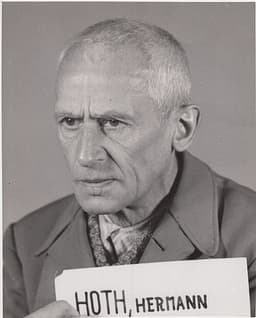
Hermann Hoth
General · Modern
48.4Total

Napoleon Bonaparte
General · Modern
70.9Total
Basic Information
Born
1885
1769
Died
1971
1821
Era
Modern
Modern
Nationality
Germany
France
Occupation
General
General
Civilization
Western
Western
Score Comparison
Military (10%)
67.3
94.0
Political (20%)
27.9
72.0
Influence (20%)
56.4
40.0
Legacy (20%)
48.3
80.0
Leadership (15%)
36.9
78.0
Strategy (15%)
58.0
90.0
TOTAL
48.4
70.9
Hermann Hoth — Complete Timeline
1941 AD
Command of Panzer Group 3 in Operation BarbarossaWar◆ Major
Hoth commanded Panzer Group 3 during the invasion of the Soviet Union. His forces advanced on Minsk and Vitebsk, encircling large Soviet forces in the early stages of the campaign.
World War IIEastern FrontOperation Barbarossa
Impact: regional
1943 AD
Command of 4th Panzer Army at KurskWar◆ Major
Hoth led the 4th Panzer Army in the southern sector of the Battle of Kursk. His forces achieved initial penetrations but were halted at Prokhorovka, contributing to the German failure.
World War IIEastern FrontKursk
Impact: regional
1948 AD
Imprisonment for War CrimesPolitical Action◆ Major
Hoth was tried at the Subsequent Nuremberg Trials in the High Command Trial. He was found guilty of war crimes and crimes against humanity and sentenced to 15 years imprisonment.
War Crimes TrialPost-War Justice
Impact: national
Napoleon Bonaparte — Complete Timeline
1799 AD
Coup of 18 BrumaireOther◆ Major
Napoleon Bonaparte, with support from his brother Lucien and key political figures, overthrew the Directory in a bloodless coup. He established the Consulate with himself as First Consul, effectively becoming the ruler of France. This event ended the French Revolution's most unstable period.
French RevolutionCoupRise to Power
Impact: regional
1804 AD
Promulgation of the Napoleonic CodeOther◆ Major
Napoleon enacted the Civil Code of the French, known as the Napoleonic Code, a comprehensive set of laws that replaced the fragmented feudal legal systems. The code established legal equality, protected property rights, and secularized law. It became the basis for legal systems in many European and world countries.
Legal ReformNapoleonic CodeCivil Law
Impact: globalconstructive
1805 AD
Battle of AusterlitzWar◆ Major
Napoleon's Grande Arm
Napoleonic WarsBattleDecisive Victory
Impact: global
1812 AD
Invasion of RussiaWar◆ Major
Napoleon led the Grande Arm
Napoleonic WarsInvasionDisaster
Impact: globaldestructive
1815 AD
Battle of WaterlooWar◆ Major
Napoleon's French army was defeated by the combined forces of the Duke of Wellington's Anglo-Allied army and Gebhard Leberecht von Bl
Napoleonic WarsBattleFinal Defeat
Impact: globaldestructive
Expert Analysis
hermann-hoth-vs-napoleon-bonaparte
# The Emperor and the General
On a June morning in 1815, Napoleon Bonaparte surveyed the muddy fields near Waterloo, his grand army poised for a battle that would seal his fate. One hundred twenty-eight years later, another German commander, Hermann Hoth, peered across the steppes of southern Russia, his panzer divisions grinding toward the Soviet fortress of Kursk. Both men commanded vast forces. Both believed in decisive victory. One reshaped a continent; the other became a footnote in a war his nation lost. Why did their paths diverge so dramatically? The answer lies not merely in talent, but in the worlds that made them.
Origins
Napoleon Bonaparte was born in 1769 on the island of Corsica, a place only recently annexed by France. His family were minor nobility, struggling and proud. He spoke Italian before French, and carried the chip of a provincial outsider. The French Revolution, which erupted when he was twenty, shattered the old order and opened doors that had been locked for centuries. A gifted artillery officer could become emperor—and did.
Hermann Hoth was born in 1885 in Neuruppin, Prussia, into a military family. His Germany was united, industrial, and authoritarian. The Kaiser’s army rewarded obedience, not ambition. Hoth learned to follow orders, to plan meticulously, to see war as a science. The world of Napoleon—where a young man could seize a crown with sheer audacity—was as foreign to him as the moon.
Rise to Power
Napoleon’s ascent was meteoric. At twenty-four, he drove the British from Toulon. At twenty-six, he crushed a royalist uprising in Paris with a “whiff of grapeshot.” By thirty, he had conquered Italy and Egypt. His political genius matched his military brilliance: he staged a coup in 1799, became First Consul, and crowned himself Emperor in 1804. Each step was a gamble, each victory a leap.
Hoth rose slowly, methodically. He served in World War I as a staff officer, then survived the Weimar Republic’s lean years. The Nazi rearmament of the 1930s gave him his chance. By 1941, he commanded Panzer Group 3 in Operation Barbarossa, the invasion of the Soviet Union. His tanks raced toward Minsk and Vitebsk, encircling hundreds of thousands of Soviet soldiers. He was a skilled executor of a monstrous plan, not its architect.
Leadership & Governance
Napoleon ruled an empire. He reformed French law with the Napoleonic Code, centralized the administration, and built schools and roads. He was a political visionary who understood that power required legitimacy. His marshals were rewarded with titles and lands, bound to him by loyalty and greed. He commanded from the front, personally directing battles like Austerlitz in 1805, where his 94.0 military score was forged in fire.
Hoth never governed. He commanded armies, not nations. His 80.0 military score reflects competence, but his 65.7 strategy score reveals a limitation: he was a brilliant tactician, not a strategic thinker. At Kursk in 1943, his 4th Panzer Army achieved initial penetrations against Soviet defenses, but the offensive stalled. He could not change the war’s course. His political score of 63.9 is telling—he served a regime he never challenged, even as it descended into criminality.
Triumph & Tragedy
Napoleon’s greatest moment was Austerlitz in 1805, where he destroyed an Austro-Russian army and shattered the Third Coalition. His tragedy was Moscow in 1812—the Grand Army of 600,000 men reduced to a frozen remnant. He never recovered. Exiled to Elba, he escaped for one last gamble, only to meet Wellington at Waterloo.
Hoth’s triumph was the encirclement of Vitebsk in 1941, a textbook blitzkrieg. His tragedy was moral. After the war, in 1948, he was tried at the High Command Trial in Nuremberg and convicted of war crimes and crimes against humanity. He had implemented orders that starved Soviet prisoners and executed commissars. He spent six years in prison, released in 1954, a broken man.
Character & Destiny
Napoleon was restless, brilliant, and insatiable. “Impossible is a word to be found only in the dictionary of fools,” he said. His ambition built an empire and destroyed it. He could not stop—not after Egypt, not after Austerlitz, not after Jena. The same drive that made him a conqueror doomed him.
Hoth was competent, disciplined, and obedient. He did not question the regime he served. He did not refuse criminal orders. His tragedy was not failure but complicity. He was a cog in a machine that murdered millions, and he accepted it.
Legacy
Napoleon’s legacy is everywhere: the Napoleonic Code shapes European law, his campaigns are studied in war colleges, his name evokes both glory and caution. His influence score of 82.0 and legacy of 78.0 reflect a man who changed the world, for better and worse.
Hoth is remembered, if at all, as a symbol of the Wehrmacht’s moral collapse. His legacy score of 66.5 is a warning: competence without conscience is not greatness.
Conclusion
Standing on that muddy field at Waterloo, Napoleon could see his empire crumbling. Hoth, in his prison cell decades later, could see the same. Both men were products of their age—one of revolution and boundless possibility, the other of order and blind obedience. Napoleon’s flaw was his ambition; Hoth’s was his lack of it. In the end, the emperor and the general teach us the same lesson: history judges not only what you achieve, but what you allow.
Rankings
🥇
Napoleon BonaparteLeader
Mil: 94.0Pol: 72.0Inf: 40.0
70.9
🥈
Hermann Hoth
Mil: 67.3Pol: 27.9Inf: 56.4
48.4
+22.5 behind
How This Comparison Works
Algorithm
Each figure is scored on 6 dimensions (0—100 scale) based on structured historical data: Military (10%), Political (20%), Influence (20%), Legacy (20%), Leadership (15%), Strategy (15%). The weighted total produces the final ranking.
Data Sources
Scores are computed from structured sub-indicators in the database. Scale factors adjust for era (Ancient ×0.85, Modern ×1.0) and civilization size (Eastern ×1.05, Other ×0.80) to account for differences in population and military scale.
Maximum 3 Figures
Comparisons are limited to 2—3 figures to ensure readability and statistical meaningfulness.
Error Margins
±5 points per dimension — Sub-scores are derived from historical records with inherent uncertainty. Two figures within 5 points on a dimension should be considered roughly equivalent in that area.
Total Score Accuracy
±3 points overall — The weighted combination of 6 dimensions produces a total score with approximately ±3 points of uncertainty. Differences of less than 3 points are not statistically significant— the figures are effectively tied.
Known Limitations
- Historical records are incomplete and uneven across civilizations
- Figures from oral-tradition societies may be underrepresented
- Occupation labels can misclassify multi-role figures
- Scores measure capability and impact, not moral character
- Quantitative scoring is a comparison tool, not absolute truth
Capability Radar
Military (10%) — Battles & Warfare
Battles
75
95
Win Rate
70
90
Expansion
60
95
Political (20%) — Governance & Reform
Reform
10
95
Diplomacy
15
80
Economy
10
85
Influence (20%) — Cultural & Global Reach
Cultural
30
85
Global
40
90
Legacy (20%) — Historical Impact
Historical
50
95
Longevity
30
90
Leadership (15%) — Power & Stability
Tenure
20
85
Stability
10
70
Strategy (15%) — Tactics & Innovation
Strategy
75
95
Tactics
80
98
Reform
40
92
Similar Comparisons
Comments & Discussion
No comments yet. Be the first to share your thoughts!