Loading...
Alcibiades vs Julius Caesar
Julius Caesar leads by 26.9 pts · 2 figures compared
…
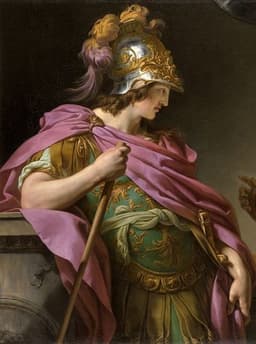
Alcibiades
General · Ancient
55.9Total

Julius Caesar
General · Ancient
82.8Total
Basic Information
Born
-450
-100
Died
-404
-44
Era
Ancient
Ancient
Nationality
Greece
Roman Republic
Occupation
General
General
Civilization
Western
Western
Score Comparison
Military (10%)
60.0
88.0
Political (20%)
45.1
78.0
Influence (20%)
61.0
85.0
Legacy (20%)
58.0
82.0
Leadership (15%)
43.8
80.0
Strategy (15%)
68.1
85.0
TOTAL
55.9
82.8
Alcibiades — Complete Timeline
415 BC
Sicilian ExpeditionWar
Alcibiades persuaded Athens to launch a massive expedition against Syracuse in Sicily. He was appointed as one of the commanders but was recalled to face charges of sacrilege. He defected to Sparta instead, providing them with strategic advice that contributed to Athens' defeat.
Peloponnesian WarSicilyDefection
Impact: regionaldestructive
Defection to SpartaPolitical Action◆ Major
After being recalled from the Sicilian Expedition, Alcibiades fled to Sparta. He advised the Spartans to fortify Decelea in Attica and to send aid to Syracuse, actions that severely weakened Athens. His defection was a major blow to Athenian strategy.
Peloponnesian WarSpartaTreason
Impact: regionaldestructive
411 BC
Return to Athens and Naval VictoriesWar◆ Major
Alcibiades returned to Athens after being recalled by the democratic faction. He led the Athenian navy to several victories over the Spartans, including at Cyzicus and Abydos, restoring Athenian morale and temporarily reversing the tide of the war.
Peloponnesian WarNaval BattleAthens
Impact: regionalconstructive
404 BC
Second Exile and AssassinationPolitical Action◆ Major
After a naval defeat at Notium, Alcibiades was again exiled from Athens. He fled to Phrygia in Persia, where he was assassinated by Persian agents, likely at the instigation of the Spartan general Lysander. His death ended his turbulent political career.
ExileAssassinationPersia
Impact: regionaltragic
Julius Caesar — Complete Timeline
58 BC
Gallic WarsWar◆ Major
Caesar, as proconsul of Gaul, launched a series of campaigns that conquered all of Gaul (modern France, Belgium, and parts of Switzerland). He fought numerous battles, including against the Helvetii, the Belgae, and the Gallic chieftain Vercingetorix. The wars brought immense wealth and a loyal army to Caesar.
Gallic WarsConquestRoman Expansion
Impact: regional
49 BC
Crossing the RubiconPolitical Action◆ Major
Caesar led Legio XIII across the Rubicon River into Italy, defying the Roman Senate's order to disband his army. This act triggered a civil war against Pompey and the Optimates, ultimately leading to Caesar's dictatorship and the end of the Roman Republic.
Roman Civil WarEnd of RepublicPower Struggle
Impact: global
48 BC
Battle of PharsalusWar◆ Major
Caesar's outnumbered army defeated the larger forces of Pompey the Great at Pharsalus in Greece. Caesar's tactical use of a reserve line to counter Pompey's cavalry charge proved decisive. Pompey fled to Egypt, where he was assassinated, leaving Caesar as the undisputed master of the Roman world.
Roman Civil WarBattleDecisive Victory
Impact: regional
44 BC
Appointment as Dictator for LifePolitical Action◆ Major
The Roman Senate appointed Caesar dictator perpetuo (dictator for life), granting him unprecedented personal power. This move concentrated military, legislative, and judicial authority in one person, effectively ending the Roman Republic's traditional system of checks and balances and alarming many senators.
DictatorshipEnd of RepublicPower Consolidation
Impact: regionaldestructive
Assassination on the Ides of MarchPolitical Action◆ Major
A group of Roman senators, led by Marcus Junius Brutus and Gaius Cassius Longinus, stabbed Caesar to death at a meeting of the Senate in the Theatre of Pompey. The assassination was intended to restore the Republic, but instead triggered another civil war that led to the rise of the Roman Empire.
AssassinationRoman PoliticsEnd of Republic
Impact: globaldestructive
Expert Analysis
alcibiades-vs-julius-caesar
# The Gambler and the Conqueror
On a spring morning in 44 BCE, Julius Caesar walked into the Senate chamber, dismissing a warning of danger with a wave of his hand. Within minutes, he lay bleeding from twenty-three stab wounds, the greatest general of his age destroyed by those he had pardoned. Forty years earlier, on the other side of the Greek world, another brilliant commander had fled Athens in the dead of night, abandoning his command to save his skin. One man would die believing he had remade the world; the other would die in a foreign land, having betrayed every cause he ever served.
Origins
Caesar was born into the chaos of a dying republic. His family, the Julii, claimed descent from the goddess Venus, but their fortune had faded. Growing up in the violent politics of Rome, where senators hired gangs and generals marched on their own capital, Caesar learned early that survival meant mastering the art of the possible. He was a child of crisis, and crisis would become his native element.
Alcibiades came of age in Athens at its zenith, a golden city drunk on empire and democracy. He was born to wealth and beauty, the ward of Pericles himself. Where Caesar clawed his way upward from obscurity, Alcibiades was handed everything—and treated it all as a toy. His youth was a scandal: he cut off his dog's tail for attention, threw a famous sculptor into prison for a bet, and mocked the sacred mysteries of Eleusis in a drunken party. Athens laughed at his excesses because he was brilliant, and brilliance forgives much.
Rise to Power
Caesar's path was slow and calculated. He served as a priest in his teens, fled Rome during a purge, and returned to build a career through careful alliances. He borrowed fortunes to host lavish games, won military command in Spain, and forged the First Triumvirate with Pompey and Crassus. Every step was a wager, but each wager was hedged with preparation. By the time he was appointed governor of Gaul, Caesar had spent twenty years learning how power actually worked.
Alcibiades rose like a rocket. At thirty, he was the most popular man in Athens—handsome, eloquent, and reckless. When he proposed the Sicilian Expedition in 415 BCE, the greatest military gamble in Athenian history, the Assembly gave him command not because of his record but because of his charisma. "He persuaded the citizens to hope for more than was possible," wrote the historian Thucydides. Where Caesar built power brick by brick, Alcibiades tried to vault over walls.
Leadership & Governance
In Gaul, Caesar displayed a genius for organization. He commanded armies of fifty thousand men across trackless forests, built bridges in ten days, and besieged fortresses that had never fallen. He knew every centurion by name, shared the soldiers' rations, and wrote dispatches that read like epic poetry. His political reforms as dictator were equally systematic: he reformed the calendar, granted citizenship to provincials, and broke the power of the old oligarchy. Caesar governed like an engineer, solving problems one by one.
Alcibiades led like a dancer, improvising as he went. When he defected to Sparta after the Sicilian Expedition, he advised the Spartans to fortify Decelea—a strategic masterstroke that crippled Athens. When he returned to Athenian command in 411 BCE, he won three naval victories in a row, restoring Athens' fortunes. But he could not hold a course. He was brilliant in the moment, incapable of building for the long term. His leadership was a series of dazzling flashes, followed by darkness.
Triumph & Tragedy
Caesar's greatest moment came at Alesia in 52 BCE, when he besieged a Gallic fortress while simultaneously defeating a relief army four times his size. It was a double envelopment that military academies still study. His tragedy was the Ides of March—not because he was killed, but because he had no plan for what came after. He had destroyed the Republic but built nothing to replace it, leaving the world to Augustus.
Alcibiades' triumph was his return to Athens in 407 BCE, when the fleet welcomed him with gold crowns and the people hailed him as savior. His tragedy was his own nature. After a naval defeat at Notium—caused by a subordinate's blunder—he was exiled again. He fled to Persia, where he was assassinated by a mob of assassins in 404 BCE. Athens, meanwhile, surrendered to Sparta that same year.
Character & Destiny
Caesar was cold and calculating, but he was also generous to a fault. He pardoned his enemies because he believed their gratitude would bind them to him—a miscalculation that cost him his life. He trusted his own luck so completely that he stopped reading warnings. "The dice are cast," he said at the Rubicon, but he never considered that the dice might roll against him.
Alcibiades was incapable of loyalty because he was incapable of believing in anything beyond his own ambition. He betrayed Athens, Sparta, and Persia in turn, and each time he expected to be welcomed back. He was, in the end, a man who could not see that trust, once broken, cannot be glued back together.
Legacy
Caesar's name became the title of emperors—Kaiser, Tsar—and his reforms outlasted the Republic he destroyed. He is remembered as the man who crossed the Rubicon, the father of the Roman Empire, the author of the Gallic Wars. His murder made him a martyr and a myth.
Alcibiades is remembered as a cautionary tale. "They loved him, hated him, and could not live without him," wrote Plutarch. He was the most brilliant failure of the ancient world, proof that genius without discipline is just a faster way to fall.
Conclusion
Standing at the edge of history, both men saw the same truth: the old order was dying. Caesar chose to build a new one, stone by stone, knowing that the work might kill him. Alcibiades chose to dance on the ruins, dazzling everyone until the fire went out. One died for his vision; the other died for his emptiness. In the end, the difference between a conqueror and a gambler is not talent—it is the willingness to stay when the game turns cold.
Rankings
🥇
Julius CaesarLeader
Mil: 88.0Pol: 78.0Inf: 85.0
82.8
🥈
Alcibiades
Mil: 60.0Pol: 45.1Inf: 61.0
55.9
+26.9 behind
How This Comparison Works
Algorithm
Each figure is scored on 6 dimensions (0—100 scale) based on structured historical data: Military (10%), Political (20%), Influence (20%), Legacy (20%), Leadership (15%), Strategy (15%). The weighted total produces the final ranking.
Data Sources
Scores are computed from structured sub-indicators in the database. Scale factors adjust for era (Ancient ×0.85, Modern ×1.0) and civilization size (Eastern ×1.05, Other ×0.80) to account for differences in population and military scale.
Maximum 3 Figures
Comparisons are limited to 2—3 figures to ensure readability and statistical meaningfulness.
Error Margins
±5 points per dimension — Sub-scores are derived from historical records with inherent uncertainty. Two figures within 5 points on a dimension should be considered roughly equivalent in that area.
Total Score Accuracy
±3 points overall — The weighted combination of 6 dimensions produces a total score with approximately ±3 points of uncertainty. Differences of less than 3 points are not statistically significant— the figures are effectively tied.
Known Limitations
- Historical records are incomplete and uneven across civilizations
- Figures from oral-tradition societies may be underrepresented
- Occupation labels can misclassify multi-role figures
- Scores measure capability and impact, not moral character
- Quantitative scoring is a comparison tool, not absolute truth
Capability Radar
Military (10%) — Battles & Warfare
Battles
65
95
Win Rate
55
92
Expansion
40
97
Political (20%) — Governance & Reform
Reform
45
90
Diplomacy
85
85
Economy
40
82
Influence (20%) — Cultural & Global Reach
Cultural
60
88
Global
55
94
Legacy (20%) — Historical Impact
Historical
70
95
Longevity
65
96
Leadership (15%) — Power & Stability
Tenure
60
75
Stability
20
60
Strategy (15%) — Tactics & Innovation
Strategy
70
94
Tactics
80
96
Reform
30
88
Similar Comparisons
Comments & Discussion
No comments yet. Be the first to share your thoughts!