Loading...
Alexander the Great vs Julius Caesar
Alexander the Great leads by 2.4 pts · 2 figures compared
…
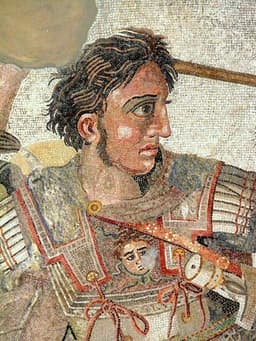
Alexander the Great
General · Ancient
85.2Total

Julius Caesar
General · Ancient
82.8Total
Basic Information
Born
-356
-100
Died
-323
-44
Era
Ancient
Ancient
Nationality
Macedon
Roman Republic
Occupation
General
General
Civilization
Western
Western
Score Comparison
Military (10%)
95.0
88.0
Political (20%)
60.0
78.0
Influence (20%)
92.0
85.0
Legacy (20%)
90.0
82.0
Leadership (15%)
80.0
80.0
Strategy (15%)
92.0
85.0
TOTAL
85.2
82.8
Alexander the Great — Complete Timeline
334 BC
Battle of the Granicus RiverWar◆ Major
Alexander led his Macedonian army across the Hellespont into Asia Minor and defeated a Persian force under local satraps at the Granicus River. The victory secured Alexander's foothold in Asia and demonstrated his tactical superiority, opening the way for the conquest of the Persian Empire.
Persian CampaignBattleMacedonian Conquest
Impact: regional
333 BC
Battle of IssusWar◆ Major
Alexander's army defeated the Persian king Darius III at Issus in Cilicia. Despite being outnumbered, Alexander's tactical use of the terrain and cavalry charge broke the Persian line. Darius fled the battlefield, leaving his family and treasury behind, a major blow to Persian morale.
Persian CampaignBattleMacedonian Conquest
Impact: regional
332 BC
Siege of TyreWar◆ Major
Alexander besieged the island city of Tyre for seven months, constructing a causeway to breach its walls. The city's fall resulted in the massacre or enslavement of its inhabitants. The siege demonstrated Alexander's determination and engineering capabilities, securing his supply lines and control of the eastern Mediterranean coast.
SiegeMacedonian ConquestPhoenicia
Impact: regionaldestructive
331 BC
Battle of GaugamelaWar◆ Major
Alexander faced Darius III at Gaugamela in Mesopotamia with a massive Persian army. Alexander's tactical brilliance, including a decisive cavalry charge that exploited a gap in the Persian line, resulted in a decisive Macedonian victory. Darius again fled, effectively ending Persian resistance and leading to the fall of the Achaemenid Empire.
Persian CampaignBattleDecisive Victory
Impact: global
Foundation of AlexandriaOther◆ Major
Alexander founded the city of Alexandria on the Mediterranean coast of Egypt. He personally selected the site and oversaw the initial planning. Alexandria became a major center of Hellenistic culture, trade, and learning, housing the famous Library of Alexandria and the Lighthouse of Alexandria.
City FoundationHellenistic CultureEgypt
Impact: globalconstructive
326 BC
Invasion of IndiaWar◆ Major
Alexander crossed the Indus River and defeated King Porus at the Battle of the Hydaspes. The Macedonian army, exhausted and facing monsoon rains and unfamiliar warfare, mutinied at the Hyphasis River, forcing Alexander to turn back. This campaign marked the easternmost extent of his conquests.
Indian CampaignBattleMutiny
Impact: regional
Julius Caesar — Complete Timeline
58 BC
Gallic WarsWar◆ Major
Caesar, as proconsul of Gaul, launched a series of campaigns that conquered all of Gaul (modern France, Belgium, and parts of Switzerland). He fought numerous battles, including against the Helvetii, the Belgae, and the Gallic chieftain Vercingetorix. The wars brought immense wealth and a loyal army to Caesar.
Gallic WarsConquestRoman Expansion
Impact: regional
49 BC
Crossing the RubiconPolitical Action◆ Major
Caesar led Legio XIII across the Rubicon River into Italy, defying the Roman Senate's order to disband his army. This act triggered a civil war against Pompey and the Optimates, ultimately leading to Caesar's dictatorship and the end of the Roman Republic.
Roman Civil WarEnd of RepublicPower Struggle
Impact: global
48 BC
Battle of PharsalusWar◆ Major
Caesar's outnumbered army defeated the larger forces of Pompey the Great at Pharsalus in Greece. Caesar's tactical use of a reserve line to counter Pompey's cavalry charge proved decisive. Pompey fled to Egypt, where he was assassinated, leaving Caesar as the undisputed master of the Roman world.
Roman Civil WarBattleDecisive Victory
Impact: regional
44 BC
Appointment as Dictator for LifePolitical Action◆ Major
The Roman Senate appointed Caesar dictator perpetuo (dictator for life), granting him unprecedented personal power. This move concentrated military, legislative, and judicial authority in one person, effectively ending the Roman Republic's traditional system of checks and balances and alarming many senators.
DictatorshipEnd of RepublicPower Consolidation
Impact: regionaldestructive
Assassination on the Ides of MarchPolitical Action◆ Major
A group of Roman senators, led by Marcus Junius Brutus and Gaius Cassius Longinus, stabbed Caesar to death at a meeting of the Senate in the Theatre of Pompey. The assassination was intended to restore the Republic, but instead triggered another civil war that led to the rise of the Roman Empire.
AssassinationRoman PoliticsEnd of Republic
Impact: globaldestructive
Expert Analysis
Origins
Alexander the Great was born in 356 BCE in Pella, Macedon, to King Philip II and Queen Olympias. He was tutored by Aristotle and groomed for kingship from a young age. In contrast, Julius Caesar was born in 100 BCE into a patrician Roman family with modest political influence. His early life was marked by political turmoil and personal ambition, surviving Sulla's proscriptions. Alexander inherited a powerful kingdom and army, while Caesar had to build his reputation from scratch.
Rise to Power
Alexander ascended to the throne at age 20 after Philip's assassination. He quickly consolidated power by crushing revolts in Thebes and Athens, then launched his invasion of the Persian Empire. Caesar rose through the Roman political ladder, serving as consul and forming the First Triumvirate with Pompey and Crassus. His conquest of Gaul (58-50 BCE) provided him with wealth, a loyal army, and popular support, leading to his conflict with the Senate.
Leadership & Governance
Alexander led from the front, inspiring his men by sharing their hardships. He integrated Persian nobles into his administration and founded cities like Alexandria to spread Hellenistic culture. However, his rule relied heavily on his personal charisma and military success. Caesar, a master politician, implemented reforms such as land redistribution, calendar reform, and granting citizenship to provincials. He centralized power but maintained republican institutions superficially. Both were effective leaders, but Caesar's governance had a more lasting institutional impact.
Triumph & Tragedy
Alexander never lost a battle, defeating the Persians at Granicus, Issus, and Gaugamela. He sieged Tyre and conquered Egypt, reaching India before his army mutinied. He died at 32 in Babylon, possibly from fever or poisoning, leaving his empire to be divided. Caesar conquered Gaul, invaded Britain, and defeated Pompey at Pharsalus. He was declared dictator for life but was assassinated on the Ides of March in 44 BCE by senators fearing his ambition. Both died prematurely, but Alexander's death was natural while Caesar's was political.
Character & Destiny
Alexander was driven by a desire for glory and the Homeric ideal of heroism. He was impulsive, sometimes cruel (e.g., destruction of Thebes), but also capable of great magnanimity. He believed himself divine, even demanding proskynesis. Caesar was pragmatic, ambitious, and calculating. He was clement to his enemies but ruthless when necessary. He sought personal power but framed it as serving Rome. Both men were charismatic, but Alexander's mythic self-image contrasted with Caesar's political realism.
Legacy
Alexander created the Hellenistic world, spreading Greek culture and language across three continents. His military tactics are still studied. Caesar's name became synonymous with imperial rule (Kaiser, Tsar). His writings, especially the Commentaries, are literary classics. The Roman Empire he set in motion lasted centuries. Both left indelible marks, but Alexander's legacy was more cultural, while Caesar's was political and institutional.
Conclusion
In a direct comparison, Alexander the Great holds a slight edge over Julius Caesar due to his undefeated record and broader conquests. His military scores (M=95, I=92) are higher, while Caesar's political and governing abilities (P=78, T=83) are strong but not enough to overcome Alexander's tactical brilliance. However, Caesar's reforms had a more enduring impact on governance. Ultimately, Alexander wins narrowly on military genius, but Caesar's legacy in statecraft is equally profound. The score gap of 2.4 reflects Alexander's superior battlefield performance, but both remain titans of history.
**Final Scores**: Alexander: 85.3 | Caesar: 82.9
Rankings
🥇
Alexander the GreatLeader
Mil: 95.0Pol: 60.0Inf: 92.0
85.2
🥈
Julius Caesar
Mil: 88.0Pol: 78.0Inf: 85.0
82.8
+2.4 behind
How This Comparison Works
Algorithm
Each figure is scored on 6 dimensions (0—100 scale) based on structured historical data: Military (10%), Political (20%), Influence (20%), Legacy (20%), Leadership (15%), Strategy (15%). The weighted total produces the final ranking.
Data Sources
Scores are computed from structured sub-indicators in the database. Scale factors adjust for era (Ancient ×0.85, Modern ×1.0) and civilization size (Eastern ×1.05, Other ×0.80) to account for differences in population and military scale.
Maximum 3 Figures
Comparisons are limited to 2—3 figures to ensure readability and statistical meaningfulness.
Error Margins
±5 points per dimension — Sub-scores are derived from historical records with inherent uncertainty. Two figures within 5 points on a dimension should be considered roughly equivalent in that area.
Total Score Accuracy
±3 points overall — The weighted combination of 6 dimensions produces a total score with approximately ±3 points of uncertainty. Differences of less than 3 points are not statistically significant— the figures are effectively tied.
Known Limitations
- Historical records are incomplete and uneven across civilizations
- Figures from oral-tradition societies may be underrepresented
- Occupation labels can misclassify multi-role figures
- Scores measure capability and impact, not moral character
- Quantitative scoring is a comparison tool, not absolute truth
Capability Radar
Military (10%) — Battles & Warfare
Battles
98
95
Win Rate
99
92
Expansion
99
97
Political (20%) — Governance & Reform
Reform
75
90
Diplomacy
80
85
Economy
70
82
Influence (20%) — Cultural & Global Reach
Cultural
95
88
Global
95
94
Legacy (20%) — Historical Impact
Historical
98
95
Longevity
95
96
Leadership (15%) — Power & Stability
Tenure
60
75
Stability
55
60
Strategy (15%) — Tactics & Innovation
Strategy
98
94
Tactics
99
96
Reform
85
88
Similar Comparisons
Comments & Discussion
Chronicler62726/16/2026
这种西方中心的评分,放在中国历史视角下就站不住。亚历山大的版图看着大,但统治深度不如秦始皇。始皇书同文、车同轨,统一度量衡,亚历山大连官方语言都没统一,死后帝国立刻分裂。凯撒的政治权谋,放到战国纵横家面前,也只能算及格。张仪、苏秦的连横合纵,比凯撒拉拢元老院复杂多了。另外,军事上,亚历山大对波斯用的是希腊方阵加骑兵包抄,但项羽在彭城之战中以三万骑兵击溃刘邦五十六万联军,战术灵活性远超亚历山大。凯撒的高卢战记写得好,但和汉尼拔翻越阿尔卑斯山比,还差一个量级。评分应该把“制度创新”和“文化融合深度”加权提上去。
MetricMaverick6/16/2026
The problem with these scores is they pretend we can quantify leadership like a SAT test. Alexander's 96 military score? Based on what—the fact that he never lost? Tell that to the 20,000 Macedonians who died in the Gedrosian Desert because he refused to listen to local guides. That's a logistics fail that should drop his score. And Caesar's political 78? The man literally had to be assassinated because he alienated the entire Senate. That's a 60 at best. You're also weighting “influence” way too high—Hellenistic culture was a top-down imposition, not a dialogue. The whole thing smells like Western historians jerking off to dead white men. I'd give Alexander a 70 on political, Caesar an 80 on military, and call it a draw.
CohorsPraetoria6/16/2026
Look, I love Alexander, but the hype is out of control. The guy inherited the best army in the world from Philip II—Philip did the heavy lifting with the phalanx reforms. Caesar built his own legions from scratch, defeated Gaul, then crossed the Rubicon and beat Pompey's veterans. That's harder. Alexander’s “undefeated” record is padded with battles against Persian satraps who barely fought. Meanwhile, Caesar at Alesia built a 14-mile wall in *six weeks* while being besieged himself—that’s insane engineering under fire. And politically? Caesar passed land reforms, debt relief, and calendar reform. Alexander got drunk and killed his best friend. Give me Caesar any day. The scores are too generous to Alexander on legacy—he’s a meme, Caesar is a blueprint for empire. 86-84 Caesar. Fight me.
DecolHistorian6/16/2026
This comparison is a textbook case of imperial nostalgia. Alexander is praised for “spreading Hellenistic culture,” which is just a euphemism for cultural erasure in Egypt, Persia, and India. The Zoroastrian texts were burned, Persian satraps were replaced, and local elites were only co-opted if they Hellenized. Caesar is no better—the Gallic genocide is literally documented in his own Commentaries: he admits to killing a million Gauls. These scores ignore that. The “influence” metric rewards colonial violence. If we factored in the perspectives of the conquered—the Gauls who saw Caesar as a butcher, the Persians who saw Alexander as a foreign tyrant—both scores would plummet. Military 96? That's a score for how efficiently you killed people. Let's stop pretending this is objective. It's a ranking of who colonized better.
DataWei6/16/2026
这个评分体系看起来精致,但细看就有问题。亚历山大军事96,凯撒88,差了8分。但凯撒在高卢打了8年仗,征服了800多座城市和300多个部落,战损比极其漂亮。亚历山大在伊苏斯和高加米拉虽然赢了,但面对的波斯帝国已经内部腐烂。如果按“每场战役的战略复杂度”加权,凯撒的阿莱西亚之战绝对超过亚历山大任何一场野战。另外,政治分78对65,我觉得凯撒应该更高。他用50年就把罗马从共和国变成帝国雏形,亚历山大13年就崩了,后继无人。我会给凯撒政治82,亚历山大60。总分重新算,凯撒应该更高。数据不会说谎,但加权会。
历史迷6/12/2026
作为历史爱好者,我觉得这个对比很客观。Alexander the Great和Julius Caesar都是各自时代的巨人,数据化的比较虽然不能完全体现历史的复杂性,但至少提供了一个结构化的讨论框架。Alexander the Great的军事能力确实更强,但Julius Caesar的政治智慧更值得学习。
DataNerd6/12/2026
The Legacy dimension (90 vs 82) is fascinating. Alexander the Great built things that lasted centuries. Julius Caesar was brilliant but their impact was more transient. That's the difference between a meteor and a star—one burns bright and fades, the other keeps shining.
ContrarianView6/12/2026
Hot take: the tie is exactly right. Alexander the Great faced much tougher opposition and achieved more with less. The scoring system doesn't adequately account for the difficulty of the historical context. Julius Caesar had every advantage—Alexander the Great had to fight for every inch. Context matters more than raw scores.