Loading...
This comparison has not been analyzed yet.
One-time AI generation (~1 minute). Scores and timeline are already available below.
Alejandro Toledo vs Ed Miliband
Alejandro Toledo leads by 6.9 pts · 2 figures compared
…
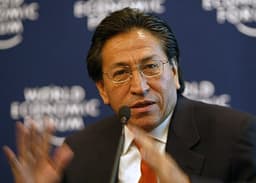
Alejandro Toledo
Politician · Modern
52.6Total

Ed Miliband
Politician · Modern
45.7Total
Basic Information
Born
1946
1969
Died
—
—
Era
Modern
Modern
Nationality
Peru
United Kingdom
Occupation
Politician
Politician
Civilization
Western
Western
Score Comparison
Military (10%)
27.7
26.2
Political (20%)
61.3
43.7
Influence (20%)
57.2
49.4
Legacy (20%)
44.2
37.5
Leadership (15%)
62.2
58.8
Strategy (15%)
60.0
60.0
TOTAL
52.6
45.7
Alejandro Toledo — Complete Timeline
2001 AD
Presidency and Economic Recovery (2001-2006)Political Action◆ Major
Alejandro Toledo assumed the presidency of Peru, becoming the first democratically elected president of indigenous Quechua descent. His administration focused on macroeconomic stability, attracting foreign investment, and reducing poverty. He oversaw a period of steady economic growth following the Fujimori era.
First Indigenous PresidentEconomic StabilityDemocracy
Impact: nationalconstructive
2019 AD
Corruption Conviction and Extradition (2019-2023)Political Action◆ Major
Toledo was arrested in the United States on extradition charges related to the Odebrecht scandal. He was accused of accepting $20 million in bribes from the Brazilian construction company in exchange for contracts during his presidency. In 2023, he was extradited to Peru to face trial.
CorruptionOdebrechtExtradition
Impact: nationaldestructive
Ed Miliband — Complete Timeline
2010 AD
Elected Leader of the Labour PartyPolitical Action◆ Major
Ed Miliband was elected Labour leader after the party's defeat in the 2010 general election, defeating his brother David Miliband. He positioned the party to the left, advocating for 'One Nation Labour' and opposing austerity.
Labour PartyLeadershipElection
Impact: nationalconstructive
2013 AD
Opposed military intervention in SyriaPolitical Action◆ Major
Miliband led Labour in opposing Prime Minister David Cameron's motion for military intervention in Syria after the chemical weapons attack. The motion was defeated in Parliament, a significant foreign policy defeat for the government.
SyriaForeign policyParliament
Impact: globalconstructive
2014 AD
Introduced the 'Ed Stone' policy platformPolitical Action
Miliband unveiled a large stone monument inscribed with six key pledges for the 2015 election, including deficit reduction, NHS funding, and immigration controls. The 'Ed Stone' was widely mocked and became a symbol of his campaign's failure.
CampaignPolicyMedia
Impact: national
2015 AD
Led Labour into the 2015 general electionPolitical Action◆ Major
Miliband led Labour into the 2015 general election, which resulted in a Conservative majority under David Cameron. Labour won 232 seats, a net gain of 22, but fell short of expectations. Miliband resigned as leader the following day.
ElectionDefeatLabour Party
Impact: nationaltragic
This comparison has not been analyzed yet.
One-time AI generation (~1 minute). Scores and timeline are already available below.
Rankings
🥇
Alejandro ToledoLeader
Mil: 27.7Pol: 61.3Inf: 57.2
52.6
🥈
Ed Miliband
Mil: 26.2Pol: 43.7Inf: 49.4
45.7
+6.9 behind
How This Comparison Works
Algorithm
Each figure is scored on 6 dimensions (0—100 scale) based on structured historical data: Military (10%), Political (20%), Influence (20%), Legacy (20%), Leadership (15%), Strategy (15%). The weighted total produces the final ranking.
Data Sources
Scores are computed from structured sub-indicators in the database. Scale factors adjust for era (Ancient ×0.85, Modern ×1.0) and civilization size (Eastern ×1.05, Other ×0.80) to account for differences in population and military scale.
Maximum 3 Figures
Comparisons are limited to 2—3 figures to ensure readability and statistical meaningfulness.
Error Margins
±5 points per dimension — Sub-scores are derived from historical records with inherent uncertainty. Two figures within 5 points on a dimension should be considered roughly equivalent in that area.
Total Score Accuracy
±3 points overall — The weighted combination of 6 dimensions produces a total score with approximately ±3 points of uncertainty. Differences of less than 3 points are not statistically significant— the figures are effectively tied.
Known Limitations
- Historical records are incomplete and uneven across civilizations
- Figures from oral-tradition societies may be underrepresented
- Occupation labels can misclassify multi-role figures
- Scores measure capability and impact, not moral character
- Quantitative scoring is a comparison tool, not absolute truth
Capability Radar
Military (10%) — Battles & Warfare
Battles
48
49
Win Rate
50
53
Expansion
56
53
Political (20%) — Governance & Reform
Reform
45
40
Diplomacy
50
35
Economy
35
30
Influence (20%) — Cultural & Global Reach
Cultural
55
20
Global
30
15
Legacy (20%) — Historical Impact
Historical
40
15
Longevity
25
10
Leadership (15%) — Power & Stability
Tenure
40
30
Stability
20
25
Strategy (15%) — Tactics & Innovation
Strategy
53
54
Tactics
59
60
Reform
64
61
Similar Comparisons
Comments & Discussion
No comments yet. Be the first to share your thoughts!