Loading...
Alejandro Toledo vs Kare Willoch
Kare Willoch leads by 0.1 pts · 2 figures compared
…
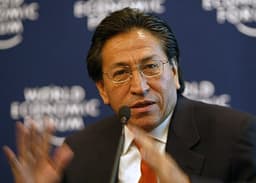
Alejandro Toledo
Politician · Modern
52.6Total

Kare Willoch
Politician · Modern
52.7Total
Basic Information
Born
1946
1928
Died
—
—
Era
Modern
Modern
Nationality
Peru
Norway
Occupation
Politician
Politician
Civilization
Western
Western
Score Comparison
Military (10%)
27.7
49.9
Political (20%)
61.3
53.8
Influence (20%)
57.2
53.3
Legacy (20%)
44.2
45.0
Leadership (15%)
62.2
72.0
Strategy (15%)
60.0
42.5
TOTAL
52.6
52.7
Alejandro Toledo — Complete Timeline
2001 AD
Presidency and Economic Recovery (2001-2006)Political Action◆ Major
Alejandro Toledo assumed the presidency of Peru, becoming the first democratically elected president of indigenous Quechua descent. His administration focused on macroeconomic stability, attracting foreign investment, and reducing poverty. He oversaw a period of steady economic growth following the Fujimori era.
First Indigenous PresidentEconomic StabilityDemocracy
Impact: nationalconstructive
2019 AD
Corruption Conviction and Extradition (2019-2023)Political Action◆ Major
Toledo was arrested in the United States on extradition charges related to the Odebrecht scandal. He was accused of accepting $20 million in bribes from the Brazilian construction company in exchange for contracts during his presidency. In 2023, he was extradited to Peru to face trial.
CorruptionOdebrechtExtradition
Impact: nationaldestructive
Kare Willoch — Complete Timeline
1981 AD
Became Prime Minister of NorwayPolitical Action
On October 14, 1981, Willoch became Prime Minister, leading a coalition government of the Conservative Party, Christian Democratic Party, and Centre Party. This ended 35 years of Labour Party rule, marking a major political shift.
Conservative PartyCoalitionPolitical Shift
Impact: national
1982 AD
Implemented Economic LiberalizationReform◆ Major
Willoch's government introduced market-oriented reforms, including deregulation of credit markets, tax cuts, and privatization of state-owned enterprises. These policies aimed to stimulate economic growth but also led to increased inequality and a banking crisis later.
Economic ReformDeregulationPrivatization
Impact: national
1985 AD
Continued Conservative PoliciesPolitical Action
After the 1985 election, Willoch formed a minority Conservative government, continuing his liberalization policies. However, his government struggled with a declining oil price and rising unemployment, leading to unpopular austerity measures.
Minority GovernmentAusterityOil Price
Impact: national
1986 AD
Resigned over Tax PolicyPolitical Action◆ Major
Willoch resigned as Prime Minister in May 1986 after losing a vote of confidence over proposed tax increases on gasoline. The defeat came after the Chernobyl disaster heightened public concern about nuclear power, which was linked to the tax issue.
Tax PolicyVote of ConfidenceResignation
Impact: national
Expert Analysis
Origins
Alejandro Toledo was born on March 28, 1946, in Cabana, Peru, into a poor indigenous Quechua family. He was the eighth of sixteen children and worked as a shoeshiner and newspaper vendor to support his education. He earned a scholarship to study at the University of San Francisco, later obtaining a PhD in economics from Stanford University. His background shaped his focus on poverty reduction and indigenous rights.
Kåre Willoch was born on October 3, 1928, in Oslo, Norway, into a middle-class family. He studied economics at the University of Oslo and became active in the Conservative Party early in his career. His formative years were marked by post-war reconstruction and a belief in market-oriented reforms.
Rise to Power
Toledo rose to prominence in the 1990s as a vocal opponent of President Alberto Fujimori's authoritarian regime. He led protests against Fujimori's third term and narrowly lost the 2000 election amid allegations of fraud. After Fujimori's resignation, Toledo won the 2001 presidential election with 53.1% of the vote, becoming Peru's first democratically elected indigenous president.
Willoch became Prime Minister of Norway on October 14, 1981, after leading the Conservative Party to victory. He formed a coalition government with the Christian Democratic and Centre Parties, ending decades of Labour Party dominance. His rise was fueled by public discontent with high taxes and state intervention.
Leadership & Governance
Toledo's presidency (2001-2006) focused on economic recovery and social inclusion. He implemented fiscal discipline and free trade agreements, leading to 5% annual GDP growth. He also created programs for indigenous communities and expanded education. However, his government faced corruption scandals, and his approval rating dropped below 10% by 2006. His political score is 61.3, reflecting mixed effectiveness.
Willoch's government (1981-1986) introduced significant economic liberalization: deregulation of credit markets, tax cuts, and privatization of state enterprises. These reforms boosted economic growth but also led to increased inequality. His leadership score is 72.0, indicating strong governance, but his strategy score is 42.5, as his policies sometimes lacked coherence.
Triumph & Tragedy
Toledo's greatest success was restoring democracy and economic stability after Fujimori's fall. He oversaw the return of property seized during the regime and increased foreign investment. His greatest failure was the corruption scandal: in 2019, he was arrested in the US for accepting $20 million in bribes from Odebrecht, leading to his extradition to Peru in 2023. This tarnished his legacy and undermined his anti-corruption stance.
Willoch's triumph was modernizing Norway's economy through liberalization, which laid the groundwork for future prosperity. His tragedy came in May 1986 when he resigned after losing a confidence vote over proposed gasoline tax increases. The defeat highlighted his inability to manage coalition politics and public opinion.
Character & Destiny
Toledo was a charismatic populist who inspired hope among Peru's marginalized. However, his decision-making was often impulsive and prone to ethical lapses. His destiny was shaped by his background: rising from poverty to the presidency, but falling from grace due to corruption. Historical assessments note his early achievements but condemn his later criminality.
Willoch was a principled conservative, committed to free-market ideas. He was known for his intellectual rigor but also his stubbornness, which contributed to his political downfall. His character led him to push reforms despite opposition, but he lacked the flexibility to sustain power.
Legacy
Toledo's legacy is mixed: he is remembered as a symbol of indigenous empowerment and democratic restoration, but his corruption conviction overshadows his achievements. His policies had lasting impact on Peru's economy, but his personal fall damaged the credibility of anti-corruption efforts. His total score of 52.6 reflects this duality.
Willoch's legacy is more positive: he is credited with breaking the Labour Party's monopoly and introducing market reforms that shaped modern Norway. His policies influenced later governments, but his short tenure limited his long-term impact. His total score of 52.7 edges out Toledo by 0.1 points.
Conclusion
While both leaders had similar overall scores, Willoch's impact on Norway's economic trajectory was more coherent and lasting. Toledo's early promise was undone by corruption, making his legacy more cautionary than inspirational. Willoch, with a leadership score of 72.0 against Toledo's 62.2, demonstrated more effective governance. Therefore, Kåre Willoch had a greater positive impact, despite a narrower score gap.
Rankings
🥇
Kare WillochLeader
Mil: 49.9Pol: 53.8Inf: 53.3
52.7
🥈
Alejandro Toledo
Mil: 27.7Pol: 61.3Inf: 57.2
52.6
+0.1 behind
How This Comparison Works
Algorithm
Each figure is scored on 6 dimensions (0—100 scale) based on structured historical data: Military (10%), Political (20%), Influence (20%), Legacy (20%), Leadership (15%), Strategy (15%). The weighted total produces the final ranking.
Data Sources
Scores are computed from structured sub-indicators in the database. Scale factors adjust for era (Ancient ×0.85, Modern ×1.0) and civilization size (Eastern ×1.05, Other ×0.80) to account for differences in population and military scale.
Maximum 3 Figures
Comparisons are limited to 2—3 figures to ensure readability and statistical meaningfulness.
Error Margins
±5 points per dimension — Sub-scores are derived from historical records with inherent uncertainty. Two figures within 5 points on a dimension should be considered roughly equivalent in that area.
Total Score Accuracy
±3 points overall — The weighted combination of 6 dimensions produces a total score with approximately ±3 points of uncertainty. Differences of less than 3 points are not statistically significant— the figures are effectively tied.
Known Limitations
- Historical records are incomplete and uneven across civilizations
- Figures from oral-tradition societies may be underrepresented
- Occupation labels can misclassify multi-role figures
- Scores measure capability and impact, not moral character
- Quantitative scoring is a comparison tool, not absolute truth
Capability Radar
Military (10%) — Battles & Warfare
Battles
48
28
Win Rate
50
31
Expansion
56
36
Political (20%) — Governance & Reform
Reform
45
60
Diplomacy
50
55
Economy
35
60
Influence (20%) — Cultural & Global Reach
Cultural
55
30
Global
30
30
Legacy (20%) — Historical Impact
Historical
40
40
Longevity
25
30
Leadership (15%) — Power & Stability
Tenure
40
65
Stability
20
55
Strategy (15%) — Tactics & Innovation
Strategy
53
38
Tactics
59
41
Reform
64
44
Similar Comparisons
Comments & Discussion
No comments yet. Be the first to share your thoughts!