Loading...
Alejandro Toledo vs Ong Eng Guan
Alejandro Toledo leads by 17.3 pts · 2 figures compared
…
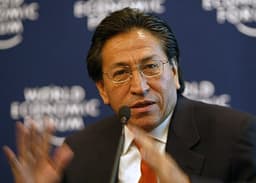
Alejandro Toledo
Politician · Modern
52.6Total

Ong Eng Guan
Politician · Modern
35.3Total
Basic Information
Born
1946
1925
Died
—
—
Era
Modern
Modern
Nationality
Peru
Singapore
Occupation
Politician
Politician
Civilization
Western
Eastern
Score Comparison
Military (10%)
27.7
12.2
Political (20%)
61.3
26.4
Influence (20%)
57.2
46.3
Legacy (20%)
44.2
37.5
Leadership (15%)
62.2
34.6
Strategy (15%)
60.0
40.2
TOTAL
52.6
35.3
Alejandro Toledo — Complete Timeline
2001 AD
Presidency and Economic Recovery (2001-2006)Political Action◆ Major
Alejandro Toledo assumed the presidency of Peru, becoming the first democratically elected president of indigenous Quechua descent. His administration focused on macroeconomic stability, attracting foreign investment, and reducing poverty. He oversaw a period of steady economic growth following the Fujimori era.
First Indigenous PresidentEconomic StabilityDemocracy
Impact: nationalconstructive
2019 AD
Corruption Conviction and Extradition (2019-2023)Political Action◆ Major
Toledo was arrested in the United States on extradition charges related to the Odebrecht scandal. He was accused of accepting $20 million in bribes from the Brazilian construction company in exchange for contracts during his presidency. In 2023, he was extradited to Peru to face trial.
CorruptionOdebrechtExtradition
Impact: nationaldestructive
Ong Eng Guan — Complete Timeline
1957 AD
Elected First Mayor of SingaporePolitical Action◆ Major
Ong Eng Guan was elected the first Mayor of Singapore in 1957 under the PAP banner. He implemented populist policies and gained a personal following, but his tenure was marked by conflict with the party leadership.
MayorPAP
1960 AD
Expelled from the People's Action PartyPolitical Action◆ Major
Ong was expelled from the PAP in 1960 for insubordination and factionalism. He had challenged party discipline and criticized Lee Kuan Yew's leadership, leading to his removal.
ExpulsionPAP split
Impact: nationaldestructive
1961 AD
Founded the United People's PartyPolitical Action
After his expulsion, Ong founded the United People's Party (UPP) as a vehicle for his political ambitions. The UPP contested the 1963 general election but failed to gain significant support.
Political partyOpposition
Impact: national
Won the Hong Lim By-ElectionPolitical Action◆ Major
Ong won the Hong Lim by-election in 1961 as an independent, defeating the PAP candidate. This victory demonstrated his personal popularity and weakened the PAP's majority in the Legislative Assembly.
By-electionPAP defeat
1963 AD
Defeated in the 1963 General ElectionPolitical Action◆ Major
Ong lost his parliamentary seat in the 1963 general election, running under the UPP banner. His political influence declined sharply after this defeat, and he eventually retired from politics.
Election defeatPolitical decline
Impact: national
Expert Analysis
Origins
Alejandro Toledo was born on March 28, 1946, in Cabana, Peru, into a poor indigenous Quechua family. He was one of 16 children and worked as a shoeshiner and street vendor to support his education. With scholarships, he earned a BA in economics from the University of San Francisco and a PhD in educational economics from Stanford University. His academic career included positions at the Harvard Institute for International Development and the Inter-American Development Bank.
Ong Eng Guan was born in 1925 in Singapore, into a Peranakan Chinese family. He studied at St. Joseph's Institution and later Raffles College. He began his career as a teacher and became involved in politics through the Labour Party. He joined the People's Action Party (PAP) in 1954 and quickly rose due to his oratory and populist appeal.
Rise to Power
Toledo entered politics in the 1990s, founding the party Perú Posible. He ran for president in 2000 against Alberto Fujimori but lost amid allegations of fraud. After Fujimori's resignation due to corruption scandals, Toledo won the 2001 presidential election with 53.1% of the vote, becoming the first democratically elected indigenous president of Peru.
Ong Eng Guan was elected the first Mayor of Singapore in 1957 under the PAP banner. He implemented populist policies such as free education and healthcare, gaining a personal following. In 1959, he was also elected to the Legislative Assembly. However, his factionalism and defiance of party leadership led to his expulsion from the PAP in 1960. He then won the Hong Lim by-election in 1961 as an independent, defeating the PAP candidate, which weakened the party. He founded the United People's Party (UPP) but lost his seat in the 1963 general election.
Leadership & Governance
Toledo's governance focused on macroeconomic stability, attracting foreign investment, and reducing poverty. His administration achieved an average GDP growth of 5% per year, reduced inflation, and increased international reserves. He implemented social programs like "Juntos" (conditional cash transfers) and expanded rural education. However, his political score of 61.3 reflects his struggles with a fragmented congress and low approval ratings, which dropped to 8% by the end of his term.
Ong Eng Guan's leadership was characterized by populist measures and personalistic rule. As mayor, he bypassed party structures and built a direct connection with voters. His political score of 26.4 indicates his inability to build sustainable institutions or maintain party loyalty. His strategy score of 40.2 shows tactical acumen in winning by-elections but a lack of long-term vision.
Triumph & Tragedy
Toledo's greatest success was engineering Peru's economic recovery after the Fujimori era, with GDP growth averaging 5.5% from 2002 to 2006. He also oversaw the creation of the Truth and Reconciliation Commission. However, his legacy was tarnished by corruption allegations. In 2019, he was arrested in the US on charges of accepting $20 million in bribes from Odebrecht, and in 2023 he was extradited to Peru. His legacy score of 44.2 reflects the contrast between his initial promise and his later downfall.
Ong Eng Guan's triumph was his victory in the 1961 Hong Lim by-election, which demonstrated his personal popularity and dealt a blow to the PAP. However, his tragedy was his political decline after 1963. His inability to build a lasting party or coalition led to his defeat, and he eventually left politics. His total score of 35.3 reflects his limited long-term impact.
Character & Destiny
Toledo was charismatic and media-savvy, but his indecisiveness and tolerance of corruption within his circle undermined his presidency. His leadership score of 62.2 indicates moderate effectiveness, but his downfall stemmed from ethical lapses.
Ong Eng Guan was a fiery orator and populist, but his arrogance and refusal to accept party discipline led to his expulsion. His political score of 26.4 reflects his inability to work within a system. His character determined his fate: a rebel without a cause beyond personal ambition.
Legacy
Toledo's legacy is mixed. He is remembered as the first indigenous president, which broke a racial barrier in Peru. His economic policies set a foundation for growth, but the corruption scandal overshadowed his achievements. He scored 44.2 in legacy.
Ong Eng Guan is largely forgotten in Singapore's national narrative. His brief rebellion against Lee Kuan Yew's PAP is a footnote, but he demonstrated the limits of populism without organization. His legacy score of 37.5 reflects his minimal lasting impact.
Conclusion
Alejandro Toledo had a greater impact than Ong Eng Guan, as evidenced by his higher total score (52.6 vs 35.3) and his role as Peru's first indigenous president. While both faced corruption and political decline, Toledo's presidency affected an entire nation's trajectory, whereas Ong's influence was confined to a few by-elections. Toledo's economic reforms and symbolic importance outweigh Ong's brief populist surge.
Rankings
🥇
Alejandro ToledoLeader
Mil: 27.7Pol: 61.3Inf: 57.2
52.6
🥈
Ong Eng Guan
Mil: 12.2Pol: 26.4Inf: 46.3
35.3
+17.3 behind
How This Comparison Works
Algorithm
Each figure is scored on 6 dimensions (0—100 scale) based on structured historical data: Military (10%), Political (20%), Influence (20%), Legacy (20%), Leadership (15%), Strategy (15%). The weighted total produces the final ranking.
Data Sources
Scores are computed from structured sub-indicators in the database. Scale factors adjust for era (Ancient ×0.85, Modern ×1.0) and civilization size (Eastern ×1.05, Other ×0.80) to account for differences in population and military scale.
Maximum 3 Figures
Comparisons are limited to 2—3 figures to ensure readability and statistical meaningfulness.
Error Margins
±5 points per dimension — Sub-scores are derived from historical records with inherent uncertainty. Two figures within 5 points on a dimension should be considered roughly equivalent in that area.
Total Score Accuracy
±3 points overall — The weighted combination of 6 dimensions produces a total score with approximately ±3 points of uncertainty. Differences of less than 3 points are not statistically significant— the figures are effectively tied.
Known Limitations
- Historical records are incomplete and uneven across civilizations
- Figures from oral-tradition societies may be underrepresented
- Occupation labels can misclassify multi-role figures
- Scores measure capability and impact, not moral character
- Quantitative scoring is a comparison tool, not absolute truth
Capability Radar
Military (10%) — Battles & Warfare
Battles
48
16
Win Rate
50
19
Expansion
56
18
Political (20%) — Governance & Reform
Reform
45
20
Diplomacy
50
10
Economy
35
15
Influence (20%) — Cultural & Global Reach
Cultural
55
10
Global
30
5
Legacy (20%) — Historical Impact
Historical
40
15
Longevity
25
10
Leadership (15%) — Power & Stability
Tenure
40
15
Stability
20
5
Strategy (15%) — Tactics & Innovation
Strategy
53
21
Tactics
59
29
Reform
64
30
Similar Comparisons
Comments & Discussion
No comments yet. Be the first to share your thoughts!