Loading...
Alessandro Farnese Duke of Parma vs Curtis LeMay
Alessandro Farnese Duke of Parma leads by 8.0 pts · 2 figures compared
…
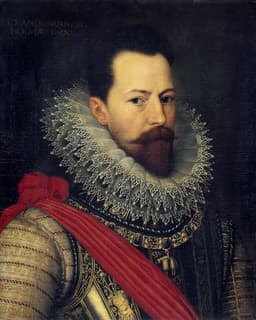
Alessandro Farnese Duke of Parma
General · Modern
69.9Total

Curtis LeMay
General · Modern
61.9Total
Basic Information
Born
1545
1906
Died
1592
1990
Era
Modern
Modern
Nationality
Spain
United States
Occupation
General
General
Civilization
Western
Western
Score Comparison
Military (10%)
79.9
78.5
Political (20%)
69.2
45.1
Influence (20%)
68.0
65.0
Legacy (20%)
72.0
55.0
Leadership (15%)
62.0
62.0
Strategy (15%)
72.0
80.3
TOTAL
69.9
61.9
Alessandro Farnese Duke of Parma — Complete Timeline
1579 AD
Siege of MaastrichtWar◆ Major
Farnese led Spanish forces in a successful siege of Maastricht, a key rebel stronghold. The city was stormed after a brutal four-month siege, and its defenders were massacred, demonstrating Farnese's military effectiveness.
SiegeDutch RevoltSpanish Army
Impact: regionaldestructive
1585 AD
Siege of AntwerpWar
Farnese captured Antwerp, the largest city in the Netherlands, after a year-long siege. He constructed a bridge of boats across the Scheldt River to blockade the city, forcing its surrender and splitting the rebel provinces.
SiegeDutch RevoltMilitary Engineering
Impact: regional
Reconquest of the Southern NetherlandsWar◆ Major
Through a series of campaigns, Farnese reconquered the southern provinces of the Netherlands (modern-day Belgium) for Spain. This established the basis for the later split between the Dutch Republic and the Spanish Netherlands.
ReconquestNetherlandsSpanish Empire
Impact: regional
1590 AD
Invasion of FranceWar◆ Major
Farnese led a Spanish army into France to support the Catholic League against Henry of Navarre. He relieved the Siege of Paris and later the Siege of Rouen, but his campaigns were hampered by supply issues and political constraints.
French Wars of ReligionSpanish InterventionMilitary Campaign
Impact: regional
Curtis LeMay — Complete Timeline
1942 AD
Assumed Command of the 305th Bombardment GroupOther◆ Major
LeMay took command of the 305th Bombardment Group in England in 1942. He implemented rigorous training and formation tactics that reduced bomber losses to German fighters, establishing his reputation as an innovative and demanding commander in the Eighth Air Force.
World War IIStrategic Bombing
Impact: national
1945 AD
Led the Firebombing of TokyoOther◆ Major
On March 9-10, 1945, LeMay ordered 334 B-29 bombers to conduct a low-altitude incendiary raid on Tokyo. The attack destroyed 16 square miles of the city, killed an estimated 100,000 civilians, and burned out over one million residents, marking a shift to area bombing of Japanese cities.
World War IIStrategic BombingCivilian Casualties
Impact: globaldestructive
1948 AD
Appointed Commander of Strategic Air CommandOther◆ Major
LeMay was appointed commander of the Strategic Air Command (SAC) in October 1948. He transformed SAC from a poorly organized force into a highly efficient nuclear deterrent, instituting rigorous training, 24-hour alert status, and a professional culture that defined Cold War air power.
Cold WarNuclear Deterrence
Impact: global
1961 AD
Became Chief of Staff of the United States Air ForceOther◆ Major
LeMay served as Chief of Staff of the U.S. Air Force from June 1961 to February 1965. He advocated for expanded bombing campaigns in the Vietnam War, including the bombing of North Vietnam, and clashed with civilian leadership over strategy, particularly during the Cuban Missile Crisis.
Cold WarVietnam WarMilitary Leadership
Impact: national
1968 AD
Ran for Vice President with George WallacePolitical Action
LeMay was the vice presidential running mate for American Independent Party candidate George Wallace in the 1968 presidential election. His controversial suggestion that nuclear weapons could be used in Vietnam damaged the campaign, which ultimately won 13.5% of the popular vote.
PoliticsPresidential Election
Impact: nationaldestructive
Expert Analysis
Origins
Alessandro Farnese (1545–1592) was born into the powerful Farnese family of Italy, son of Duke Ottavio Farnese and Margaret of Austria, a natural daughter of Emperor Charles V. Raised at the Spanish court, he received military training under his uncle, King Philip II of Spain, and married Infanta Maria of Portugal, cementing ties with the Habsburg dynasty. Farnese's upbringing was steeped in Renaissance warfare and diplomacy, preparing him for command in the Eighty Years' War.
Curtis LeMay (1906–1990) was born in Columbus, Ohio, to a working-class family. He studied civil engineering at Ohio State University, joining the Army Air Corps in 1929. LeMay's early career focused on navigation and bombing techniques, leading to pioneering work in long-range bombing. His rise was driven by technical proficiency and relentless drilling, not aristocratic privilege.
Rise to Power
Farnese's rise began in 1571 when he fought at the Battle of Lepanto under Don John of Austria. In 1578, he was appointed Governor-General of the Spanish Netherlands after the death of Don John. His key turning point was the Siege of Maastricht (1579), where he captured the rebel stronghold after a brutal four-month siege, demonstrating his engineering and assault tactics. This victory solidified his reputation and led to his appointment as Captain-General.
LeMay's rise accelerated in World War II. In 1942, he assumed command of the 305th Bombardment Group in England, where he developed formation tactics that cut bomber losses. His promotion to command the 20th Air Force in the Pacific in 1945 gave him authority over B-29 Superfortresses. His shift to low-altitude incendiary raids, culminating in the March 9-10, 1945 firebombing of Tokyo, marked his strategic ascent. After the war, he commanded the Berlin Airlift and later transformed the Strategic Air Command (SAC) into a nuclear deterrent.
Leadership & Governance
Farnese's leadership combined tactical innovation with diplomatic finesse. He used siegecraft to minimize casualties among his professional Spanish tercios, famously constructing a bridge of boats across the Scheldt during the Siege of Antwerp (1584-1585). He also issued the Act of Union of Atrecht (1579), reconciling Catholic nobles to Spanish rule. His governance in the Southern Netherlands established a stable Catholic state, but his conciliatory approach was undermined by Philip II's insistence on harsh repression.
LeMay was a stern disciplinarian who demanded perfection. He restructured SAC with rigorous training, constant drills, and nuclear alert procedures. His leadership style was authoritarian; he famously said, "I have no substitute for victory." During the Vietnam War, he advocated for bombing North Vietnam "back to the Stone Age." His political influence was limited—his 1968 vice presidential run with George Wallace ended in defeat. LeMay scored 45.1 in political acumen versus Farnese's 69.2.
Triumph & Tragedy
Farnese's greatest triumph was the reconquest of the Southern Netherlands (1581-1587), recapturing cities like Tournai, Bruges, Ghent, and Antwerp. This established the Spanish Netherlands (modern Belgium) as a Catholic stronghold. His tragedy came in 1590 when Philip II diverted him to France to support the Catholic League. Although he relieved Paris (1590) and Rouen (1592), the campaign drained resources and he died from wounds in 1592, leaving the Netherlands war unfinished.
LeMay's triumph was the firebombing campaign against Japan, which destroyed 67 Japanese cities and contributed to Japan's surrender without a costly invasion. His transformation of SAC into a credible nuclear force deterred Soviet aggression. His tragedy was the moral controversy over civilian casualties—the Tokyo firebombing killed 100,000 civilians—and his later advocacy for nuclear escalation. LeMay's legacy is tarnished by his role in the Vietnam War, where his proposals for massive bombing failed to achieve strategic objectives.
Character & Destiny
Farnese was methodical and diplomatic, often seeking negotiated settlements before assault. His character—pious, loyal to Spain, yet pragmatic—allowed him to win over Flemish nobles. However, his obedience to Philip II's orders to invade France led to his downfall. Historian Geoffrey Parker notes that Farnese's "combination of military skill and political tact was unmatched" but was wasted by Madrid's rigid policies.
LeMay was blunt, uncompromising, and obsessed with efficiency. He believed in overwhelming force, famously stating, "If you kill enough of them, they'll stop fighting." His character made him a brilliant organizer but a poor politician. His 1968 campaign revealed his inability to connect with voters. LeMay's destiny was to be a wartime instrument whose methods became controversial in peacetime.
Legacy
Farnese's legacy is the creation of a separate Southern Netherlands, which evolved into modern Belgium. His siege techniques influenced military engineering for centuries. He scored 79.9 in military skill and 72.0 in legacy. His political score of 69.2 reflects his success in governance, though his long-term impact was limited by Spanish decline.
LeMay's legacy is the establishment of strategic bombing as a central element of US military doctrine. He scored 78.5 in military and 80.3 in strategy, but his political score (45.1) and legacy (55.0) suffer from controversy. The Strategic Air Command he built became the cornerstone of Cold War deterrence, but his methods are criticized as indiscriminate.
Conclusion
Alessandro Farnese achieved a higher total score (69.9 vs 61.9) and had more enduring impact. His reconquest of the Southern Netherlands created a political entity that exists today, while LeMay's firebombing, though effective, did not create lasting institutions. Farnese's diplomatic and military balance contrasts with LeMay's narrow focus on destruction. While LeMay's strategic bombing shaped modern warfare, Farnese's state-building legacy is more concrete and positive. Therefore, Alessandro Farnese had greater impact.
Rankings
🥇
Alessandro Farnese Duke of ParmaLeader
Mil: 79.9Pol: 69.2Inf: 68.0
69.9
🥈
Curtis LeMay
Mil: 78.5Pol: 45.1Inf: 65.0
61.9
+8.0 behind
How This Comparison Works
Algorithm
Each figure is scored on 6 dimensions (0—100 scale) based on structured historical data: Military (10%), Political (20%), Influence (20%), Legacy (20%), Leadership (15%), Strategy (15%). The weighted total produces the final ranking.
Data Sources
Scores are computed from structured sub-indicators in the database. Scale factors adjust for era (Ancient ×0.85, Modern ×1.0) and civilization size (Eastern ×1.05, Other ×0.80) to account for differences in population and military scale.
Maximum 3 Figures
Comparisons are limited to 2—3 figures to ensure readability and statistical meaningfulness.
Error Margins
±5 points per dimension — Sub-scores are derived from historical records with inherent uncertainty. Two figures within 5 points on a dimension should be considered roughly equivalent in that area.
Total Score Accuracy
±3 points overall — The weighted combination of 6 dimensions produces a total score with approximately ±3 points of uncertainty. Differences of less than 3 points are not statistically significant— the figures are effectively tied.
Known Limitations
- Historical records are incomplete and uneven across civilizations
- Figures from oral-tradition societies may be underrepresented
- Occupation labels can misclassify multi-role figures
- Scores measure capability and impact, not moral character
- Quantitative scoring is a comparison tool, not absolute truth
Capability Radar
Military (10%) — Battles & Warfare
Battles
85
85
Win Rate
88
90
Expansion
80
80
Political (20%) — Governance & Reform
Reform
65
45
Diplomacy
78
30
Economy
60
20
Influence (20%) — Cultural & Global Reach
Cultural
60
55
Global
70
70
Legacy (20%) — Historical Impact
Historical
75
75
Longevity
65
60
Leadership (15%) — Power & Stability
Tenure
70
60
Stability
55
25
Strategy (15%) — Tactics & Innovation
Strategy
90
92
Tactics
92
95
Reform
75
88
Similar Comparisons
Comments & Discussion
No comments yet. Be the first to share your thoughts!