Loading...
Alessandro Farnese Duke of Parma vs Napoleon Bonaparte
Napoleon Bonaparte leads by 1.0 pts · 2 figures compared
…
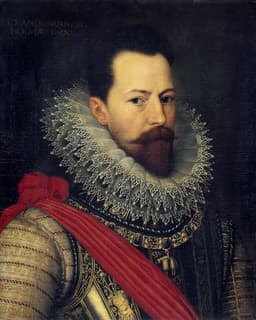
Alessandro Farnese Duke of Parma
General · Modern
69.9Total

Napoleon Bonaparte
General · Modern
70.9Total
Basic Information
Born
1545
1769
Died
1592
1821
Era
Modern
Modern
Nationality
Spain
France
Occupation
General
General
Civilization
Western
Western
Score Comparison
Military (10%)
79.9
94.0
Political (20%)
69.2
72.0
Influence (20%)
68.0
40.0
Legacy (20%)
72.0
80.0
Leadership (15%)
62.0
78.0
Strategy (15%)
72.0
90.0
TOTAL
69.9
70.9
Alessandro Farnese Duke of Parma — Complete Timeline
1579 AD
Siege of MaastrichtWar◆ Major
Farnese led Spanish forces in a successful siege of Maastricht, a key rebel stronghold. The city was stormed after a brutal four-month siege, and its defenders were massacred, demonstrating Farnese's military effectiveness.
SiegeDutch RevoltSpanish Army
Impact: regionaldestructive
1585 AD
Siege of AntwerpWar
Farnese captured Antwerp, the largest city in the Netherlands, after a year-long siege. He constructed a bridge of boats across the Scheldt River to blockade the city, forcing its surrender and splitting the rebel provinces.
SiegeDutch RevoltMilitary Engineering
Impact: regional
Reconquest of the Southern NetherlandsWar◆ Major
Through a series of campaigns, Farnese reconquered the southern provinces of the Netherlands (modern-day Belgium) for Spain. This established the basis for the later split between the Dutch Republic and the Spanish Netherlands.
ReconquestNetherlandsSpanish Empire
Impact: regional
1590 AD
Invasion of FranceWar◆ Major
Farnese led a Spanish army into France to support the Catholic League against Henry of Navarre. He relieved the Siege of Paris and later the Siege of Rouen, but his campaigns were hampered by supply issues and political constraints.
French Wars of ReligionSpanish InterventionMilitary Campaign
Impact: regional
Napoleon Bonaparte — Complete Timeline
1799 AD
Coup of 18 BrumaireOther◆ Major
Napoleon Bonaparte, with support from his brother Lucien and key political figures, overthrew the Directory in a bloodless coup. He established the Consulate with himself as First Consul, effectively becoming the ruler of France. This event ended the French Revolution's most unstable period.
French RevolutionCoupRise to Power
Impact: regional
1804 AD
Promulgation of the Napoleonic CodeOther◆ Major
Napoleon enacted the Civil Code of the French, known as the Napoleonic Code, a comprehensive set of laws that replaced the fragmented feudal legal systems. The code established legal equality, protected property rights, and secularized law. It became the basis for legal systems in many European and world countries.
Legal ReformNapoleonic CodeCivil Law
Impact: globalconstructive
1805 AD
Battle of AusterlitzWar◆ Major
Napoleon's Grande Arm
Napoleonic WarsBattleDecisive Victory
Impact: global
1812 AD
Invasion of RussiaWar◆ Major
Napoleon led the Grande Arm
Napoleonic WarsInvasionDisaster
Impact: globaldestructive
1815 AD
Battle of WaterlooWar◆ Major
Napoleon's French army was defeated by the combined forces of the Duke of Wellington's Anglo-Allied army and Gebhard Leberecht von Bl
Napoleonic WarsBattleFinal Defeat
Impact: globaldestructive
Expert Analysis
alessandro-farnese-duke-of-parma-vs-napoleon-bonaparte
### The Emperor and the Duke: Two Titans, Two Fates
On a June morning in 1815, Napoleon Bonaparte watched the fields of Waterloo turn into a slaughterhouse. His Grande Armée, once the terror of Europe, was crumbling under a combined Anglo-Prussian assault. A hundred miles away, in a museum in Parma, a portrait of another soldier stared out from a gilded frame—Alessandro Farnese, a man who, two centuries earlier, had nearly pulled off the impossible. Both were masters of siegecraft and strategy. Both fought to expand the power of their respective empires. Yet one died a prisoner on a remote Atlantic island, while the other died in his bed, celebrated as the savior of the Spanish Netherlands. Why did their paths diverge so sharply? The answer lies not just in their genius, but in the worlds they inhabited and the choices they made.
### Origins
Napoleon Bonaparte was born in 1769 on the rugged island of Corsica, a land recently annexed by France. His family was minor nobility, proud and resentful of French rule. From the start, he was an outsider—an Italian-speaking Corsican in a French military academy. This bred in him a fierce ambition, a hunger to prove himself that bordered on obsession. He devoured history and military treatises, dreaming of Alexander and Caesar. The French Revolution, which tore down the old order, was his great opportunity: a world where talent, not birth, could lead to a throne.
Alessandro Farnese, born in 1545, came from the opposite end of the social spectrum. He was the grandson of Emperor Charles V and the son of a papal family that had already produced a pope. He grew up in the Spanish court, a prince of the Catholic world, groomed for command. Where Napoleon had to claw his way up, Farnese was handed a sword and told to wield it for God and King Philip II. His training was in the brutal school of the Italian Wars, where Spanish tercios dominated Europe. His identity was never in doubt: he was a loyal servant of the Habsburg dynasty, fighting to preserve an empire, not to create one.
### Rise to Power
Napoleon’s rise was a rocket. At 24, he cleared the streets of Paris with a "whiff of grapeshot," saving the revolutionary government. At 26, he conquered Italy in a lightning campaign that humiliated the Austrians. His Italian victories were not just military—they were political performances. He wrote proclamations that stirred the hearts of soldiers and civilians alike, painting himself as a liberator. By 1799, he had seized power in a coup, becoming First Consul. His path was forged by chaos: he rode the wave of revolution, always pushing higher.
Farnese’s ascent was slower, more deliberate. He earned his spurs at the Battle of Lepanto in 1571, commanding a galley in the great naval victory over the Ottomans. But his true test came in the Netherlands, where Dutch rebels had been fighting Spanish rule for over a decade. In 1578, Philip II appointed him Governor-General of the Spanish Netherlands—a poisoned chalice. The Spanish army was mutinous, unpaid, and demoralized. Farnese did not seize power; he inherited a mess. His genius lay in patience: he rebuilt the army, negotiated truces with some rebels, and isolated the rest.
### Leadership & Governance
As a commander, Napoleon was a revolutionary. He reorganized armies into corps, used artillery as a mobile hammer, and exploited speed to divide his enemies. His 1805 victory at Austerlitz remains a masterpiece of deception and crushing force. But as a ruler, he was a reformer. The Napoleonic Code standardized French law, abolished feudal privileges, and spread the ideals of the Revolution across Europe. Yet his governance was autocratic: he crowned himself emperor, silenced dissent, and demanded total loyalty. His ambition had no ceiling—he wanted to redraw the map of Europe.
Farnese was a different kind of leader. His military style was methodical, even cautious. His siege of Antwerp in 1585 was a wonder of engineering: he built a massive bridge of boats across the Scheldt River to cut off the city, blockading it for a year until it surrendered. He understood that in the Netherlands, every town was a fortress, and every victory had to be consolidated. Politically, he was a diplomat. He offered amnesty to rebels who returned to the Catholic Church, and he courted the Flemish nobility. He knew that reconquest required more than soldiers—it required winning hearts, or at least neutralizing them.
### Triumph & Tragedy
Napoleon’s greatest moment was Austerlitz, where he destroyed the combined armies of Russia and Austria. The sun rose over the battlefield, and Napoleon wept with joy. His greatest tragedy was the invasion of Russia in 1812. It was a colossal miscalculation: he marched 600,000 men into the vastness of Russia, only to lose them to winter, hunger, and guerrilla attacks. His empire never recovered. Waterloo was the final nail—a battle he could have won if his generals had arrived on time, if the rain had stopped, if fate had smiled. But it did not.
Farnese’s triumph was the reconquest of the Southern Netherlands, modern-day Belgium. By 1585, he had restored Spanish rule to the region, isolating the Dutch rebels in the north. His tragedy was that he never finished the job. In 1590, Philip II ordered him to invade France to support the Catholic League against the Protestant Henry of Navarre. Farnese obeyed, but he knew it was a distraction. He died in 1592, at 47, exhausted by war. His unfinished work—the reconquest of the entire Netherlands—was left to lesser men.
### Character & Destiny
Napoleon was driven by an insatiable ego. He once said, "Power is my mistress." He believed he could bend history to his will. This confidence made him unstoppable in victory, but it also blinded him. He could not compromise; he could not stop. His downfall came from overreach—a refusal to accept limits. He was a man of the modern age, but his ambition was ancient, like Alexander’s.
Farnese was a man of duty. He wrote to Philip II: "I serve Your Majesty, not my own ambition." He was a master of the possible, not the spectacular. He understood that in the Netherlands, the war was a grind—a series of sieges, negotiations, and small victories. He was a pragmatist in an age of religious fanaticism. His fate was to be a tool of a king who did not share his wisdom. Philip II micromanaged from Madrid, squandering Farnese’s gains.
### Legacy
Napoleon’s legacy is global. His legal codes, his administrative reforms, his myth of the self-made man—these shaped modern Europe and beyond. He is remembered as a genius and a tyrant, a liberator and a conqueror. His name is synonymous with ambition.
Farnese’s legacy is quieter. He is a footnote in most history books, a "nearly" figure. But in Belgium, he is remembered as the man who kept the Spanish Netherlands Catholic and loyal. His military innovations—especially in siegecraft—influenced later generals, including Napoleon himself. He represents the triumph of patience over glory.
### Conclusion
Standing at Waterloo, Napoleon might have thought of Farnese. Not directly, but as a ghost of what could have been. Both men faced the same question: how do you hold an empire together? Napoleon tried to conquer the world; Farnese tried to save a piece of it. One burned out in a blaze of light; the other faded into the gray of duty. History remembers the fire, but it is the gray that often builds the foundations.
Rankings
🥇
Napoleon BonaparteLeader
Mil: 94.0Pol: 72.0Inf: 40.0
70.9
🥈
Alessandro Farnese Duke of Parma
Mil: 79.9Pol: 69.2Inf: 68.0
69.9
+1.0 behind
How This Comparison Works
Algorithm
Each figure is scored on 6 dimensions (0—100 scale) based on structured historical data: Military (10%), Political (20%), Influence (20%), Legacy (20%), Leadership (15%), Strategy (15%). The weighted total produces the final ranking.
Data Sources
Scores are computed from structured sub-indicators in the database. Scale factors adjust for era (Ancient ×0.85, Modern ×1.0) and civilization size (Eastern ×1.05, Other ×0.80) to account for differences in population and military scale.
Maximum 3 Figures
Comparisons are limited to 2—3 figures to ensure readability and statistical meaningfulness.
Error Margins
±5 points per dimension — Sub-scores are derived from historical records with inherent uncertainty. Two figures within 5 points on a dimension should be considered roughly equivalent in that area.
Total Score Accuracy
±3 points overall — The weighted combination of 6 dimensions produces a total score with approximately ±3 points of uncertainty. Differences of less than 3 points are not statistically significant— the figures are effectively tied.
Known Limitations
- Historical records are incomplete and uneven across civilizations
- Figures from oral-tradition societies may be underrepresented
- Occupation labels can misclassify multi-role figures
- Scores measure capability and impact, not moral character
- Quantitative scoring is a comparison tool, not absolute truth
Capability Radar
Military (10%) — Battles & Warfare
Battles
85
95
Win Rate
88
90
Expansion
80
95
Political (20%) — Governance & Reform
Reform
65
95
Diplomacy
78
80
Economy
60
85
Influence (20%) — Cultural & Global Reach
Cultural
60
85
Global
70
90
Legacy (20%) — Historical Impact
Historical
75
95
Longevity
65
90
Leadership (15%) — Power & Stability
Tenure
70
85
Stability
55
70
Strategy (15%) — Tactics & Innovation
Strategy
90
95
Tactics
92
98
Reform
75
92
Similar Comparisons
Comments & Discussion
CANNON_AND_CORONET6/17/2026
Napoleon’s career proves the Revolution was his true secret weapon. Without it, he’s just another brilliant artillery officer stuck behind a desk. Farnese, by contrast, worked within the Habsburg system of noble patronage and still rewrote the rulebook on siege warfare. The Duke’s capture of Antwerp in 1585 was one of the most technically perfect sieges in history—40,000 men, naval blockade, and swamp-digging that made Vauban blush. Napoleon never faced that kind of institutional friction. Give
焦土教皇6/17/2026
拿破仑就是个靠革命上位的暴发户。法尔内塞用围城战挽救了西班牙帝国,1585年攻陷安特卫普时,他指挥的浮桥和堤坝工程让全欧洲工程师汗颜。而拿破仑呢?滑铁卢那天他居然让内伊元帅发动那种自杀式冲锋,骑炮兵支援都跟不上。法尔内塞要是穿越到1815年,绝对会先挖三条平行堑壕逼威灵顿出来决战,而不是让胸甲骑兵在泥里送死。天才和赌徒的差别就在这儿。