Loading...
This comparison has not been analyzed yet.
One-time AI generation (~1 minute). Scores and timeline are already available below.
Alessandro Farnese Duke of Parma vs Jalaluddin Haqqani
Alessandro Farnese Duke of Parma leads by 17.2 pts · 2 figures compared
…
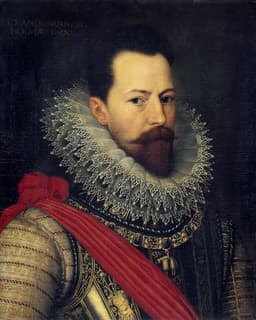
Alessandro Farnese Duke of Parma
General · Modern
69.9Total

Jalaluddin Haqqani
General · Modern
52.7Total
Basic Information
Born
1545
1939
Died
1592
—
Era
Modern
Modern
Nationality
Spain
Afghanistan
Occupation
General
General
Civilization
Western
Middle Eastern
Score Comparison
Military (10%)
79.9
60.0
Political (20%)
69.2
43.7
Influence (20%)
68.0
59.0
Legacy (20%)
72.0
49.2
Leadership (15%)
62.0
50.7
Strategy (15%)
72.0
55.0
TOTAL
69.9
52.7
Alessandro Farnese Duke of Parma — Complete Timeline
1579 AD
Siege of MaastrichtWar◆ Major
Farnese led Spanish forces in a successful siege of Maastricht, a key rebel stronghold. The city was stormed after a brutal four-month siege, and its defenders were massacred, demonstrating Farnese's military effectiveness.
SiegeDutch RevoltSpanish Army
Impact: regionaldestructive
1585 AD
Siege of AntwerpWar
Farnese captured Antwerp, the largest city in the Netherlands, after a year-long siege. He constructed a bridge of boats across the Scheldt River to blockade the city, forcing its surrender and splitting the rebel provinces.
SiegeDutch RevoltMilitary Engineering
Impact: regional
Reconquest of the Southern NetherlandsWar◆ Major
Through a series of campaigns, Farnese reconquered the southern provinces of the Netherlands (modern-day Belgium) for Spain. This established the basis for the later split between the Dutch Republic and the Spanish Netherlands.
ReconquestNetherlandsSpanish Empire
Impact: regional
1590 AD
Invasion of FranceWar◆ Major
Farnese led a Spanish army into France to support the Catholic League against Henry of Navarre. He relieved the Siege of Paris and later the Siege of Rouen, but his campaigns were hampered by supply issues and political constraints.
French Wars of ReligionSpanish InterventionMilitary Campaign
Impact: regional
Jalaluddin Haqqani — Complete Timeline
1978 AD
Founding of the Haqqani NetworkPolitical Action◆ Major
Jalaluddin Haqqani established the Haqqani network, a powerful mujahideen faction in Afghanistan's Paktia province. The network became known for its military effectiveness, cross-border operations into Pakistan, and later ties to the Taliban and Al-Qaeda.
MujahideenInsurgencyAfghanistan
Impact: regional
1980 AD
Battle of Khost (1980-1981)War◆ Major
Haqqani led mujahideen forces in the prolonged siege of Khost, a key Soviet-held city in eastern Afghanistan. The battle demonstrated his tactical skills and resulted in significant Soviet casualties, boosting his reputation as a leading anti-Soviet commander.
Soviet-Afghan WarSiegeVictory
Impact: regional
1995 AD
Alliance with the TalibanPolitical Action◆ Major
Haqqani pledged allegiance to the Taliban movement as it rose to power in Afghanistan. His network provided military support and expertise, helping the Taliban capture Kabul in 1996. This alliance solidified the Haqqani network's role in the Taliban regime.
TalibanAlliancePower Shift
Impact: national
2018 AD
Death and Succession by Sirajuddin HaqqaniPolitical Action
Jalaluddin Haqqani died after a long illness, passing leadership of the Haqqani network to his son Sirajuddin. Under Sirajuddin, the network continued its insurgency against U.S. and Afghan forces, maintaining its influence in Afghanistan's post-2001 conflict.
SuccessionHaqqani NetworkLegacy
Impact: regional
This comparison has not been analyzed yet.
One-time AI generation (~1 minute). Scores and timeline are already available below.
Rankings
🥇
Alessandro Farnese Duke of ParmaLeader
Mil: 79.9Pol: 69.2Inf: 68.0
69.9
🥈
Jalaluddin Haqqani
Mil: 60.0Pol: 43.7Inf: 59.0
52.7
+17.2 behind
How This Comparison Works
Algorithm
Each figure is scored on 6 dimensions (0—100 scale) based on structured historical data: Military (10%), Political (20%), Influence (20%), Legacy (20%), Leadership (15%), Strategy (15%). The weighted total produces the final ranking.
Data Sources
Scores are computed from structured sub-indicators in the database. Scale factors adjust for era (Ancient ×0.85, Modern ×1.0) and civilization size (Eastern ×1.05, Other ×0.80) to account for differences in population and military scale.
Maximum 3 Figures
Comparisons are limited to 2—3 figures to ensure readability and statistical meaningfulness.
Error Margins
±5 points per dimension — Sub-scores are derived from historical records with inherent uncertainty. Two figures within 5 points on a dimension should be considered roughly equivalent in that area.
Total Score Accuracy
±3 points overall — The weighted combination of 6 dimensions produces a total score with approximately ±3 points of uncertainty. Differences of less than 3 points are not statistically significant— the figures are effectively tied.
Known Limitations
- Historical records are incomplete and uneven across civilizations
- Figures from oral-tradition societies may be underrepresented
- Occupation labels can misclassify multi-role figures
- Scores measure capability and impact, not moral character
- Quantitative scoring is a comparison tool, not absolute truth
Capability Radar
Military (10%) — Battles & Warfare
Battles
85
55
Win Rate
88
60
Expansion
80
45
Political (20%) — Governance & Reform
Reform
65
20
Diplomacy
78
55
Economy
60
15
Influence (20%) — Cultural & Global Reach
Cultural
60
30
Global
70
35
Legacy (20%) — Historical Impact
Historical
75
45
Longevity
65
40
Leadership (15%) — Power & Stability
Tenure
70
40
Stability
55
10
Strategy (15%) — Tactics & Innovation
Strategy
90
65
Tactics
92
70
Reform
75
50
Similar Comparisons
Alessandro Farnese Duke of Parma vs Napoleon BonaparteAlessandro Farnese Duke of Parma vs Stanislaw KoniecpolskiAlessandro Farnese Duke of Parma vs Erich LudendorffAlessandro Farnese Duke of Parma vs Duke of WellingtonAlessandro Farnese Duke of Parma vs Uesugi KenshinAlessandro Farnese Duke of Parma vs Julius Caesar
Comments & Discussion
No comments yet. Be the first to share your thoughts!