Loading...
Alfonso III of Asturias vs Julius Caesar
Julius Caesar leads by 28.2 pts · 2 figures compared
…
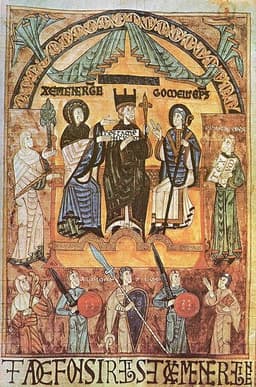
Alfonso III of Asturias
Emperor · Medieval
54.6Total

Julius Caesar
General · Ancient
82.8Total
Basic Information
Born
852
-100
Died
910
-44
Era
Medieval
Ancient
Nationality
Asturias
Roman Republic
Occupation
Emperor
General
Civilization
Western
Western
Score Comparison
Military (10%)
70.0
88.0
Political (20%)
48.0
78.0
Influence (20%)
54.9
85.0
Legacy (20%)
47.5
82.0
Leadership (15%)
64.0
80.0
Strategy (15%)
52.5
85.0
TOTAL
54.6
82.8
Alfonso III of Asturias — Complete Timeline
868 AD
Expansion to the Duero RiverWar◆ Major
Alfonso III led military campaigns that pushed the Asturian frontier south to the Duero River, capturing key fortresses such as Zamora and Toro. This expansion doubled the size of the kingdom and established a defensible border against the Emirate of Cordoba.
ReconquistaTerritorial ExpansionDuero
Impact: regionalconstructive
870 AD
Repopulation of Braga and PortoReform◆ Major
Alfonso III ordered the repopulation of the abandoned cities of Braga and Porto in northern Portugal, granting land and privileges to settlers from Galicia and Asturias. This initiative strengthened Christian control over the region and laid the groundwork for the future Kingdom of Portugal.
RepopulationPortugalSettlement
Impact: regionalconstructive
883 AD
Chronicle of Alfonso IIICultural◆ Major
Alfonso III commissioned the Chronicle of Alfonso III, a historical work that chronicled the kings of Asturias from Pelagius to his own reign. The chronicle served as a foundational text for Asturian and Leonese historiography, shaping the narrative of the Reconquista.
ChronicleHistoriographyReconquista
Impact: regionalconstructive
910 AD
Deposition by SonsPolitical Action◆ Major
Alfonso III was deposed by his three sons, Garcia, Ordo
DepositionDivision of KingdomSuccession Crisis
Impact: nationaltragic
Julius Caesar — Complete Timeline
58 BC
Gallic WarsWar◆ Major
Caesar, as proconsul of Gaul, launched a series of campaigns that conquered all of Gaul (modern France, Belgium, and parts of Switzerland). He fought numerous battles, including against the Helvetii, the Belgae, and the Gallic chieftain Vercingetorix. The wars brought immense wealth and a loyal army to Caesar.
Gallic WarsConquestRoman Expansion
Impact: regional
49 BC
Crossing the RubiconPolitical Action◆ Major
Caesar led Legio XIII across the Rubicon River into Italy, defying the Roman Senate's order to disband his army. This act triggered a civil war against Pompey and the Optimates, ultimately leading to Caesar's dictatorship and the end of the Roman Republic.
Roman Civil WarEnd of RepublicPower Struggle
Impact: global
48 BC
Battle of PharsalusWar◆ Major
Caesar's outnumbered army defeated the larger forces of Pompey the Great at Pharsalus in Greece. Caesar's tactical use of a reserve line to counter Pompey's cavalry charge proved decisive. Pompey fled to Egypt, where he was assassinated, leaving Caesar as the undisputed master of the Roman world.
Roman Civil WarBattleDecisive Victory
Impact: regional
44 BC
Appointment as Dictator for LifePolitical Action◆ Major
The Roman Senate appointed Caesar dictator perpetuo (dictator for life), granting him unprecedented personal power. This move concentrated military, legislative, and judicial authority in one person, effectively ending the Roman Republic's traditional system of checks and balances and alarming many senators.
DictatorshipEnd of RepublicPower Consolidation
Impact: regionaldestructive
Assassination on the Ides of MarchPolitical Action◆ Major
A group of Roman senators, led by Marcus Junius Brutus and Gaius Cassius Longinus, stabbed Caesar to death at a meeting of the Senate in the Theatre of Pompey. The assassination was intended to restore the Republic, but instead triggered another civil war that led to the rise of the Roman Empire.
AssassinationRoman PoliticsEnd of Republic
Impact: globaldestructive
Expert Analysis
alfonso-iii-of-asturias-vs-julius-caesar
# The Conqueror and the Chronicler: Caesar and Alfonso III
On a winter day in 49 BCE, Julius Caesar stood at the banks of the Rubicon River, a small stream in northern Italy that marked the boundary of his legal command. Behind him lay Gaul, conquered and pacified; ahead lay Rome, the Republic he would soon shatter. “The die is cast,” he reportedly said, and stepped into history. Almost a millennium later, in 910 CE, an aging Alfonso III of Asturias faced a different kind of crossing—not a river, but the bitter divide between a father and his sons. Where Caesar’s defiance forged an empire, Alfonso’s submission dissolved a kingdom. These two men, separated by centuries and circumstance, both sought to shape their worlds, yet their paths diverged like the roads of a Roman legion and the winding trails of a medieval frontier.
Origins
Julius Caesar was born into the patrician Julian clan in 100 BCE, a time when the Roman Republic was already cracking under the weight of its own success. His family was ancient but not wealthy, and Caesar grew up in the shadow of civil wars and the dictatorship of Sulla. He learned early that in Rome, survival meant ambition, and ambition meant mastering the art of politics, war, and debt. His uncle by marriage, Gaius Marius, had been a populist reformer; his father died when Caesar was sixteen. The boy emerged into a world where the old senatorial order was dying, and a new kind of leader—part general, part demagogue—was rising.
Alfonso III was born in 852 CE into a far different world. The Kingdom of Asturias was a tiny Christian redoubt in the mountains of northern Iberia, clinging to existence after the Muslim conquest of Visigothic Spain. His father, Ordoño I, had fought to expand this fragile realm. Alfonso inherited a kingdom defined by its faith, its frontier, and its chronic need for heroes. Unlike Caesar, who inherited a legacy of republican glory, Alfonso inherited a legacy of survival. His people saw themselves as the heirs of the Visigoths, the last defenders of Christian civilization against the Umayyad Caliphate. Every king’s duty was to push south, to reclaim what had been lost.
Rise to Power
Caesar’s rise was a masterpiece of calculated risk. He fled Sulla’s proscriptions, served as a military tribune in Asia, and returned to Rome to climb the political ladder—quaestor, aedile, praetor. He borrowed fortunes to stage lavish games, courted the masses, and forged the First Triumvirate with Pompey and Crassus. His command in Gaul from 58 to 50 BCE was his true springboard: he conquered the entire region, crossed the Rhine into Germany, and invaded Britain, all while writing *Commentarii de Bello Gallico*—a self-serving masterpiece of propaganda that made him a legend in his own time. When the Senate ordered him to disband his army, he refused. The Rubicon was his answer.
Alfonso III’s rise was quieter but no less determined. He became king in 866 CE after his father’s death, inheriting a kingdom that was still carving itself out of the mountains. His early years were spent consolidating power, suppressing rebellions among the Basque and Galician nobility, and securing his borders. In 868, he launched a major campaign that pushed the Asturian frontier south to the Duero River, capturing fortresses that had been lost for generations. This was no Gaul-wide conquest—the Duero was a river, not a province—but for Asturias, it was a leap. Alfonso was not a Caesar; he was a builder, patient and persistent.
Leadership & Governance
Caesar governed as he conquered: with speed, ruthlessness, and an eye for the dramatic. As dictator, he reformed the calendar (the Julian calendar we still use), centralized tax collection, granted citizenship to provincials, and began massive public works. His military genius lay in his ability to combine speed, discipline, and calculated risk—at Alesia, he besieged the Gallic chieftain Vercingetorix while simultaneously building defenses against a relief army, a feat of logistics and nerve. But his political wisdom was flawed: he pardoned his enemies, but he also accumulated power without restraint, accepting the title “dictator for life” and having his face stamped on coins like a king. He seemed to forget that the Republic’s elite hated nothing more than a monarch.
Alfonso III ruled as a medieval king: by alliance, by faith, and by the sword. His expansion to the Duero was not just a military victory but a colonization project. In 870, he ordered the repopulation of Braga and Porto, abandoned cities in what is now northern Portugal, granting land to settlers and charters to churches. This was state-building on a frontier, not empire-building. In 883, he commissioned the *Chronicle of Alfonso III*, a historical work that traced the Asturian kings back to Pelagius, the legendary victor of Covadonga. This was propaganda, yes—but propaganda of a different kind than Caesar’s. Where Caesar wrote to glorify himself, Alfonso commissioned a chronicle to glorify his dynasty and his people’s divine mission. His leadership was less about personal brilliance and more about institutional endurance.
Triumph & Tragedy
Caesar’s greatest triumph was his conquest of Gaul, which made him the richest and most powerful man in the Roman world. His greatest tragedy was his assassination on the Ides of March, 44 BCE, stabbed by senators who feared his ambition. He fell at the foot of Pompey’s statue, a man who had defeated his rivals only to be destroyed by his friends.
Alfonso III’s greatest triumph was the expansion to the Duero, which doubled the size of his kingdom and set the stage for the future Reconquista. His greatest tragedy came in 910, when his three sons—Garcia, Ordoño, and Fruela—deposed him and forced him to abdicate. The kingdom was divided among them, and Alfonso died soon after, a broken king. Where Caesar’s death sparked a civil war that ended the Republic, Alfonso’s deposition merely split a kingdom that would later reunite under his grandson.
Character & Destiny
Caesar was a man of immense charisma, intellectual curiosity, and cold ambition. He could be merciful—he pardoned Brutus and Cassius after Pharsalus—but he also had a streak of arrogance that blinded him to danger. He believed his own myth. When warned of the conspiracy, he dismissed it, saying, “It is more important for the Republic that I should not be afraid to die.” His character drove him to seize power, and his destiny was to become the bridge between Republic and Empire.
Alfonso III was a king of a different temper: devout, methodical, and perhaps too trusting. He built his kingdom with the help of his sons, only to be betrayed by them. His chronicle suggests a man who saw himself as a servant of a larger cause—the Christian reconquest—rather than a singular genius. His destiny was to be a founder, not a destroyer. Where Caesar’s ambition shattered a world, Alfonso’s ambition built one, piece by piece, until his family tore it apart.
Legacy
Caesar’s legacy is monumental. The Roman Empire that followed was his creation in spirit, and the title “Caesar” became synonymous with emperor for centuries. His writings shaped Western literature, his calendar shaped Western time, and his life became a template for every aspiring dictator from Napoleon to Mussolini. He is remembered as a genius and a tyrant, a man who destroyed the Republic but gave birth to an empire.
Alfonso III’s legacy is quieter but no less significant. His expansion to the Duero laid the foundation for the Kingdom of León, which would become the heart of the Reconquista. His chronicle preserved the myth of a Christian Spain that never truly died, a story that would inspire generations. He is remembered as “Alfonso the Great,” but his greatness is of a different kind—not the flash of a falling star, but the slow, steady glow of a forge fire.
Conclusion
Caesar and Alfonso III both stood at the edge of their worlds—one at a river, the other at the end of his reign. Caesar crossed and changed everything; Alfonso was crossed and lost everything. Yet both men were architects of the future, building with the materials their times gave them. Caesar’s story is one of ambition that consumed its creator; Alfonso’s is one of ambition that outlasted its author. In the end, the die is cast for all of us—but some dice land as empires, and others as kingdoms divided.
Rankings
🥇
Julius CaesarLeader
Mil: 88.0Pol: 78.0Inf: 85.0
82.8
🥈
Alfonso III of Asturias
Mil: 70.0Pol: 48.0Inf: 54.9
54.6
+28.2 behind
How This Comparison Works
Algorithm
Each figure is scored on 6 dimensions (0—100 scale) based on structured historical data: Military (10%), Political (20%), Influence (20%), Legacy (20%), Leadership (15%), Strategy (15%). The weighted total produces the final ranking.
Data Sources
Scores are computed from structured sub-indicators in the database. Scale factors adjust for era (Ancient ×0.85, Modern ×1.0) and civilization size (Eastern ×1.05, Other ×0.80) to account for differences in population and military scale.
Maximum 3 Figures
Comparisons are limited to 2—3 figures to ensure readability and statistical meaningfulness.
Error Margins
±5 points per dimension — Sub-scores are derived from historical records with inherent uncertainty. Two figures within 5 points on a dimension should be considered roughly equivalent in that area.
Total Score Accuracy
±3 points overall — The weighted combination of 6 dimensions produces a total score with approximately ±3 points of uncertainty. Differences of less than 3 points are not statistically significant— the figures are effectively tied.
Known Limitations
- Historical records are incomplete and uneven across civilizations
- Figures from oral-tradition societies may be underrepresented
- Occupation labels can misclassify multi-role figures
- Scores measure capability and impact, not moral character
- Quantitative scoring is a comparison tool, not absolute truth
Capability Radar
Military (10%) — Battles & Warfare
Battles
55
95
Win Rate
60
92
Expansion
70
97
Political (20%) — Governance & Reform
Reform
45
90
Diplomacy
50
85
Economy
40
82
Influence (20%) — Cultural & Global Reach
Cultural
40
88
Global
30
94
Legacy (20%) — Historical Impact
Historical
50
95
Longevity
35
96
Leadership (15%) — Power & Stability
Tenure
65
75
Stability
30
60
Strategy (15%) — Tactics & Innovation
Strategy
65
94
Tactics
50
96
Reform
40
88
Similar Comparisons
Comments & Discussion
RUBICON\_REVISIONIST6/17/2026
People keep calling Caesar a genius, but let’s be real: the Rubicon crossing was a desperate gamble by a man drowning in debt and facing prosecution. He didn’t "forge an empire"—he triggered a century of civil wars that ended the Republic. Meanwhile, Alfonso III actually held his crumbling kingdom together for 44 years through strategic abdication and chronicling his own legacy. Caesar wrote propaganda disguised as history; Alfonso wrote history as a political weapon. Which one’s the real Chroni
桂冠修补匠6/17/2026
说阿方索三世是“懦弱”的?放屁。他在儿子反叛时选择退位,不是软弱,而是精明的政治计算——他保住了阿斯图里亚斯王国的存续,还抽空写了《编年史》来塑造基督教西班牙的正统神话。恺撒过卢比孔河是赌上共和国,阿方索过父子裂痕是赌上王国未来。一个赢在军事天才,一个赢在文字功夫。九百年后谁更被人记得?是那个征服了高卢的叛国者,还是那个用墨水画出国界的国王?我选后者。
CENTURION\_SCEPTIC6/17/2026
Let’s talk troop numbers: Caesar crossed with one legion (about 5,000 men) against Pompey’s potential millions. That’s not “strategic genius,” that’s suicidal bluffing that succeeded through sheer luck and Pompey’s indecision. Meanwhile, Alfonso’s “submission” gave Asturias eight more years of stability—something Caesar’s march never achieved for Rome. The die was cast, sure, but it landed on snake eyes for the Republic. Give me Alfonso’s measured chronicles over Caesar’s gambling any day.
断章取义者6/17/2026
别信那些教科书吹嘘的“我来,我见,我征服”。恺撒在高卢屠杀了上百万人,还把俘虏当奴隶卖掉,这特么是“征服”还是种族灭绝?阿方索三世攻打摩尔人时虽然也杀人,但至少他留下了《阿方索三世编年史》这样的民族叙事,没把敌人全灭。一个靠铁血,一个靠墨水——如果我选历史偶像,宁可要那个会写书的国王,也不要那个只会卖惨的军阀。历史是胜利者写的,但胜利者也得有点良心。
STOIC\_HISTORIAN6/17/2026
Apples to oranges, folks. Caesar lived in a world where military glory was the only currency for political survival; Alfonso ruled a feudal kingdom where piety and lineage mattered more. Caesar’s "defiance" ended the Republic; Alfonso’s "submission" arguably prevented a Visigothic-style collapse into chaos. Both were ruthless politicians—Caesar eradicated Gaulish resistance, Alfonso executed his