Loading...
Alfonso X of Castile vs Li Chen
Li Chen leads by 4.8 pts · 2 figures compared
…
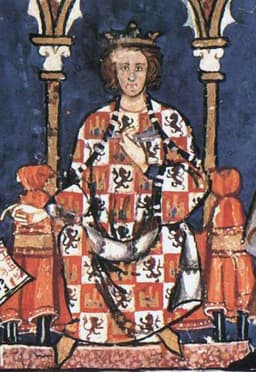
Alfonso X of Castile
Emperor · Medieval
54.6Total

Li Chen
Emperor · Medieval
59.4Total
Basic Information
Born
1221
810
Died
1284
859
Era
Medieval
Medieval
Nationality
Holy Roman Empire
China
Occupation
Emperor
Emperor
Civilization
Western
Eastern
Score Comparison
Military (10%)
45.0
70.0
Political (20%)
53.8
59.3
Influence (20%)
65.0
55.0
Legacy (20%)
40.0
55.0
Leadership (15%)
65.0
66.0
Strategy (15%)
60.0
60.7
TOTAL
54.6
59.4
Alfonso X of Castile — Complete Timeline
1252 AD
Commissioned the Alfonsine TablesCultural◆ Major
Alfonso X commissioned the Alfonsine Tables, a set of astronomical tables based on Ptolemaic models. These tables were used by European astronomers for centuries and became a standard reference in medieval science.
AstronomyScienceCultural Patronage
Impact: globalconstructive
1257 AD
Elected King of GermanyPolitical Action◆ Major
Alfonso X of Castile was elected King of Germany by a faction of prince-electors, opposing Richard of Cornwall. This election was part of the Great Interregnum, with Alfonso receiving support from the Hohenstaufen loyalists and the Papacy.
ElectionGreat InterregnumCastilian Claim
Impact: regional
Never Visited GermanyPolitical Action◆ Major
Alfonso X never traveled to Germany to assert his claim to the throne. His absence weakened his authority, and he was unable to secure effective control over the German kingdom, leaving the title contested.
AbsenceGreat InterregnumRival Claimant
Impact: regional
1275 AD
Renounced Claim to German ThronePolitical Action◆ Major
Alfonso X formally renounced his claim to the German throne in favor of Rudolf of Habsburg. This renunciation ended the Great Interregnum and allowed Rudolf to be recognized as the legitimate king of Germany.
RenunciationGreat InterregnumRudolf of Habsburg
Impact: regional
Li Chen — Complete Timeline
846 AD
Restoration of Central AuthorityPolitical Action◆ Major
Li Chen ascended the throne after the death of his nephew, Li Yan. He immediately reversed the anti-Buddhist policies and began a series of reforms to restore central authority. He appointed capable chancellors and reduced the power of eunuchs.
ReformCentralizationEunuch Power Reduction
Impact: nationalconstructive
847 AD
Reform of the Salt MonopolyReform◆ Major
Li Chen reformed the state salt monopoly to increase revenue and reduce corruption. He lowered salt prices to curb smuggling and improved the efficiency of the monopoly system, which became a major source of Tang fiscal stability.
Salt MonopolyFiscal ReformEconomic Policy
Impact: nationalconstructive
849 AD
Reconquest of the Hexi CorridorWar◆ Major
Li Chen's forces launched a campaign to recapture the Hexi Corridor from the Tibetan Empire. Tang armies achieved several victories, regaining control of key cities and restoring Chinese authority over the Silk Road route.
Hexi CorridorTibetTerritorial Recovery
Impact: regionalconstructive
859 AD
Death of Li ChenOther
Li Chen died in 859 after a reign that briefly revived Tang fortunes. He was posthumously called the 'Little Taizong' for his capable rule. His death marked the end of the last period of Tang stability before the dynasty's final decline.
DeathEnd of RevivalTang Decline
Impact: nationaltragic
Expert Analysis
Origins
Alfonso X of Castile was born on November 23, 1221, in Toledo, the eldest son of King Ferdinand III of Castile and Elisabeth of Swabia. He was educated in the court of his father, known for his cultural patronage, and received a broad education in law, science, and languages. His exposure to Christian, Muslim, and Jewish scholars shaped his intellectual pursuits. Alfonso's claim to the German throne came through his mother, a granddaughter of Emperor Frederick I Barbarossa.
Li Chen, born in 810, was the 14th son of Emperor Xianzong of Tang. His mother was a concubine of low status. Li Chen grew up in the shadow of his brothers and nephews, often feigning incompetence to avoid political danger. He was known for his taciturn demeanor and was considered by many to be simple-minded. This disguise allowed him to survive the violent succession struggles of the late Tang.
Rise to Power
Alfonso X became King of Castile and León upon his father's death in 1252. He immediately pursued a policy of consolidation and cultural advancement. In 1257, a faction of German prince-electors, opposing Richard of Cornwall, elected Alfonso as King of Germany. This election was part of the Great Interregnum. However, Alfonso never visited Germany to assert his claim, relying on diplomacy and spending vast sums to maintain support. His absence weakened his authority, and he was unable to secure effective control. In 1275, he formally renounced his claim in favor of Rudolf of Habsburg, ending the interregnum.
Li Chen's rise was more dramatic. After the death of his nephew, Emperor Wuzong, in 846, the eunuchs placed Li Chen on the throne, expecting him to be a puppet. Instead, Li Chen immediately reversed Wuzong's anti-Buddhist policies and began a series of reforms to restore central authority. He proved to be a capable and energetic ruler, surprising the court with his decisiveness. His reign, known as the Dazhong era, marked a brief revival of Tang fortunes.
Leadership & Governance
Alfonso X's leadership style was scholarly and bureaucratic. He prioritized legal codification, commissioning the Siete Partidas, a comprehensive legal code that influenced Spanish law for centuries. He also promoted the translation of Arabic and Greek works into Latin and Castilian, fostering the Toledo School of Translators. His governance, however, was marked by fiscal irresponsibility and a tendency to overreach. He debased the coinage to fund his ambitions, leading to inflation and economic instability. His military campaigns against the Moors were indecisive, and his claim to the German throne drained resources without benefit.
Li Chen's governance was pragmatic and focused on efficiency. He reformed the state salt monopoly to increase revenue and reduce corruption, lowering salt prices to curb smuggling. He also sought to reduce the power of eunuchs and regional military governors, though with limited success. His administrative reforms improved tax collection and restored some central control over the provinces. Li Chen's leadership was hands-on; he personally reviewed petitions and appointed competent officials. His style earned him the posthumous title "Little Taizong," comparing him to the great Tang founder.
Triumph & Tragedy
Alfonso X's greatest triumph was his cultural patronage. The Alfonsine Tables, commissioned under his direction, were astronomical tables based on Ptolemaic models and used by European astronomers for centuries. The Siete Partidas became a foundational legal text. His tragedy was his political overreach. His claim to Germany was a costly failure, and his later years were marred by a rebellion by his son Sancho, who seized power in 1282. Alfonso died in 1284, abandoned and disillusioned.
Li Chen's triumph was the reconquest of the Hexi Corridor from the Tibetan Empire. Tang armies achieved several victories, regaining control of strategic territories and restoring prestige. His reforms briefly revived the Tang economy and central authority. The tragedy was the brevity of his success. Li Chen died in 859 after only 13 years of reign. His successors were unable to sustain his policies, and the Tang dynasty collapsed within decades. His death marked the end of the last period of Tang stability.
Character & Destiny
Alfonso X was a man of intellect but poor judgment. He prioritized cultural pursuits over practical governance, and his inability to delegate or focus led to failures. His character was marked by stubbornness and a tendency to pursue grand schemes without realistic planning. Historians note that he scored 65.0 in leadership and 53.8 in political skill, reflecting his strengths in vision but weaknesses in execution. His destiny was shaped by his refusal to compromise, leading to isolation and loss of power.
Li Chen, in contrast, was calculating and patient. He feigned weakness to survive, then acted decisively when in power. His political score of 59.3 and leadership of 66.0 indicate a balanced ruler who used cunning and reform to achieve results. His character was cautious but effective; he avoided the grandiose and focused on tangible improvements. However, his short reign and lack of a strong successor meant his gains were temporary. His destiny was to be a bright but brief flash in a declining dynasty.
Legacy
Alfonso X's legacy is primarily cultural. The Alfonsine Tables remained standard until the Renaissance. The Siete Partidas influenced legal systems in Spain and Latin America. His patronage of learning made Castile a center of translation and knowledge. However, his political legacy was negative: his fiscal policies weakened the crown, and his failure in Germany contributed to the fragmentation of the Holy Roman Empire. He scored 40.0 in legacy, reflecting limited enduring political impact.
Li Chen's legacy is as a restorer. He is remembered as the "Little Taizong" for his capable rule. The Hexi Corridor remained under Tang control for a few decades after his death. His reforms provided a model for later administrations. However, his achievements were undone by his successors. His legacy score of 55.0 indicates a moderate but temporary impact. In Chinese historiography, he is a respected but not transformative figure.
Conclusion
Comparing Alfonso X and Li Chen requires weighing cultural versus political impact. Alfonso X's contributions to science and law were profound and long-lasting, but his governance was flawed and his political ambitions largely failed. Li Chen's reign was a successful but brief revival of a declining dynasty, with tangible achievements in administration and military. Based on the overall scores (Alfonso X: 54.6, Li Chen: 59.4), Li Chen had greater immediate political effectiveness. However, Alfonso X's cultural legacy arguably had a broader and more enduring influence. Taking a stance, Li Chen's pragmatic restoration and higher total score make him the more effective ruler given his context, but Alfonso X's intellectual contributions are historically significant. In terms of impact on their respective civilizations, Li Chen's temporary revival of Tang power is notable, but Alfonso X's shaping of Spanish law and science leaves a deeper mark. Thus, while Li Chen scored higher, Alfonso X's legacy is more lasting.
Rankings
🥇
Li ChenLeader
Mil: 70.0Pol: 59.3Inf: 55.0
59.4
🥈
Alfonso X of Castile
Mil: 45.0Pol: 53.8Inf: 65.0
54.6
+4.8 behind
How This Comparison Works
Algorithm
Each figure is scored on 6 dimensions (0—100 scale) based on structured historical data: Military (10%), Political (20%), Influence (20%), Legacy (20%), Leadership (15%), Strategy (15%). The weighted total produces the final ranking.
Data Sources
Scores are computed from structured sub-indicators in the database. Scale factors adjust for era (Ancient ×0.85, Modern ×1.0) and civilization size (Eastern ×1.05, Other ×0.80) to account for differences in population and military scale.
Maximum 3 Figures
Comparisons are limited to 2—3 figures to ensure readability and statistical meaningfulness.
Error Margins
±5 points per dimension — Sub-scores are derived from historical records with inherent uncertainty. Two figures within 5 points on a dimension should be considered roughly equivalent in that area.
Total Score Accuracy
±3 points overall — The weighted combination of 6 dimensions produces a total score with approximately ±3 points of uncertainty. Differences of less than 3 points are not statistically significant— the figures are effectively tied.
Known Limitations
- Historical records are incomplete and uneven across civilizations
- Figures from oral-tradition societies may be underrepresented
- Occupation labels can misclassify multi-role figures
- Scores measure capability and impact, not moral character
- Quantitative scoring is a comparison tool, not absolute truth
Capability Radar
Military (10%) — Battles & Warfare
Battles
30
65
Win Rate
25
70
Expansion
30
50
Political (20%) — Governance & Reform
Reform
70
80
Diplomacy
55
70
Economy
65
75
Influence (20%) — Cultural & Global Reach
Cultural
85
70
Global
60
60
Legacy (20%) — Historical Impact
Historical
80
75
Longevity
75
65
Leadership (15%) — Power & Stability
Tenure
60
75
Stability
40
60
Strategy (15%) — Tactics & Innovation
Strategy
40
65
Tactics
35
60
Reform
45
55
Similar Comparisons
Comments & Discussion
No comments yet. Be the first to share your thoughts!