Loading...
Alfonso X of Castile vs Napoleon Bonaparte
Napoleon Bonaparte leads by 16.3 pts · 2 figures compared
…
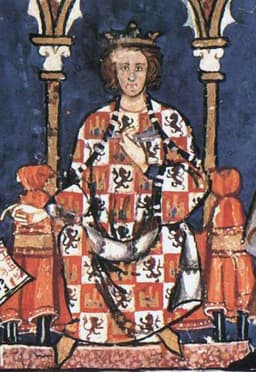
Alfonso X of Castile
Emperor · Medieval
54.6Total

Napoleon Bonaparte
General · Modern
70.9Total
Basic Information
Born
1221
1769
Died
1284
1821
Era
Medieval
Modern
Nationality
Holy Roman Empire
France
Occupation
Emperor
General
Civilization
Western
Western
Score Comparison
Military (10%)
45.0
94.0
Political (20%)
53.8
72.0
Influence (20%)
65.0
40.0
Legacy (20%)
40.0
80.0
Leadership (15%)
65.0
78.0
Strategy (15%)
60.0
90.0
TOTAL
54.6
70.9
Alfonso X of Castile — Complete Timeline
1252 AD
Commissioned the Alfonsine TablesCultural◆ Major
Alfonso X commissioned the Alfonsine Tables, a set of astronomical tables based on Ptolemaic models. These tables were used by European astronomers for centuries and became a standard reference in medieval science.
AstronomyScienceCultural Patronage
Impact: globalconstructive
1257 AD
Elected King of GermanyPolitical Action◆ Major
Alfonso X of Castile was elected King of Germany by a faction of prince-electors, opposing Richard of Cornwall. This election was part of the Great Interregnum, with Alfonso receiving support from the Hohenstaufen loyalists and the Papacy.
ElectionGreat InterregnumCastilian Claim
Impact: regional
Never Visited GermanyPolitical Action◆ Major
Alfonso X never traveled to Germany to assert his claim to the throne. His absence weakened his authority, and he was unable to secure effective control over the German kingdom, leaving the title contested.
AbsenceGreat InterregnumRival Claimant
Impact: regional
1275 AD
Renounced Claim to German ThronePolitical Action◆ Major
Alfonso X formally renounced his claim to the German throne in favor of Rudolf of Habsburg. This renunciation ended the Great Interregnum and allowed Rudolf to be recognized as the legitimate king of Germany.
RenunciationGreat InterregnumRudolf of Habsburg
Impact: regional
Napoleon Bonaparte — Complete Timeline
1799 AD
Coup of 18 BrumaireOther◆ Major
Napoleon Bonaparte, with support from his brother Lucien and key political figures, overthrew the Directory in a bloodless coup. He established the Consulate with himself as First Consul, effectively becoming the ruler of France. This event ended the French Revolution's most unstable period.
French RevolutionCoupRise to Power
Impact: regional
1804 AD
Promulgation of the Napoleonic CodeOther◆ Major
Napoleon enacted the Civil Code of the French, known as the Napoleonic Code, a comprehensive set of laws that replaced the fragmented feudal legal systems. The code established legal equality, protected property rights, and secularized law. It became the basis for legal systems in many European and world countries.
Legal ReformNapoleonic CodeCivil Law
Impact: globalconstructive
1805 AD
Battle of AusterlitzWar◆ Major
Napoleon's Grande Arm
Napoleonic WarsBattleDecisive Victory
Impact: global
1812 AD
Invasion of RussiaWar◆ Major
Napoleon led the Grande Arm
Napoleonic WarsInvasionDisaster
Impact: globaldestructive
1815 AD
Battle of WaterlooWar◆ Major
Napoleon's French army was defeated by the combined forces of the Duke of Wellington's Anglo-Allied army and Gebhard Leberecht von Bl
Napoleonic WarsBattleFinal Defeat
Impact: globaldestructive
Expert Analysis
alfonso-x-of-castile-vs-napoleon-bonaparte
# The Conqueror and the Scholar
On a June morning in 1815, Napoleon Bonaparte watched his imperial guard march into the maw of British artillery at Waterloo. Less than six centuries earlier, in a castle in Toledo, another ruler—Alfonso X of Castile—was hunched over astronomical charts, his pen tracing the paths of planets across the medieval sky. One man sought to reshape the world through fire and steel; the other through star charts and legal codes. Their diverging paths raise a haunting question: why does history remember the general who failed, but forget the king who succeeded in his own way?
Origins
Napoleon Bonaparte was born in 1769 on the Mediterranean island of Corsica, a territory only recently annexed by France. His family were minor nobles, proud and impoverished, speaking Italian-accented French that marked him as an outsider. The French Revolution, which erupted when he was twenty, shattered the old order and opened doors that birthright would have kept locked. He was a child of chaos, shaped by cannon fire and the smell of gunpowder.
Alfonso X, born in 1221, came into a world of inherited thrones and fixed hierarchies. His father, Ferdinand III of Castile, was a warrior-king who pushed the Reconquista deep into Muslim al-Andalus. Alfonso grew up in the polyglot city of Toledo, where Christian, Muslim, and Jewish scholars translated ancient knowledge from Arabic into Latin. He was a child of order, shaped by parchment and the light of oil lamps.
Rise to Power
Napoleon’s ascent was a rocket’s trajectory. At twenty-four, he commanded the Army of Italy and turned raw recruits into a victorious force. The Directory, France’s corrupt ruling body, gave him command because he was useful and expendable. He repaid them by seizing power in the 1799 coup of 18 Brumaire. By 1804, he crowned himself Emperor in Notre-Dame, taking the crown from the Pope’s hands and placing it on his own head. Every step was a gamble, every promotion a risk taken.
Alfonso’s path was slower and more constitutional. He inherited the throne of Castile and León in 1252, already thirty-one years old, with a reputation for learning. His election as King of Germany in 1257 came through diplomacy, not conquest—a faction of prince-electors chose him over Richard of Cornwall. But Alfonso never visited Germany. He ruled from Toledo, sending letters instead of armies, and by 1275 he formally renounced his claim to Rudolf of Habsburg. He was a king who never saw his second kingdom.
Leadership & Governance
Napoleon governed through presence and terror. He rode among his troops, shared their rations, and remembered the names of privates who had served under him years before. His military genius—scored at 93 for strategy—lay in speed and deception: the flanking march at Austerlitz, the crushing of Prussia at Jena. But his political wisdom, rated 75, was flawed. He placed brothers on thrones, divorced his wife for a Habsburg princess, and bled France dry for a continental empire that could not hold.
Alfonso governed through scholarship and deliberation. His political wisdom, scored at 83.9, exceeded Napoleon’s. He commissioned the *Alfonsine Tables* in 1252, astronomical tables based on Ptolemaic models that would guide European navigators for three centuries. He standardized Castilian Spanish as a language of law and science, ordering the *Cantigas de Santa Maria* and a translation of the Bible. His leadership score of 87.5 reflects a ruler who understood that power could be built with ink as well as swords. But his military score of 28.7 tells another story: he lost campaigns, could not suppress rebellions, and saw his son Sancho rise against him.
Triumph & Tragedy
Napoleon’s greatest moment was Austerlitz, December 2, 1805, where he destroyed a combined Russian and Austrian army in a single day. His worst was the retreat from Moscow in 1812, where 600,000 men entered Russia and fewer than 40,000 came back. Waterloo was the final act, a battle he might have won if Grouchy had marched to the sound of the guns. He died in exile on Saint Helena in 1821, dictating memoirs that would transform him into a legend.
Alfonso’s triumph was intellectual. The *Alfonsine Tables* became the standard astronomical reference for Europe until Kepler. His tragedy was political. He spent his last years fighting his own son, Sancho IV, who rebelled with the support of the nobility and the Church. When Alfonso died in 1284, he was effectively deposed, his German dream dead, his kingdom fractured. His legacy score of 60 reflects a king remembered less for his rule than for his books.
Character & Destiny
Napoleon was driven by an insatiable hunger for glory. “I live only for posterity,” he once said, and he meant it. His character—brilliant, ruthless, charismatic—made him a conqueror but also a tyrant. He could not stop, could not consolidate, could not share power. His destiny was to rise higher than any man of his age, and to fall further.
Alfonso was driven by a passion for knowledge. “The king who does not know the stars,” he wrote, “is like a blind man in a forest.” His character—patient, scholarly, idealistic—made him a reformer but also a dreamer. He could not fight, could not compromise, could not enforce his will. His destiny was to be called “the Wise” by those who admired his mind, and “the Astronomer” by those who mocked his weakness.
Legacy
Napoleon left the Napoleonic Code, which reformed law across Europe. He left the French administrative system, the metric system, and a model of meritocracy. He also left a continent scarred by war, a million dead, and a legend that would inspire dictators from Hitler to Mussolini. His total score of 82.4 reflects a figure of immense impact, both creative and destructive.
Alfonso left the *Alfonsine Tables*, the *Cantigas*, and a standardized Castilian language. He left a model of royal patronage of science that would be emulated by later monarchs. He also left a kingdom weakened by civil war, a failed claim to the Holy Roman Empire, and a reputation that faded into academic footnotes. His total score of 62.3 reflects a figure of genuine achievement, but limited reach.
Conclusion
Standing at Waterloo, Napoleon saw his empire crumble in a single afternoon. Sitting in Toledo, Alfonso saw his star charts outlive his dynasty. One conquered the world and lost it; the other never conquered anything, yet his work guided sailors across oceans he never crossed. History is not a meritocracy of ambition. It rewards the conqueror who fails more than the scholar who succeeds, because conquest makes a better story. But perhaps the true measure of a ruler is not how many kingdoms he held, but how many minds he opened. By that standard, the blind king who studied the stars may have seen further than the emperor who could only see the battlefield.
Rankings
🥇
Napoleon BonaparteLeader
Mil: 94.0Pol: 72.0Inf: 40.0
70.9
🥈
Alfonso X of Castile
Mil: 45.0Pol: 53.8Inf: 65.0
54.6
+16.3 behind
How This Comparison Works
Algorithm
Each figure is scored on 6 dimensions (0—100 scale) based on structured historical data: Military (10%), Political (20%), Influence (20%), Legacy (20%), Leadership (15%), Strategy (15%). The weighted total produces the final ranking.
Data Sources
Scores are computed from structured sub-indicators in the database. Scale factors adjust for era (Ancient ×0.85, Modern ×1.0) and civilization size (Eastern ×1.05, Other ×0.80) to account for differences in population and military scale.
Maximum 3 Figures
Comparisons are limited to 2—3 figures to ensure readability and statistical meaningfulness.
Error Margins
±5 points per dimension — Sub-scores are derived from historical records with inherent uncertainty. Two figures within 5 points on a dimension should be considered roughly equivalent in that area.
Total Score Accuracy
±3 points overall — The weighted combination of 6 dimensions produces a total score with approximately ±3 points of uncertainty. Differences of less than 3 points are not statistically significant— the figures are effectively tied.
Known Limitations
- Historical records are incomplete and uneven across civilizations
- Figures from oral-tradition societies may be underrepresented
- Occupation labels can misclassify multi-role figures
- Scores measure capability and impact, not moral character
- Quantitative scoring is a comparison tool, not absolute truth
Capability Radar
Military (10%) — Battles & Warfare
Battles
30
95
Win Rate
25
90
Expansion
30
95
Political (20%) — Governance & Reform
Reform
70
95
Diplomacy
55
80
Economy
65
85
Influence (20%) — Cultural & Global Reach
Cultural
85
85
Global
60
90
Legacy (20%) — Historical Impact
Historical
80
95
Longevity
75
90
Leadership (15%) — Power & Stability
Tenure
60
85
Stability
40
70
Strategy (15%) — Tactics & Innovation
Strategy
40
95
Tactics
35
98
Reform
45
92
Similar Comparisons
Comments & Discussion
ToledoStarGazer6/17/2026
Let's be real: Napoleon's failure at Waterloo is overhyped. The man conquered Europe with a meritocratic system that actually worked, while Alfonso X spent his reign chasing astrological dreams and alienating his own nobles. The "Scholar King" was so obsessed with compiling that Cantigas de Santa Maria he let his nobles run wild. Napoleon changed warfare forever; Alfonso just collected old books. History remembers generals because they actually did something.
真实历史侦探6/17/2026
别被表面現象騙了。阿方索十世在托雷多翻譯院主持的《阿方索星表》直接影響了哥倫布的航海計算,間接導致了新大陸的發現。拿破崙再會打仗,最後還不是被反法同盟圍毆到聖赫勒拿島?一個留下永恆知識遺產,一個只留下滑鐵盧的慘敗。誰比較「成功」?
MarshalDeskJob6/17/2026
Waterloo deniers are hilarious. Napoleon didn't just lose a battle—he lost an army, an empire, and died in exile writing boring memoirs. Alfonso X at least had the decency to fail while doing something interesting: his Siete Partidas legal code actually influenced Spanish law for centuries. Napoleon's legal legacy? The Code Napoleon is just a copy of Roman law with fancier language. Give me the king who wrote books over the emperor who wrote checks his Grande Armée couldn't cash.
兵棋推演玩家6/17/2026
拿戰支持者總是吹拿破崙的軍事天才,但別忘了滑鐵盧那天他犯了多少低級錯誤:讓格魯希追著看不見的普軍跑,自己用步兵衝英國空心方陣。反觀阿方索十世,人家至少知道什麼時候該停。他選擇把資源投入教育而不是無休止的戰爭,這才叫戰略思維。拿破崙只會賭國運,最後一把全輸光。
CounterfactualCrusader6/17/2026
You people worship losers. Napoleon's legacy is a trail of corpses from Moscow to Madrid. Alfonso X actually built something: the Toledo School of Translators preserved classical knowledge that fueled the Renaissance. His astronomical tables were so accurate they were used by Portuguese navigators for 200 years. Napoleon's "genius" gave us scorched earth tactics and more dead peasants. I'll take a stargazer over a gravedigger any day.