Loading...
Alfonso XIII vs Frederick William II of Prussia
Frederick William II of Prussia leads by 0.1 pts · 2 figures compared
…
Alfonso XIII
Emperor · Modern
47.1Total
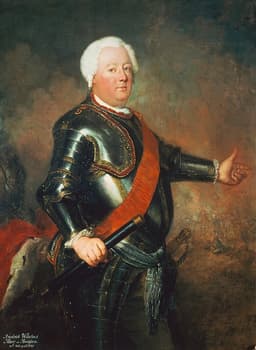
Frederick William II of Prussia
Emperor · Modern
47.2Total
Basic Information
Born
1886
1744
Died
1941
1797
Era
Modern
Modern
Nationality
Spain
Prussia
Occupation
Emperor
Emperor
Civilization
Western
Western
Score Comparison
Military (10%)
10.2
50.0
Political (20%)
61.3
39.4
Influence (20%)
54.9
51.0
Legacy (20%)
45.0
39.2
Leadership (15%)
53.2
65.0
Strategy (15%)
39.6
39.6
TOTAL
47.1
47.2
Alfonso XIII — Complete Timeline
1886 AD
Accession to the thronePolitical Action◆ Major
Alfonso XIII became King of Spain at birth, as his father Alfonso XII had died. His mother Maria Cristina served as regent until he came of age in 1902.
SuccessionRegencyMonarchy
Impact: national
1898 AD
Spanish-American WarWar
During Alfonso XIII's minority, Spain lost the Spanish-American War, ceding Cuba, Puerto Rico, and the Philippines to the United States. This disaster led to the Generation of '98 and a crisis of national identity.
WarColonial LossCrisis
Impact: globaltragic
1921 AD
Rif War and the Disaster of AnnualWar◆ Major
Spanish forces suffered a catastrophic defeat at Annual in Morocco, with thousands killed by Rifian rebels. The disaster severely damaged the monarchy's prestige and led to political crisis.
Colonial WarDefeatMorocco
Impact: regionaltragic
1923 AD
Dictatorship of Primo de RiveraPolitical Action◆ Major
Alfonso XIII supported General Miguel Primo de Rivera's coup, which established a military dictatorship. The king's association with the dictatorship further eroded support for the monarchy.
DictatorshipCoupMonarchy
Impact: nationaldestructive
1931 AD
Exile after the Second RepublicPolitical Action
After the Republican victory in municipal elections, Alfonso XIII left Spain without abdicating. The Second Spanish Republic was proclaimed, and he lived in exile until his death in 1941.
ExileRepublicEnd of Monarchy
Impact: nationaltragic
Frederick William II of Prussia — Complete Timeline
1790 AD
Patronage of Mozart and BeethovenCultural
Frederick William II was a noted patron of music. He was a cellist and commissioned works from Wolfgang Amadeus Mozart, including the 'Prussian Quartets', and from Ludwig van Beethoven, who dedicated his Cello Sonatas Op. 5 to him. His court in Berlin became a center for classical music.
PrussiaMusicMozartBeethovenPatronage
Impact: nationalconstructive
1792 AD
War of the First CoalitionWar◆ Major
Frederick William II led Prussia into the War of the First Coalition against Revolutionary France. The Prussian army was defeated at the Battle of Valmy in 1792, a major symbolic victory for the French Revolution. Prussia withdrew from the coalition in 1795 with the Treaty of Basel, recognizing French gains.
PrussiaFrench RevolutionWarValmy
Impact: globaldestructive
1793 AD
Partition of PolandWar◆ Major
Frederick William II participated in the Second Partition of Poland, acquiring the cities of Danzig and Thorn and the region of South Prussia. This expanded Prussian territory significantly but also brought a large Polish population under Prussian rule, creating long-term ethnic and political tensions.
PrussiaPolandPartitionTerritory
Impact: regionaldestructive
1794 AD
Promulgation of the Prussian General State LawsReform◆ Major
Frederick William II oversaw the completion and promulgation of the Allgemeines Landrecht (General State Laws) for the Prussian States. This comprehensive legal code, begun under Frederick the Great, codified civil, criminal, and constitutional law, unifying the legal system across Prussia's diverse territories.
PrussiaLawCodeReform
Impact: nationalconstructive
Expert Analysis
Origins
Alfonso XIII of Spain was born posthumously on May 17, 1886, the son of King Alfonso XII and Maria Christina of Austria. His father had died six months earlier, so Alfonso became king at birth, with his mother serving as regent. He was educated in military and political affairs, but his upbringing was isolated within the royal court. Frederick William II of Prussia was born on September 25, 1744, the nephew of Frederick the Great. His father was Prince Augustus William, and his mother was Duchess Luise of Brunswick-Wolfenbüttel. He received a traditional princely education, but his interests leaned toward music and the arts rather than military strategy.
Rise to Power
Alfonso XIII officially assumed the throne in 1902 at age 16. His early reign was marked by the aftermath of the Spanish-American War (1898), which had already occurred during his minority, resulting in the loss of Cuba, Puerto Rico, and the Philippines. This disaster set a pessimistic tone for his rule. Frederick William II became king in 1786 upon the death of his uncle Frederick the Great. His accession was peaceful, but he inherited a powerful, well-organized state. Unlike Alfonso, he did not face an immediate crisis, but his lack of military experience contrasted sharply with his predecessor's reputation.
Leadership & Governance
Alfonso XIII's leadership was characterized by political intervention. He frequently dismissed governments and supported the dictatorship of Miguel Primo de Rivera in 1923, hoping to stabilize Spain. However, this association weakened the monarchy. He scored 53.2 in leadership and 61.3 in political skill, indicating some ability but poor judgment in supporting authoritarian rule. Frederick William II, scoring 65.0 in leadership, was more cautious but indecisive. He oversaw the completion of the Prussian General State Laws (Allgemeines Landrecht) in 1794, a comprehensive legal code that modernized Prussia's legal system. However, his governance was undermined by favoritism and the influence of his mistress, Wilhelmine Enke.
Triumph & Tragedy
Alfonso XIII's greatest triumph was surviving multiple assassination attempts and maintaining the monarchy through crises, including the Rif War. However, his greatest tragedy was the Disaster of Annual in 1921, where Spanish forces were crushed by Rifian rebels, killing thousands. The disaster severely damaged his reputation and the monarchy. His support for Primo de Rivera's dictatorship further tarnished his legacy. After the 1931 municipal elections, he went into exile without abdicating, and the Second Republic was proclaimed. Frederick William II's triumph was the acquisition of Danzig, Thorn, and South Prussia through the Second Partition of Poland in 1793, expanding Prussian territory. His tragedy was Prussia's defeat in the War of the First Coalition against Revolutionary France, notably at the Battle of Valmy in 1792. This exposed the weakness of the Prussian army, which had been considered formidable under Frederick the Great. He also suffered from financial mismanagement and a decline in military readiness.
Character & Destiny
Alfonso XIII was energetic and politically active, but his meddling and support for dictatorship alienated many. He scored 39.6 in strategy, indicating poor long-term planning. His character—stubborn and unwilling to accept constitutional limitations—led to his downfall. Frederick William II was more passive and pleasure-loving, with a 39.6 in strategy as well. He was a patron of the arts, commissioning works from Mozart and Beethoven, but his lack of military focus allowed Prussia's military decline. Both monarchs suffered from strategic deficiencies, but Alfonso's active errors were more costly to his throne.
Legacy
Alfonso XIII's legacy is overshadowed by the collapse of the Spanish monarchy and the subsequent civil war. He scored 45.0 in legacy, reflecting his role as the last king before the Republic. His exile ended the Bourbon line temporarily, but his grandson Juan Carlos I restored the monarchy in 1975. Frederick William II's legacy is mixed: his legal code endured, but his reign is seen as a period of decline after Frederick the Great. He scored 39.2 in legacy, lower than Alfonso, but his territorial gains for Prussia lasted until the modern era. The Prussian General State Laws influenced later German legal systems.
Conclusion
While both monarchs scored similarly overall (Alfonso XIII 47.1, Frederick William II 47.2), Frederick William II had a more substantial impact. His territorial acquisitions and legal reforms left a lasting mark on Prussian and German history, despite his military failures. Alfonso XIII's reign ended in disaster, and his legacy is largely negative. Frederick William II's score in leadership (65.0) and influence (51.0) outweighs Alfonso's political score (61.3) because the Prussian king's actions had longer-term consequences. Therefore, Frederick William II of Prussia is the more significant historical figure.
Rankings
🥇
Frederick William II of PrussiaLeader
Mil: 50.0Pol: 39.4Inf: 51.0
47.2
🥈
Alfonso XIII
Mil: 10.2Pol: 61.3Inf: 54.9
47.1
+0.1 behind
How This Comparison Works
Algorithm
Each figure is scored on 6 dimensions (0—100 scale) based on structured historical data: Military (10%), Political (20%), Influence (20%), Legacy (20%), Leadership (15%), Strategy (15%). The weighted total produces the final ranking.
Data Sources
Scores are computed from structured sub-indicators in the database. Scale factors adjust for era (Ancient ×0.85, Modern ×1.0) and civilization size (Eastern ×1.05, Other ×0.80) to account for differences in population and military scale.
Maximum 3 Figures
Comparisons are limited to 2—3 figures to ensure readability and statistical meaningfulness.
Error Margins
±5 points per dimension — Sub-scores are derived from historical records with inherent uncertainty. Two figures within 5 points on a dimension should be considered roughly equivalent in that area.
Total Score Accuracy
±3 points overall — The weighted combination of 6 dimensions produces a total score with approximately ±3 points of uncertainty. Differences of less than 3 points are not statistically significant— the figures are effectively tied.
Known Limitations
- Historical records are incomplete and uneven across civilizations
- Figures from oral-tradition societies may be underrepresented
- Occupation labels can misclassify multi-role figures
- Scores measure capability and impact, not moral character
- Quantitative scoring is a comparison tool, not absolute truth
Capability Radar
Military (10%) — Battles & Warfare
Battles
10
20
Win Rate
10
15
Expansion
5
10
Political (20%) — Governance & Reform
Reform
30
20
Diplomacy
40
30
Economy
30
25
Influence (20%) — Cultural & Global Reach
Cultural
30
30
Global
30
15
Legacy (20%) — Historical Impact
Historical
40
25
Longevity
30
20
Leadership (15%) — Power & Stability
Tenure
60
60
Stability
20
20
Strategy (15%) — Tactics & Innovation
Strategy
10
10
Tactics
10
10
Reform
20
5
Similar Comparisons
Comments & Discussion
No comments yet. Be the first to share your thoughts!