Loading...
Ali Abdullah Saleh vs Lord Elgin
Lord Elgin leads by 2.8 pts · 2 figures compared
…
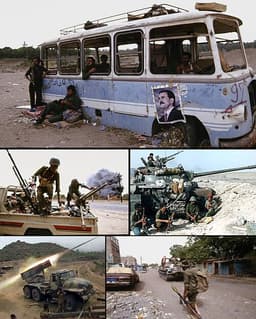
Ali Abdullah Saleh
Politician · Modern
47.6Total

Lord Elgin
Politician · Modern
50.4Total
Basic Information
Born
1947
1849
Died
—
1917
Era
Modern
Modern
Nationality
Yemen
United Kingdom
Occupation
Politician
Politician
Civilization
Middle Eastern
Western
Score Comparison
Military (10%)
50.0
48.5
Political (20%)
35.1
45.1
Influence (20%)
51.0
53.3
Legacy (20%)
41.7
45.8
Leadership (15%)
74.0
65.7
Strategy (15%)
30.3
41.1
TOTAL
47.6
50.4
Ali Abdullah Saleh — Complete Timeline
1990 AD
Unification of North and South YemenPolitical Action
Ali Abdullah Saleh, as president of North Yemen, negotiated the unification with South Yemen on May 22, 1990. He became president of the unified Republic of Yemen, a major achievement in Arab unity.
UnificationYemenArab Unity
Impact: regionalconstructive
Support for Saddam Hussein in Gulf WarPolitical Action◆ Major
Saleh initially supported Iraq's invasion of Kuwait, straining relations with Saudi Arabia and the West. This led to the expulsion of nearly a million Yemeni workers from Saudi Arabia and economic hardship.
Gulf WarDiplomacyEconomic Crisis
Impact: regionaldestructive
1994 AD
Yemeni Civil War of 1994War◆ Major
After southern leaders attempted secession, Saleh's forces crushed the rebellion in a brief civil war. This solidified his control over a unified Yemen but deepened regional divisions.
Civil WarSecessionConflict
Impact: nationaldestructive
2011 AD
Arab Spring Protests and ResignationPolitical Action
Mass protests erupted against Saleh's 33-year rule. After months of violence and a failed assassination attempt, he agreed to a Gulf Cooperation Council-brokered deal to step down in exchange for immunity.
Arab SpringProtestsResignation
Impact: nationaltragic
2017 AD
Killing by Houthi ForcesWar◆ Major
After switching sides in the Yemeni Civil War to ally with the Houthis, Saleh was killed by Houthi forces on December 4, 2017, while trying to flee Sanaa. His death ended a complex political career.
DeathCivil WarHouthis
Impact: nationaltragic
Lord Elgin — Complete Timeline
1894 AD
Viceroyalty of IndiaPolitical Action◆ Major
Lord Elgin served as Viceroy of India from 1894 to 1899. His tenure was marked by the growing strength of the Indian National Congress, which held its annual sessions with increasing demands for political reforms. He also dealt with the devastating famine of 1896-1897.
IndiaAdministrationFamine
Impact: national
1895 AD
Chitral ExpeditionWar
Lord Elgin authorized a military expedition to relieve the British garrison at Chitral in the North-West Frontier. The successful relief operation secured British control over the strategic region, but it also involved heavy casualties and was part of the ongoing 'Great Game' with Russia.
IndiaNorth-West FrontierMilitary Expedition
Impact: regional
Rise of Indian National CongressPolitical Action◆ Major
Under Lord Elgin's viceroyalty, the Indian National Congress grew in influence, holding its annual sessions with increasing attendance and more assertive demands for political reforms, including the expansion of legislative councils and Indian representation in the civil service.
IndiaNationalismPolitical Movement
Impact: national
1896 AD
Indian Famine of 1896-1897Other◆ Major
During Lord Elgin's viceroyalty, a severe famine struck large parts of India, affecting millions. The British government's relief efforts were criticized as inadequate, leading to widespread suffering and mortality. The famine highlighted the shortcomings of colonial famine policy.
IndiaFamineColonial Policy
Impact: nationaltragic
Expert Analysis
Origins
Ali Abdullah Saleh was born on March 21, 1947, in Beit al-Ahmar, a village in the Sanhan district of North Yemen. He came from a modest tribal background, his family belonging to the Hashid tribe. Saleh received only basic education, attending a local Qur'anic school before joining the military in 1958 as a teenager. He rose through the ranks of the North Yemeni army, attending the Military Academy in Sana'a and later the Armored Corps School. His early career was shaped by the civil war between royalists and republicans in the 1960s, where he fought on the republican side.
Lord Elgin, born James Bruce on July 20, 1811, in London, was the son of the 7th Earl of Elgin, who famously removed the Parthenon marbles. He was educated at Eton and Christ Church, Oxford, graduating in 1833. Elgin entered politics as a Conservative, serving as a member of Parliament before being appointed Governor of Jamaica in 1842 and later Governor General of Canada in 1847. His diplomatic skills were recognized, and he served as Postmaster General before being appointed Viceroy of India in 1894.
Rise to Power
Saleh's rise began after the 1974 military coup that brought Ibrahim al-Hamdi to power. Saleh was appointed governor of Taiz and later commander of the central region. After al-Hamdi's assassination in 1977 and the brief rule of Ahmad al-Ghashmi, Saleh became president of North Yemen in 1978 at age 31, following al-Ghashmi's assassination. He consolidated power by balancing tribal, military, and religious factions. His key turning point was the unification of North and South Yemen on May 22, 1990, after years of negotiation. This made him president of the unified Republic of Yemen.
Elgin's rise was through the British colonial administration. His appointment as Viceroy of India in 1894 came after a distinguished career in Canada and Jamaica. He was chosen for his administrative experience and diplomatic tact, as India faced growing nationalist sentiment. His tenure began with the Indian National Congress (INC) gaining momentum, having held its first session in 1885. Elgin's approach was to manage rather than suppress this movement, allowing the INC to hold annual meetings.
Leadership & Governance
Saleh ruled Yemen with a strategy of "dancing on the heads of snakes," playing tribal, political, and regional factions against each other. He centralized power, appointing family members to key positions. His governance was marked by corruption and patronage, but he maintained stability through alliances. During the 1994 civil war, when southern leaders attempted secession, Saleh's forces crushed the rebellion, solidifying his control. He supported Saddam Hussein's invasion of Kuwait in 1990, which led to Yemen's isolation and the expulsion of nearly a million Yemeni workers from Saudi Arabia. His political score of 35.1 reflects his autocratic style and lack of institutional development.
Elgin's governance as Viceroy was more administrative. He focused on maintaining British control while accommodating Indian demands. He authorized the Chitral Expedition in 1895 to secure the North-West Frontier, which was successful. However, his tenure was overshadowed by the Indian famine of 1896-1897, which affected millions. The British relief efforts were criticized for being inadequate and slow, leading to high mortality. Elgin's leadership score of 65.7 indicates a competent but not transformative administrator. His political score of 45.1 reflects his handling of the INC's rise, which he allowed but did not engage with.
Triumph & Tragedy
Saleh's greatest triumph was the unification of Yemen in 1990, a feat that had eluded previous leaders. He also survived multiple conflicts and an assassination attempt in 2011. His tragedy came during the Arab Spring when mass protests forced him to resign in 2012 after 33 years. He later allied with the Houthi rebels in the civil war but was killed by them on December 4, 2017, while trying to flee Sana'a. His legacy score of 41.7 reflects the collapse of the state he built.
Elgin's triumph was the successful handling of the Chitral Expedition, which secured British influence in the region. He also maintained stability during a period of rising nationalism. His tragedy was the devastating famine of 1896-1897, which killed an estimated 4.5 million people. The relief efforts were hampered by bureaucracy and a laissez-faire ideology, leading to widespread suffering. His influence score of 53.3 reflects his role in the INC's growth, which ultimately led to Indian independence.
Character & Destiny
Saleh was a pragmatic survivor, adept at shifting alliances. He was known for his cunning and willingness to use violence to maintain power. His character led him to stay in power too long, triggering the Arab Spring protests. His decision to side with the Houthis after his ouster backfired, leading to his death. Historians view him as a skilled but ultimately destructive leader.
Elgin was a cautious, methodical administrator. He was not a reformer but a manager, following established policies. His character led him to avoid confrontation with the INC, allowing it to grow, but also to neglect urgent famine relief due to rigid adherence to free-market principles. He is remembered as a competent but unremarkable viceroy.
Legacy
Saleh's legacy is mixed. He unified Yemen but left it a failed state, plagued by corruption and civil war. His scores: military 50.0, political 35.1, influence 51.0, leadership 74.0, strategy 30.3, total 47.6. His influence score is higher than Elgin's, but his political and strategy scores are lower.
Elgin's legacy is tied to the growth of the Indian nationalist movement. His scores: military 48.5, political 45.1, influence 53.3, leadership 65.7, strategy 41.1, total 50.4. Elgin's total score of 50.4 is 2.8 points higher than Saleh's 47.6, reflecting a more balanced record.
Conclusion
While Saleh had a dramatic impact on Yemen's unity and subsequent collapse, Elgin's influence on India's political evolution was more lasting. Elgin's higher total score (50.4 vs 47.6) and his role in the INC's growth, which shaped modern India, give him a greater historical impact. Saleh's legacy is one of short-term unification followed by long-term failure, whereas Elgin's tenure, though marked by famine, contributed to the development of Indian political consciousness.
Rankings
🥇
Lord ElginLeader
Mil: 48.5Pol: 45.1Inf: 53.3
50.4
🥈
Ali Abdullah Saleh
Mil: 50.0Pol: 35.1Inf: 51.0
47.6
+2.8 behind
How This Comparison Works
Algorithm
Each figure is scored on 6 dimensions (0—100 scale) based on structured historical data: Military (10%), Political (20%), Influence (20%), Legacy (20%), Leadership (15%), Strategy (15%). The weighted total produces the final ranking.
Data Sources
Scores are computed from structured sub-indicators in the database. Scale factors adjust for era (Ancient ×0.85, Modern ×1.0) and civilization size (Eastern ×1.05, Other ×0.80) to account for differences in population and military scale.
Maximum 3 Figures
Comparisons are limited to 2—3 figures to ensure readability and statistical meaningfulness.
Error Margins
±5 points per dimension — Sub-scores are derived from historical records with inherent uncertainty. Two figures within 5 points on a dimension should be considered roughly equivalent in that area.
Total Score Accuracy
±3 points overall — The weighted combination of 6 dimensions produces a total score with approximately ±3 points of uncertainty. Differences of less than 3 points are not statistically significant— the figures are effectively tied.
Known Limitations
- Historical records are incomplete and uneven across civilizations
- Figures from oral-tradition societies may be underrepresented
- Occupation labels can misclassify multi-role figures
- Scores measure capability and impact, not moral character
- Quantitative scoring is a comparison tool, not absolute truth
Capability Radar
Military (10%) — Battles & Warfare
Battles
30
30
Win Rate
25
31
Expansion
25
37
Political (20%) — Governance & Reform
Reform
20
35
Diplomacy
40
45
Economy
15
30
Influence (20%) — Cultural & Global Reach
Cultural
20
20
Global
25
30
Legacy (20%) — Historical Impact
Historical
30
35
Longevity
20
30
Leadership (15%) — Power & Stability
Tenure
75
40
Stability
10
25
Strategy (15%) — Tactics & Innovation
Strategy
30
38
Tactics
35
39
Reform
20
42
Similar Comparisons
Comments & Discussion
No comments yet. Be the first to share your thoughts!